Department of Neurosciences, Case Western Reserve University School of Medicine, Cleveland, OH, 44106, USA.
Stark Neurosciences Research Institute, Indiana University School of Medicine, Indianapolis, IN, 46202, USA.
J Neuroinflammation. 2018 Feb 15;15(1):43. doi: 10.1186/s12974-018-1091-y.
Alzheimer's disease (AD) is a highly prevalent neurodegenerative disorder characterized by pathological hallmarks of beta-amyloid plaque deposits, tau pathology, inflammation, and cognitive decline. Treatment remains a clinical obstacle due to lack of effective therapeutics. Agonists targeting nuclear receptors, such as bexarotene, reversed cognitive deficits regardless of treatment duration and age in murine models of AD. While bexarotene demonstrated marked efficacy in decreasing plaque levels following short-term treatment, prolonged treatment did not modulate plaque burden. This suggested that plaques might reform in mice treated chronically with bexarotene and that cessation of bexarotene treatment before plaques reform might alter amyloid pathology, inflammation, and cognition in AD mice.
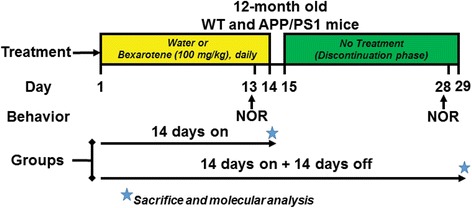
We utilized one-year-old APP/PS1 mice that were divided into two groups. We treated one group of mice for 2 weeks with bexarotene. The other group of mice was treated for 2 weeks with bexarotene followed by withdrawal of drug treatment for an additional 2 weeks. Cognition was evaluated using the novel-object recognition test either at the end of bexarotene treatment or the end of the withdrawal period. We then analyzed amyloid pathology and microgliosis at the conclusion of the study in both groups.
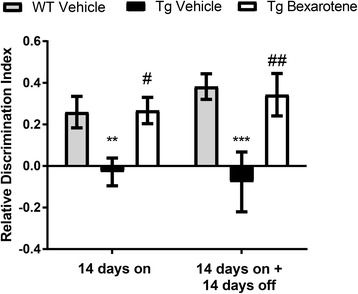
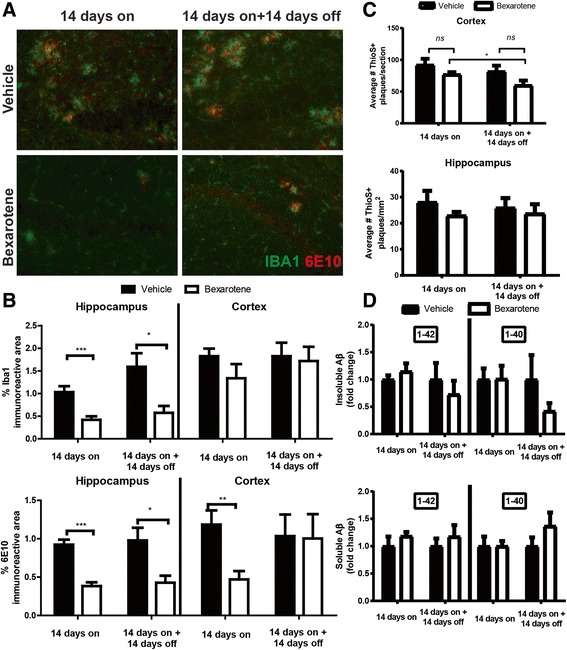
Bexarotene treatment enhanced cognition in APP/PS1 mice similar to previous findings. Strikingly, we observed sustained cognitive improvements in mice in which bexarotene treatment was discontinued for 2 weeks. We observed a sustained reduction in microgliosis and plaque burden following drug withdrawal exclusively in the hippocampus.
Our findings demonstrate that bexarotene selectively modifies aspects of neuroinflammation in a region-specific manner to reverse hippocampal-dependent cognitive deficits in AD mice and may provide insight to inform future studies with nuclear receptor agonists.
阿尔茨海默病(AD)是一种高度普遍的神经退行性疾病,其特征是β-淀粉样斑块沉积、tau 病理学、炎症和认知能力下降等病理性标志。由于缺乏有效的治疗方法,治疗仍然是一个临床难题。针对核受体的激动剂,如倍他罗汀,在 AD 小鼠模型中无论治疗持续时间和年龄如何,都能逆转认知缺陷。虽然倍他罗汀在短期治疗后显著降低斑块水平方面显示出显著的疗效,但长期治疗并未调节斑块负担。这表明,在慢性接受倍他罗汀治疗的小鼠中,斑块可能会重新形成,并且在斑块重新形成之前停止倍他罗汀治疗可能会改变 AD 小鼠的淀粉样蛋白病理、炎症和认知。
我们使用了一岁的 APP/PS1 小鼠,将它们分为两组。我们用倍他罗汀治疗一组小鼠 2 周。另一组小鼠用倍他罗汀治疗 2 周,然后停药 2 周。认知能力使用新物体识别测试在倍他罗汀治疗结束或停药结束时进行评估。然后,我们在研究结束时分析了两组的淀粉样蛋白病理和小胶质细胞增生。
倍他罗汀治疗增强了 APP/PS1 小鼠的认知能力,与之前的发现相似。令人惊讶的是,我们观察到在停药 2 周后,小鼠的认知能力持续提高。我们观察到在停药后,仅在海马体中观察到小胶质细胞增生和斑块负担持续减少。
我们的发现表明,倍他罗汀选择性地以区域特异性方式调节神经炎症的某些方面,以逆转 AD 小鼠的海马依赖性认知缺陷,并且可能为核受体激动剂的未来研究提供信息。