Department of Clinical Hematology and Bone Marrow Transplantation and.
Australian Cancer Research Foundation Translational Research Laboratory, Royal Melbourne Hospital, Melbourne, VIC, Australia.
Blood Adv. 2018 Feb 27;2(4):335-346. doi: 10.1182/bloodadvances.2017015230.
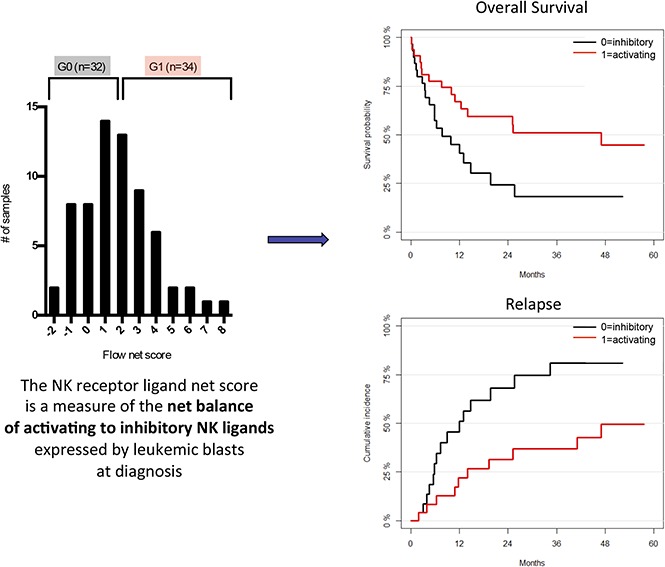
Natural killer (NKs) cells provide rapid responses to viral-infected and malignant cells, including acute myeloid leukemia (AML) blasts. The balance among inhibitory and activating signals, delivered by multiple interactions between ligands on target cells and NK receptors, determines the posture of the NK cell response to either one of target cell elimination or tolerance. The aim of this work was to study the influence of the differential expression of activating and inhibitory NK receptor ligands (NKRLs) by leukemic blasts on clinical outcome in newly diagnosed AML patients. Leukemic cells and clinical data from 66 patients undergoing induction chemotherapy were obtained from the Australasian Leukemia Lymphoma Group tissue bank. Expression of 6 activating (MICA, MICAB, CD155, CD112, ULBP1, and ULBP2/5/6) and 3 inhibitory (HLA class I, PD-L1, and PD-L2) NKRLs was analyzed by flow cytometry. AML blasts displayed heterogeneous expression of NKRLs. MICA, CD112, and ULBP1 were most frequently expressed. ULBP1 expression was significantly associated with improved 2-year overall survival (51.4% vs 11.4%), relapse-free survival (42.5% vs 10.0%), and reduced relapse (44.1% vs 78.6%). We calculated a net score of activating minus inhibitory ligands and demonstrated that the expression of an overall activating NK ligand phenotype was associated with superior 2-year overall survival (59.6% vs 24.4%) and reduced relapse (31.5% vs 68.2%). Our study provides clinical evidence for the role of NK cell-mediated immunoediting against AML, mediated by the expression of NKRLs on blasts, and supports investigation into strategies to enhance NK cell function to improve outcomes in patients with AML.
自然杀伤 (NK) 细胞对病毒感染和恶性细胞(包括急性髓系白血病 [AML] 细胞)提供快速反应。抑制和激活信号之间的平衡,通过靶细胞上的配体和 NK 受体之间的多种相互作用传递,决定了 NK 细胞对靶细胞消除或耐受的反应姿态。本研究旨在研究白血病细胞上激活和抑制性 NK 受体配体(NKRL)的差异表达对新诊断 AML 患者临床结局的影响。从 Australasian Leukemia Lymphoma Group 组织库获得 66 例接受诱导化疗的患者的白血病细胞和临床数据。通过流式细胞术分析 6 种激活(MICA、MICAB、CD155、CD112、ULBP1 和 ULBP2/5/6)和 3 种抑制(HLA Ⅰ类、PD-L1 和 PD-L2)NKRL 的表达。AML 细胞显示 NKRL 表达具有异质性。MICA、CD112 和 ULBP1 表达最频繁。ULBP1 表达与改善 2 年总生存率(51.4% vs 11.4%)、无复发生存率(42.5% vs 10.0%)和降低复发率(44.1% vs 78.6%)显著相关。我们计算了激活配体减去抑制性配体的净分数,并证明了整体激活 NK 配体表型的表达与 2 年总生存率(59.6% vs 24.4%)的提高和复发率的降低(31.5% vs 68.2%)相关。我们的研究为 NK 细胞介导的针对 AML 的免疫编辑作用提供了临床证据,该作用由 AML 细胞上 NKRL 的表达介导,并支持研究增强 NK 细胞功能以改善 AML 患者结局的策略。