Center for Dermatooncology, Department of Dermatology, University Hospital Tübingen, University of Tübingen, Liebermeisterstr.25, 72076, Tübingen, Germany.
Department of Dermatology, Universitaets Spital Zürich, Gloriastrasse 31, 8091, Zürich, Switzerland.
Mol Cancer. 2018 Feb 17;17(1):59. doi: 10.1186/s12943-018-0773-5.
During embryonic development Wnt family members and bone morphogenetic proteins (BMPs) cooperatively induce epithelial-mesenchymal transition (EMT) in the neural crest. Wnt and BMPs are reactivated during malignant transformation in melanoma. We previously demonstrated that the BMP-antagonist noggin blocked the EMT phenotype of melanoma cells in the neural crest and malignant invasion of melanoma cells in the chick embryo; vice-versa, malignant invasion was induced in human melanocytes in vivo by pre-treatment with BMP-2.
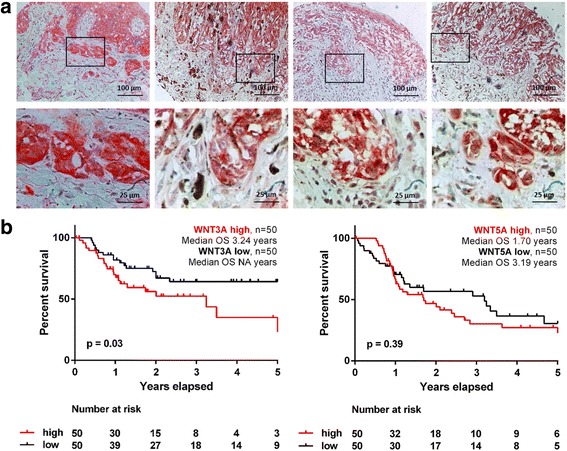
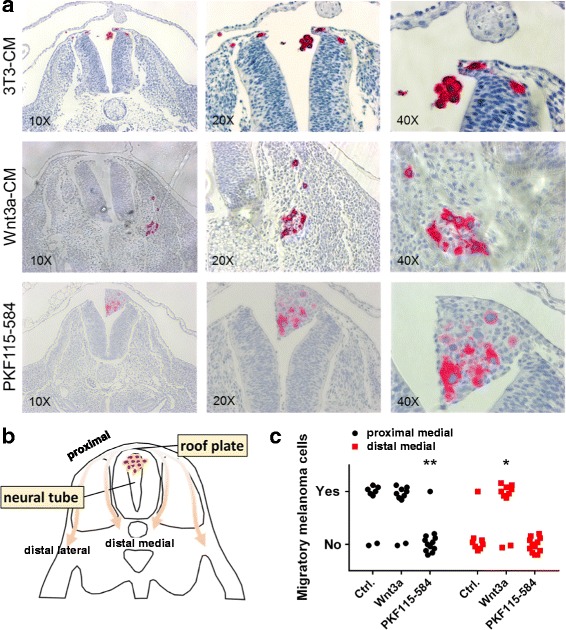
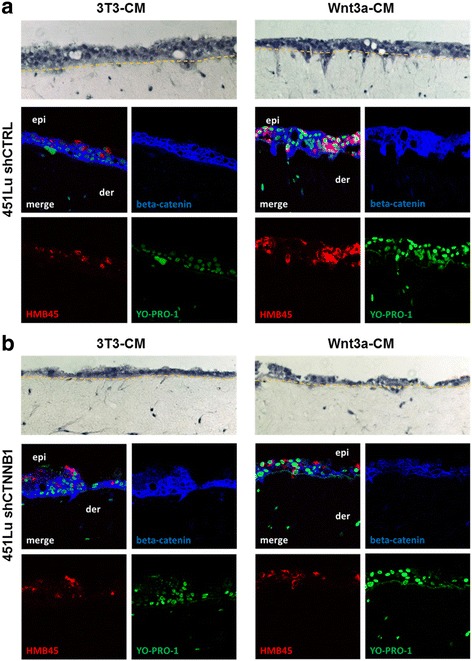
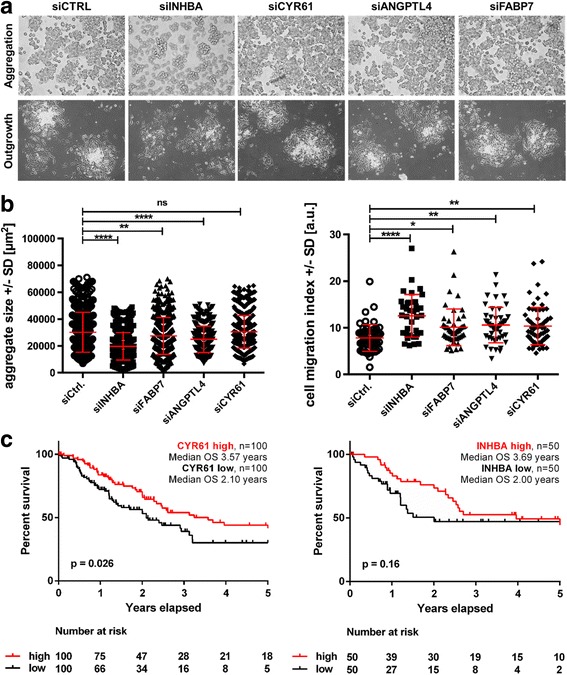
Although there are conflicting results in the literature about the role of β-catenin for invasion of melanoma cells, we found Wnt/β-catenin signaling to be analogously important for the EMT-like phenotype of human metastatic melanoma cells in the neural crest and during invasion: β-catenin was frequently expressed at the invasive front of human primary melanomas and Wnt3a expression was inversely correlated with survival of melanoma patients. Accordingly, cytoplasmic β-catenin levels were increased during invasion of melanoma cells in the rhombencephalon of the chick embryo. Fibroblast derived Wnt3a reduced melanoma cell adhesion and enhanced migration, while the β-catenin inhibitor PKF115-584 increased adhesion and reduced migration in vitro and in the chick embryonic neural crest environment in vivo. Similarly, knockdown of β-catenin impaired intradermal melanoma cell invasion and PKF115-584 efficiently reduced liver metastasis in a chick chorioallantoic membrane model. Our observations were accompanied by specific alterations in gene expression which are linked to overall survival of melanoma patients.
We present a novel role for Wnt-signaling in neural crest like melanoma cell invasion and metastasis, stressing the crucial role of embryonic EMT-inducing neural crest signaling for the spreading of malignant melanoma.
在胚胎发育过程中,Wnt 家族成员和骨形态发生蛋白(BMPs)共同诱导神经嵴中的上皮-间充质转化(EMT)。Wnt 和 BMPs 在黑色素瘤的恶性转化过程中被重新激活。我们之前的研究表明,BMP 拮抗剂 noggin 阻断了神经嵴中黑色素瘤细胞的 EMT 表型和黑色素瘤细胞在鸡胚中的恶性侵袭;反之,BMP-2 预处理可在体内诱导人黑素细胞的恶性侵袭。
尽管文献中关于β-连环蛋白在黑色素瘤细胞侵袭中的作用存在矛盾的结果,但我们发现 Wnt/β-连环蛋白信号通路对神经嵴中人类转移性黑色素瘤细胞的 EMT 样表型和侵袭过程同样重要:β-连环蛋白在人原发性黑色素瘤的侵袭前沿频繁表达,Wnt3a 的表达与黑色素瘤患者的生存呈负相关。因此,在鸡胚后脑隆起处黑色素瘤细胞的侵袭过程中,细胞质β-连环蛋白水平增加。成纤维细胞衍生的 Wnt3a 减少黑色素瘤细胞的黏附并增强迁移,而β-连环蛋白抑制剂 PKF115-584 在体外和体内鸡胚神经嵴环境中增加黏附并减少迁移。同样,β-连环蛋白的敲低会损害黑色素瘤细胞的真皮内侵袭,而 PKF115-584 则能有效地减少鸡胚绒毛尿囊膜模型中的肝转移。我们的观察结果伴随着与黑色素瘤患者总体生存相关的特定基因表达的改变。
我们提出了 Wnt 信号在神经嵴样黑色素瘤细胞侵袭和转移中的新作用,强调了胚胎 EMT 诱导的神经嵴信号对恶性黑色素瘤扩散的关键作用。