Sim Jae Kyeom, Chung Sang Mi, Choi Jong Hyun, Oh Jee Youn, Lee Seung Heon, Kim Je Hyeong, Min Kyung Hoon, Hur Gyu Young, Shim Jae Jeong, Kang Kyung Ho, Shin Bong Kyung, Lee Ju Han, Lee Sung Yong
Department of Internal Medicine, Korea University Guro Hospital, Seoul, Korea.
Department of Internal Medicine, Korea University Ansan Hospital, Ansan, Korea.
Korean J Intern Med. 2018 Jul;33(4):737-744. doi: 10.3904/kjim.2017.245. Epub 2018 Feb 20.
BACKGROUND/AIMS: Pulmonary sarcomatoid carcinoma (PSC) is a poorly differentiated non-small cell lung cancer (NSCLC) that contains components of spindle or giant cells. Owing to its low prevalence, there are insufficient data regarding its clinical features, therapeutic strategies and prognosis.
The medical records of 26 patients diagnosed with PSC from January 2009 to June 2015 were reviewed and analyzed for clinicopathological characteristics, treatment modality, and outcomes.
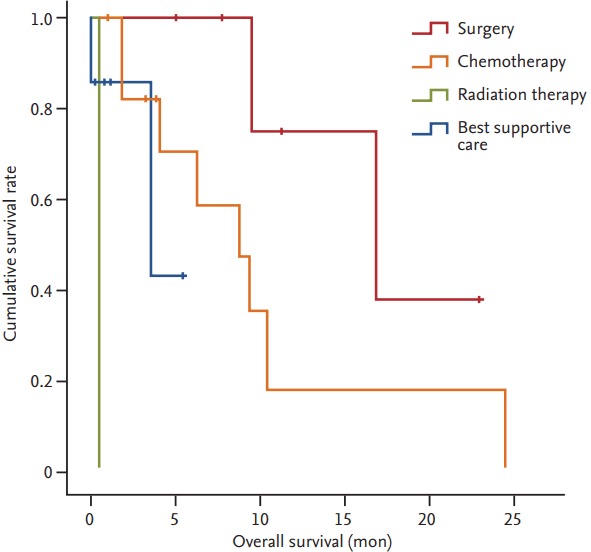
The median age was 69.5 years. Twenty-three patients (88%) were male. Twenty-four patients (92%) were smokers. The median time from symptom onset to diagnosis was one month. Eighteen patients (69%) were diagnosed at an advanced stage. Pleomorphic carcinoma was the most common subtype, and epidermal growth factor receptor (EGFR) mutation was positive in two of 11 patients. Among 13 patients tested for programmed death ligand 1 (PD-L1) immunohistochemistry assay, eight showed high expression of PD-L1. The median overall survival (OS) of all patients was 9.5 months. In total, 12 patients were treated with chemotherapy: nine with platinum-based doublet therapy, two with tyrosine kinase inhibitor, and one with docetaxel. Seven patients showed partial response or stable disease. The median OS and progression-free survival of patients who received chemotherapy were 8.7 and 2.8 months, respectively.
PSC was more common in males, smokers, and the elderly, with worse prognosis than ordinary NSCLC; chemotherapy response was favorable, and EGFR mutation status and PD-L1 expression may offer more therapeutic options.
背景/目的:肺肉瘤样癌(PSC)是一种低分化非小细胞肺癌(NSCLC),包含梭形或巨细胞成分。由于其发病率低,关于其临床特征、治疗策略和预后的数据不足。
回顾并分析了2009年1月至2015年6月期间诊断为PSC的26例患者的病历,以了解其临床病理特征、治疗方式和结果。
中位年龄为69.5岁。23例(88%)为男性。24例(92%)为吸烟者。从症状出现到诊断的中位时间为1个月。18例(69%)在晚期被诊断。多形性癌是最常见的亚型,11例患者中有2例表皮生长因子受体(EGFR)突变呈阳性。在13例接受程序性死亡配体1(PD-L1)免疫组化检测的患者中,8例显示PD-L1高表达。所有患者的中位总生存期(OS)为9.5个月。共有12例患者接受了化疗:9例接受铂类双联疗法,2例接受酪氨酸激酶抑制剂治疗,1例接受多西他赛治疗。7例患者显示部分缓解或病情稳定。接受化疗的患者的中位OS和无进展生存期分别为8.7个月和2.8个月。
PSC在男性、吸烟者和老年人中更为常见,预后比普通NSCLC更差;化疗反应良好,EGFR突变状态和PD-L1表达可能提供更多治疗选择。