Department of Physics, University of Mainz, Staudingerweg 7, D-55128, Mainz, Germany.
Department of Polymer Engineering, University of Akron, 250S Forge St, Akron, OH, 44325, USA.
Nat Commun. 2018 Feb 19;9(1):716. doi: 10.1038/s41467-018-03137-8.
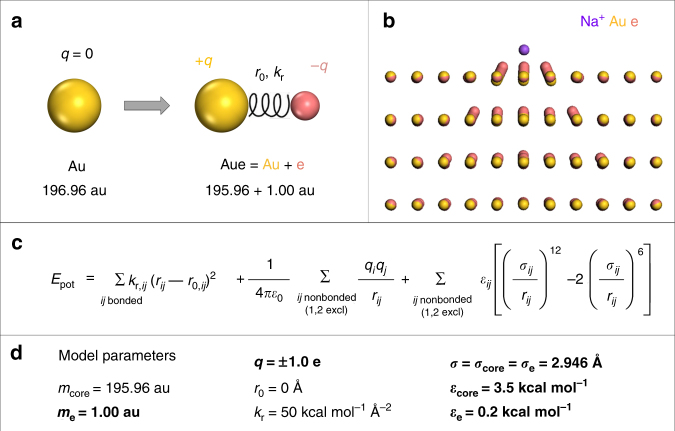
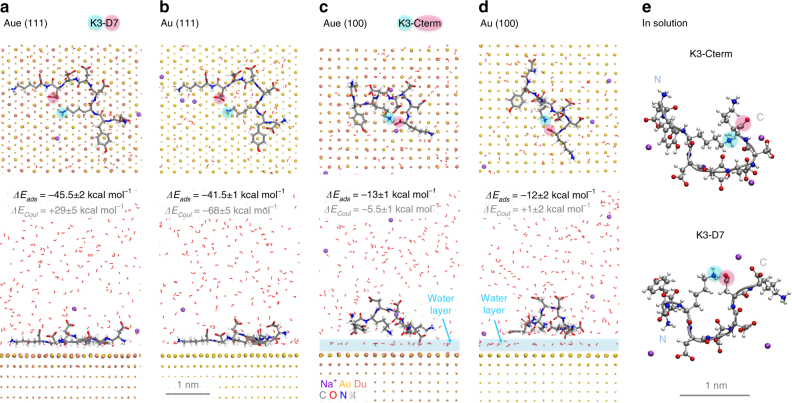
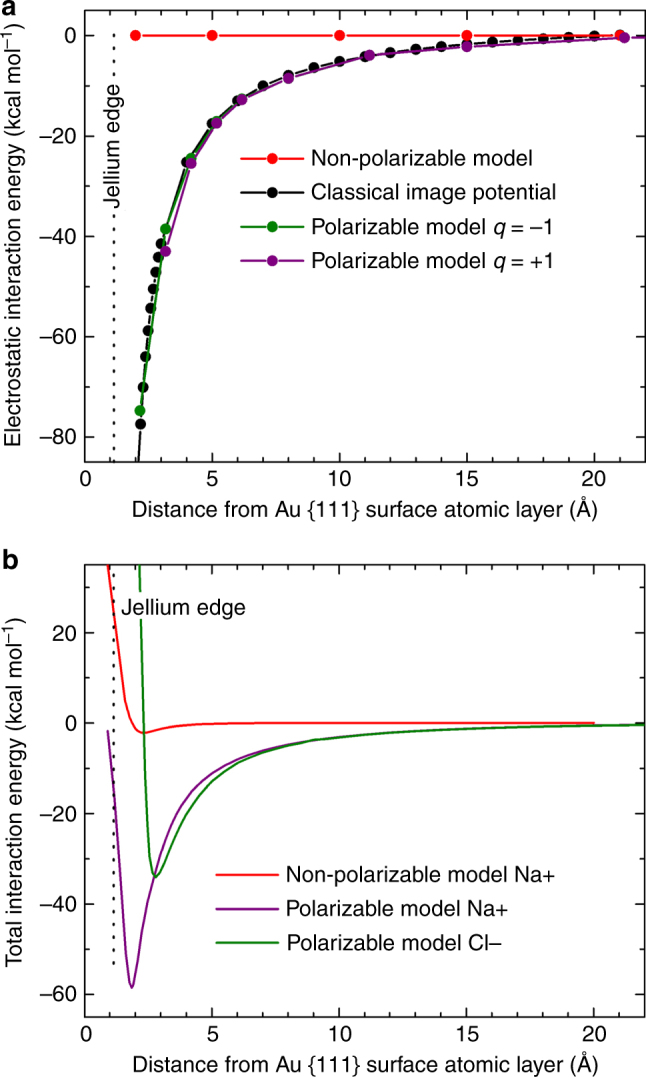
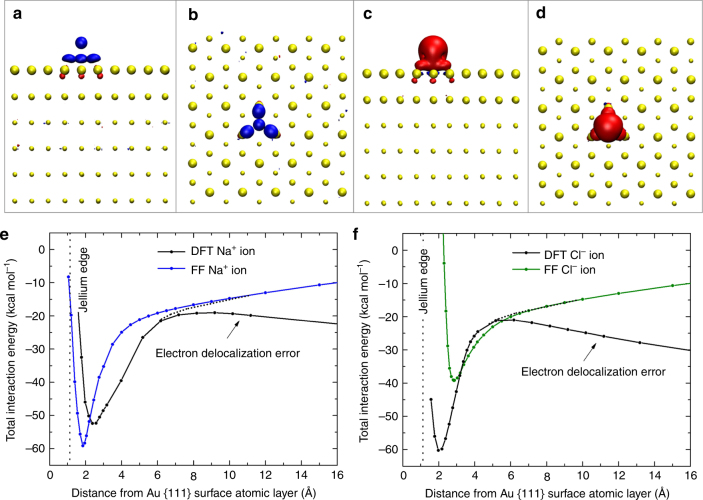
Metallic nanostructures have become popular for applications in therapeutics, catalysts, imaging, and gene delivery. Molecular dynamics simulations are gaining influence to predict nanostructure assembly and performance; however, instantaneous polarization effects due to induced charges in the free electron gas are not routinely included. Here we present a simple, compatible, and accurate polarizable potential for gold that consists of a Lennard-Jones potential and a harmonically coupled core-shell charge pair for every metal atom. The model reproduces the classical image potential of adsorbed ions as well as surface, bulk, and aqueous interfacial properties in excellent agreement with experiment. Induced charges affect the adsorption of ions onto gold surfaces in the gas phase at a strength similar to chemical bonds while ions and charged peptides in solution are influenced at a strength similar to intermolecular bonds. The proposed model can be applied to complex gold interfaces, electrode processes, and extended to other metals.
金属纳米结构在治疗、催化剂、成像和基因传递等领域的应用越来越受欢迎。分子动力学模拟在预测纳米结构组装和性能方面的影响力越来越大;然而,自由电子气中感应电荷引起的瞬时极化效应通常不包括在内。在这里,我们提出了一个简单、兼容、准确的金的极化势,它由每个金属原子的 Lennard-Jones 势和一个谐和耦合的核壳电荷对组成。该模型再现了吸附离子的经典像差,以及表面、体相和水相间的界面性质,与实验结果非常吻合。诱导电荷会影响离子在气相中吸附到金表面的强度,类似于化学键,而溶液中的离子和带电肽则受影响的强度类似于分子间键。所提出的模型可以应用于复杂的金界面、电极过程,并扩展到其他金属。