Cappello Paola, Curcio Claudia, Mandili Giorgia, Roux Cecilia, Bulfamante Sara, Novelli Francesco
Department of Molecular Biotechnology and Health Sciences, University of Turin, Turin 10126, Italy.
Molecular Biotechnology Center (MBC), University of Turin, Turin 10126, Italy.
Cancers (Basel). 2018 Feb 16;10(2):51. doi: 10.3390/cancers10020051.
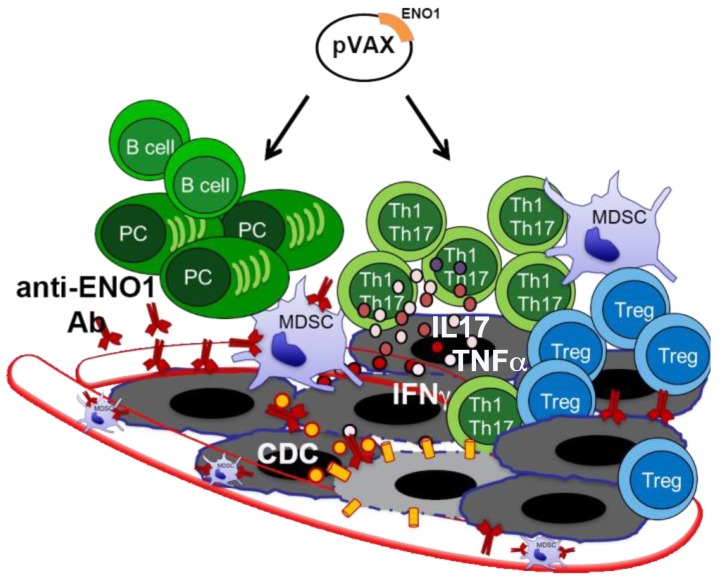
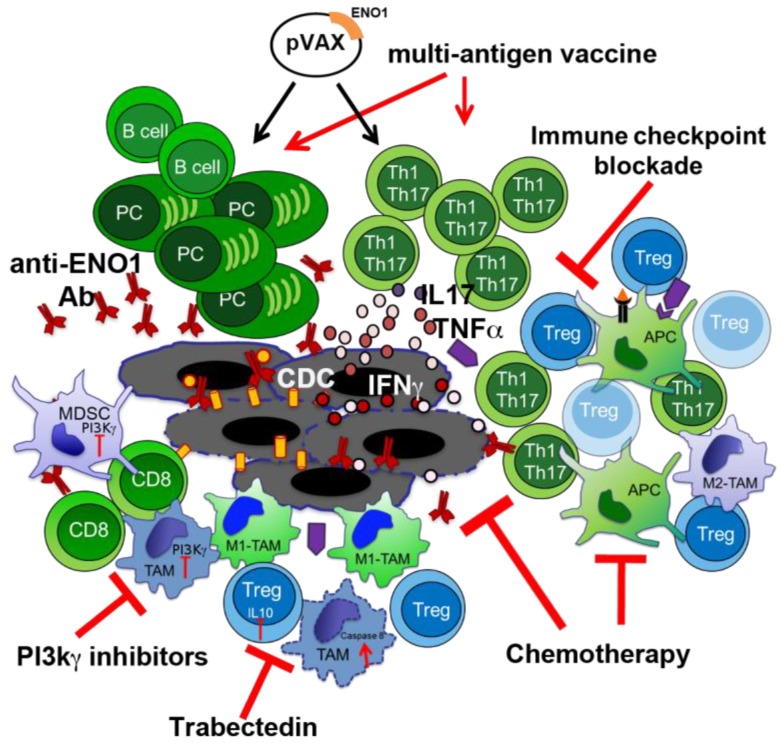
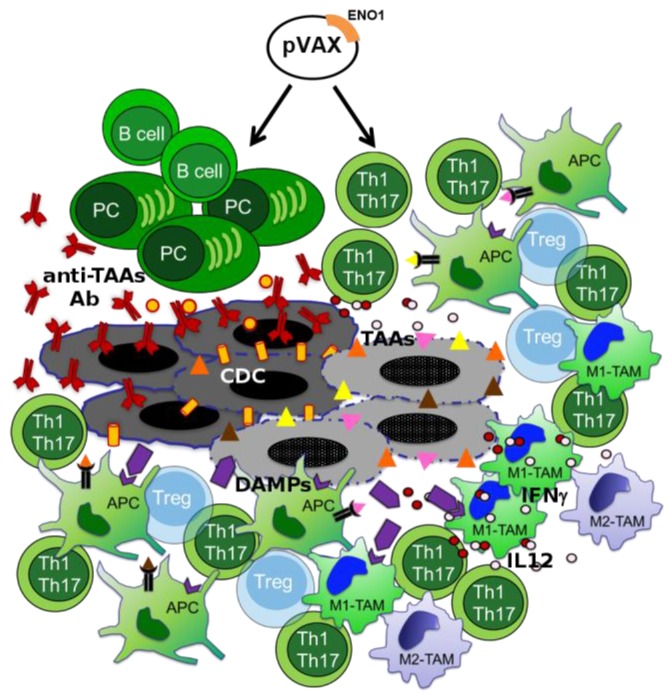
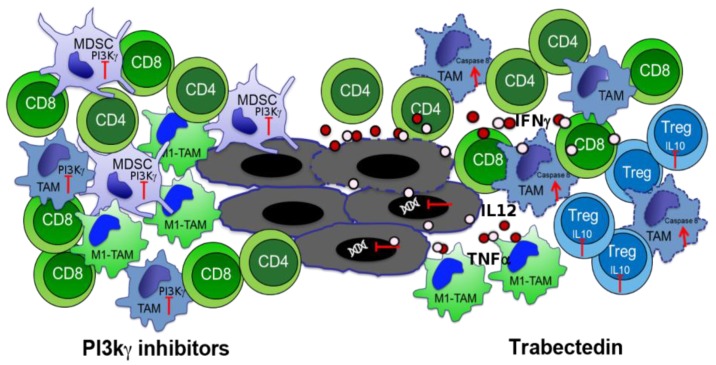
Pancreatic Ductal Adenocarcinoma (PDA) is an almost incurable radio- and chemo-resistant tumor, and its microenvironment is characterized by a strong desmoplastic reaction associated with a significant infiltration of T regulatory lymphocytes and myeloid-derived suppressor cells (Tregs, MDSC). Investigating immunological targets has identified a number of metabolic and cytoskeletal related molecules, which are typically recognized by circulating antibodies. Among these molecules we have investigated alpha-enolase (ENO1), a glycolytic enzyme that also acts a plasminogen receptor. ENO1 is also recognized by T cells in PDA patients, so we developed a DNA vaccine that targets ENO1. This efficiently induces many immunological processes (antibody formation and complement-dependent cytotoxicity (CDC)-mediated tumor killing, infiltration of effector T cells, reduction of infiltration of myeloid and Treg suppressor cells), which significantly increase the survival of genetically engineered mice that spontaneously develop pancreatic cancer. Although promising, the ENO1 DNA vaccine does not completely eradicate the tumor, which, after an initial growth inhibition, returns to proliferate again, especially when Tregs and MDSC ensue in the tumor mass. This led us to develop possible strategies for combinatorial treatments aimed to broaden and sustain the antitumor immune response elicited by DNA vaccination. Based on the data we have obtained in recent years, this review will discuss the biological bases of possible combinatorial treatments (chemotherapy, PI3K inhibitors, tumor-associated macrophages, ENO1 inhibitors) that could be effective in amplifying the response induced by the immune vaccination in PDA.
胰腺导管腺癌(PDA)是一种几乎无法治愈的放疗和化疗抵抗性肿瘤,其微环境的特征是强烈的促纤维增生反应,伴有T调节性淋巴细胞和髓源性抑制细胞(Tregs、MDSC)的大量浸润。对免疫靶点的研究已经确定了一些与代谢和细胞骨架相关的分子,这些分子通常能被循环抗体识别。在这些分子中,我们研究了α-烯醇化酶(ENO1),一种同时作为纤溶酶原受体的糖酵解酶。ENO1在PDA患者中也能被T细胞识别,因此我们开发了一种靶向ENO1的DNA疫苗。这种疫苗能有效诱导多种免疫过程(抗体形成和补体依赖性细胞毒性(CDC)介导的肿瘤杀伤、效应T细胞浸润、髓系和Treg抑制细胞浸润减少),显著提高自发发生胰腺癌的基因工程小鼠的存活率。尽管前景乐观,但ENO1 DNA疫苗并不能完全根除肿瘤,肿瘤在最初的生长抑制后会再次增殖,尤其是当肿瘤块中出现Tregs和MDSC时。这促使我们开发联合治疗的可能策略,旨在扩大和维持DNA疫苗引发的抗肿瘤免疫反应。基于我们近年来获得的数据,本综述将讨论可能的联合治疗(化疗、PI3K抑制剂、肿瘤相关巨噬细胞、ENO1抑制剂)的生物学基础,这些联合治疗可能有效增强PDA免疫疫苗诱导的反应。