Campbell Julie A, Hensher Martin, Neil Amanda, Venn Alison, Wilkinson Stephen, Palmer Andrew J
Menzies Institute for Medical Research, University of Tasmania, Medical Sciences 2 Building, 17 Liverpool Street, Hobart, TAS, 7000, Australia.
Department of Health and Human Services, Level 2, 22 Elizabeth Street, Hobart, TAS, 7000, Australia.
Pharmacoecon Open. 2018 Mar;2(1):63-76. doi: 10.1007/s41669-017-0038-z.
Long-term publicly waitlisted bariatric surgery patients typically experience debilitating physical/psychosocial obesity-related comorbidities that profoundly affect their quality of life.
We sought to measure quality-of-life impacts in a study population of severely obese patients who had multiyear waitlist times and then underwent bariatric surgery.
Participants were recruited opportunistically following a government-funded initiative to provide bariatric surgery to morbidly obese long-term waitlisted patients. Participants self-completed the EQ-5D-5L and AQoL-8D questionnaires pre- and postoperatively. Utility valuations (utilities) and individual/super dimension scores (AQoL-8D only) were generated.
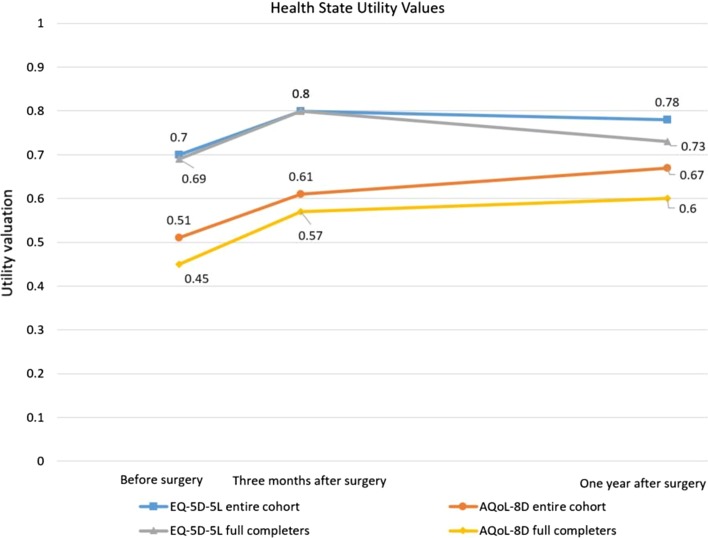
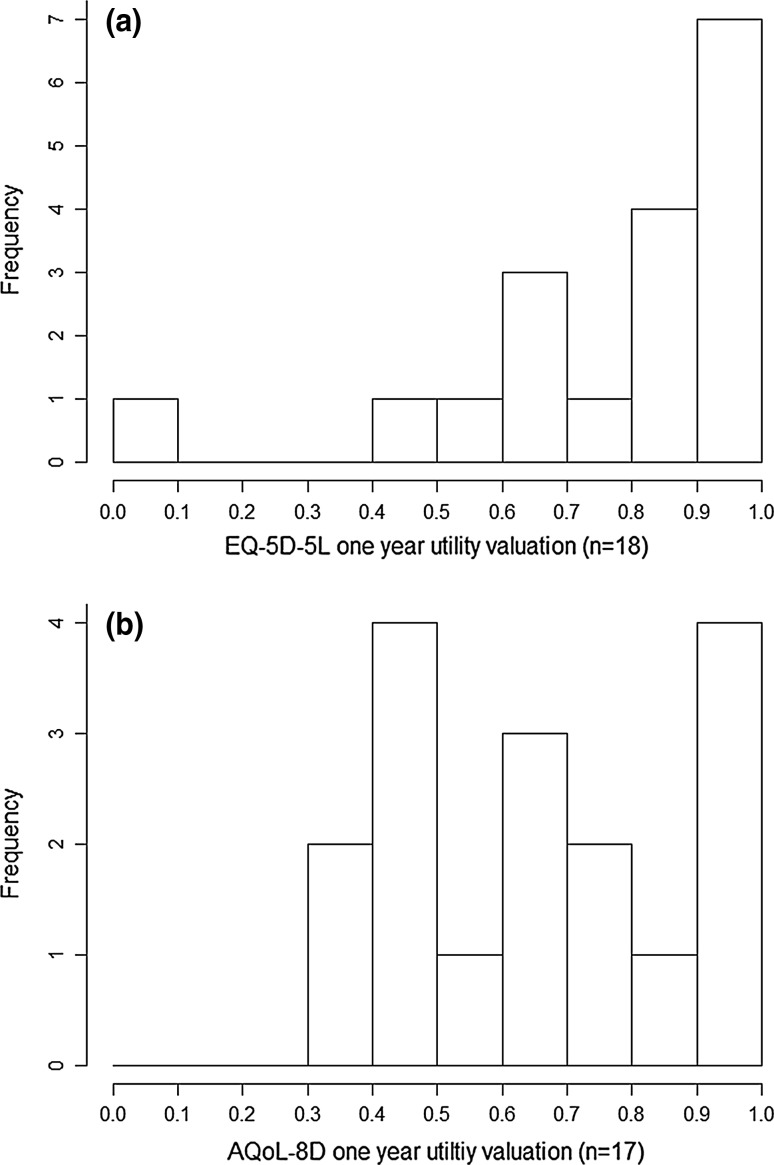
Participants' (n = 23) waitlisted time was mean [standard deviation (SD)] 6.5 (2) years, body mass index reduced from 49.3 (9.35) kg/m preoperatively to 40.8 (7.01) 1 year postoperatively (p = 0.02). One year utilities revealed clinical improvements (both instruments). AQoL-8D improved significantly from baseline to 1 year, with the change twice that of the EQ-5D-5L [EQ-5D-5L: mean (SD) 0.70 (0.25) to 0.78 (0.25); AQoL-8D: 0.51 (0.24) to 0.67 (0.23), p = 0.04], despite the AQoL-8D's narrower algorithmic range. EQ-5D-5L utility plateaued from 3 months to 1 year. AQoL-8D 1-year utility improvements were driven by Happiness/Coping/Self-worth (p < 0.05), and the Psychosocial super dimension score almost doubled at 1 year (p < 0.05). AQoL-8D revealed a wider dispersion of individual utilities.
Ongoing improvements in psychosocial parameters from 3 months to 1 year post-surgery accounted for improvements in overall utilities measured by the AQoL-8D that were not detected by EQ-5D-5L. Selection of a sensitive instrument is important to adequately assess changes in quality of life and to accurately reflect changes in quality-adjusted life-years for cost-utility analyses and resource allocation in a public healthcare resource-constrained environment.
长期在公共等候名单上的减肥手术患者通常会经历与肥胖相关的身体/心理社会合并症,这些合并症严重影响他们的生活质量。
我们试图在一个严重肥胖患者的研究群体中测量生活质量的影响,这些患者有多年的等候名单时间,然后接受了减肥手术。
在一项政府资助的为病态肥胖的长期等候名单患者提供减肥手术的倡议之后,机会性地招募了参与者。参与者在术前和术后自行完成EQ-5D-5L和AQoL-8D问卷。生成了效用估值(效用)和个体/超维度分数(仅适用于AQoL-8D)。
参与者(n = 23)的等候名单时间平均为[标准差(SD)]6.5(2)年,体重指数从术前的49.3(9.35)kg/m降至术后1年的40.8(7.01)(p = 0.02)。一年的效用显示出临床改善(两种工具均如此)。AQoL-8D从基线到1年有显著改善,变化是EQ-5D-5L的两倍[EQ-5D-5L:平均(SD)0.70(0.25)至0.78(0.25);AQoL-8D:0.51(0.24)至0.67(0.23),p = 0.04],尽管AQoL-8D的算法范围更窄。EQ-5D-5L效用从3个月到1年趋于平稳。AQoL-8D的1年效用改善是由幸福/应对/自我价值驱动的(p < 0.05),心理社会超维度分数在1年时几乎翻倍(p < 0.05)。AQoL-8D显示个体效用的分散性更大。
术后3个月至1年心理社会参数的持续改善导致了AQoL-8D测量的总体效用的改善,而EQ-5D-5L未检测到这种改善。选择一种敏感的工具对于充分评估生活质量的变化以及准确反映质量调整生命年的变化以进行成本效用分析和在公共医疗资源受限环境中的资源分配很重要。