Gao Hongbo, Li Yi-Fan
Division of Basic Biomedical Sciences, Sanford School of Medicine, University of South Dakota, Vermillion, South Dakota.
Physiol Rep. 2018 Feb;6(4). doi: 10.14814/phy2.13606.
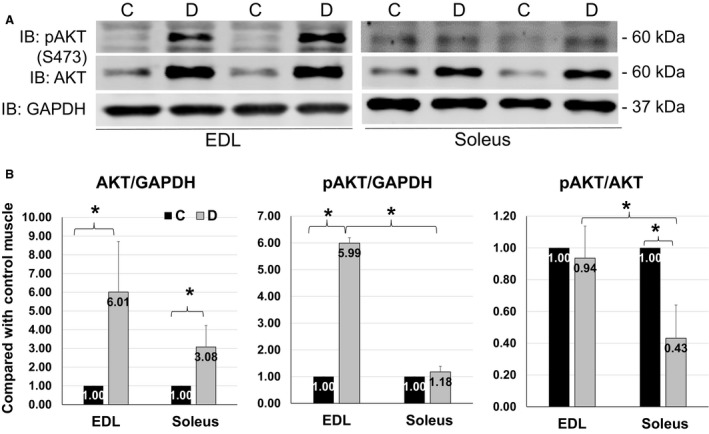
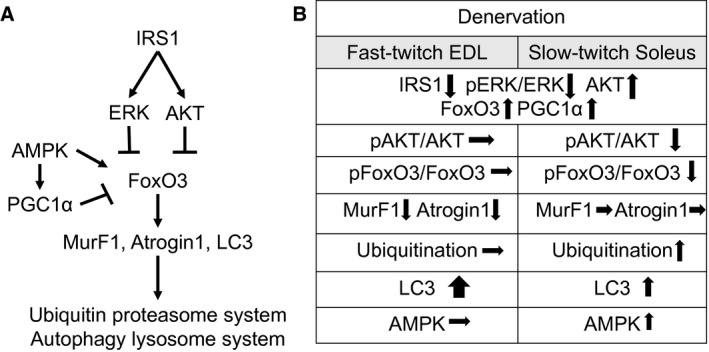
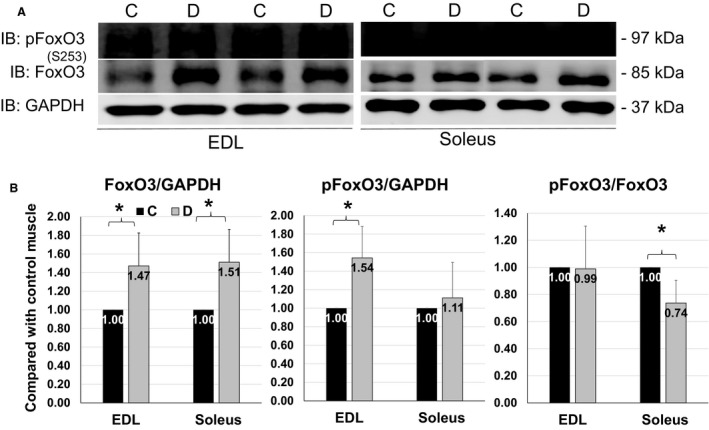
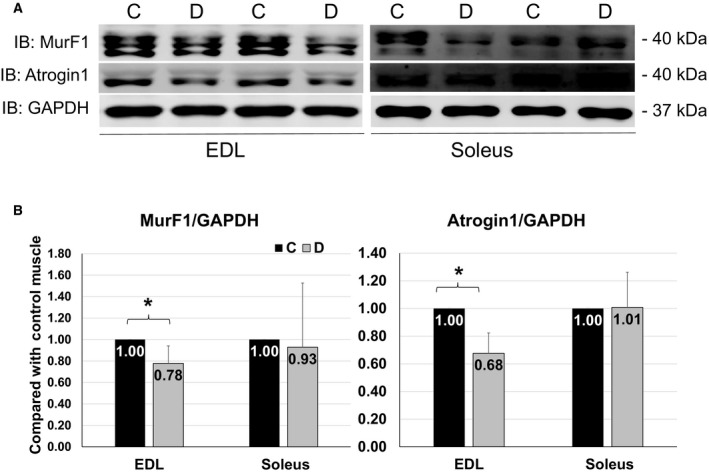
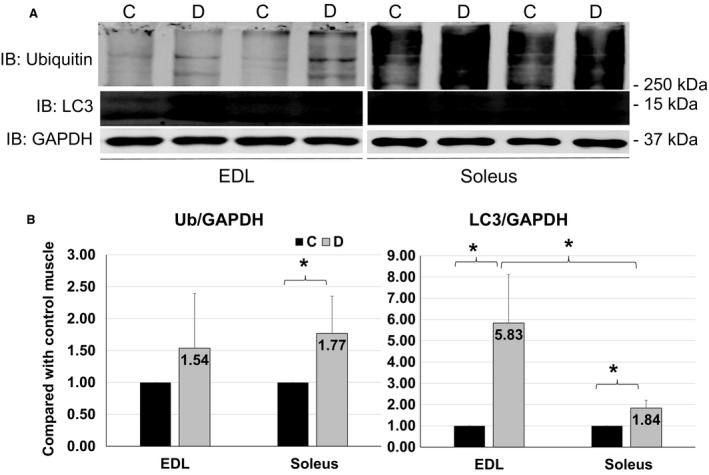
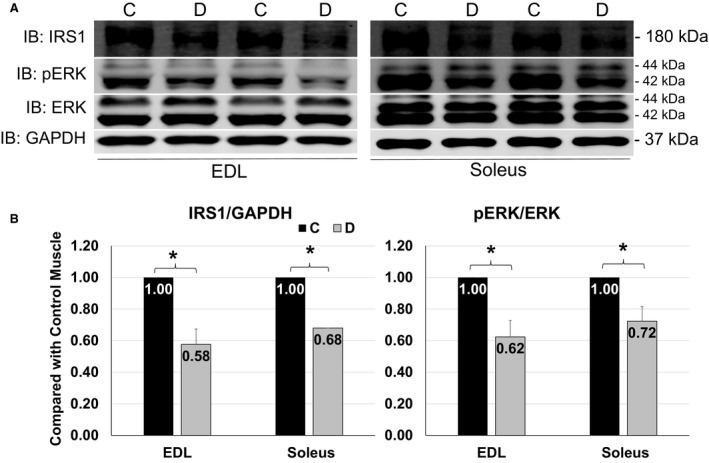
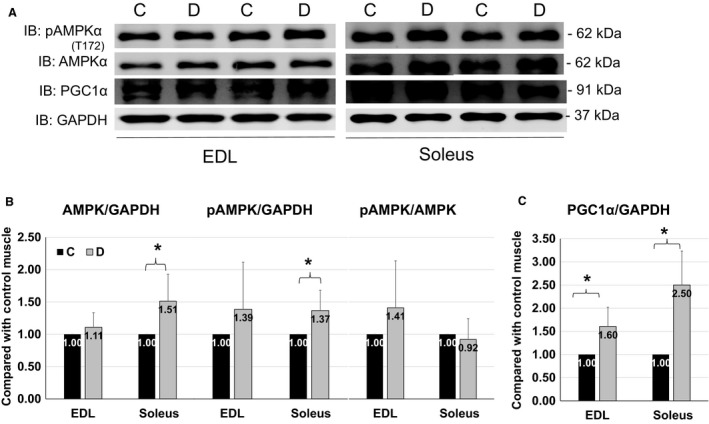
Denervation induces skeletal muscle atrophy, which primarily impairs oxidative slow twitch fibers. The underlying mechanism of this phenomenon, however, remains to be addressed. We hypothesize that denervation-induced fiber-specific atrophy may result from the distinct activities of different signaling pathways that are involved in protein synthesis and degradation in fast- and slow-twitch fibers. In this study, 1-month-old male mice were subjected to unilateral sciatic denervation for 4 days. Fast-twitch muscle extensor digitorum longus (EDL) and slow-twitch muscle soleus were collected from the denervated side and the control side of hind limbs. Total and phosphorylated protein levels of key factors of major signaling pathways in these tissues were determined using western blot assay. Our data showed that total AKT and FoxO3 protein levels were upregulated in denervated muscles as compared with control sides. Phosphorylation of AKT and FoxO3 were proportionally enhanced in denervated EDL but not soleus, indicating AKT activation drives phosphorylation of FoxO3 in EDL but not in soleus upon denervation. As a result, FoxO3-targeted atrogenes MurF1 and Atrogin1 protein abundances were reduced in denervated EDL but not altered in soleus. In consistent with this change, polyubiquitination were significantly increased in denervated soleus, but only a slight increase in ubiquitination was found in denervated EDL. Autophagy marker LC3 protein level was significantly increased in both muscle types, but in greater extent in EDL after denervation. IRS1 protein level and active ERK were reduced in both muscles upon denervation, which might contribute to the upregulation of total AKT protein level and FoxO3 abundance in EDL and soleus. Total and phosphorylated AMPK protein levels were increased in denervated soleus but not in EDL. Overall, these data reveal that the key signaling pathways that regulate protein synthesis and degradation are more sensitive in soleus than EDL in response to denervation.
去神经支配会导致骨骼肌萎缩,主要损害氧化型慢肌纤维。然而,这一现象的潜在机制仍有待探讨。我们推测,去神经支配诱导的纤维特异性萎缩可能源于不同信号通路的独特活性,这些信号通路参与快肌纤维和慢肌纤维中的蛋白质合成与降解。在本研究中,对1月龄雄性小鼠进行单侧坐骨神经去神经支配处理4天。从后肢的去神经支配侧和对照侧采集快肌趾长伸肌(EDL)和慢肌比目鱼肌。使用蛋白质免疫印迹法测定这些组织中主要信号通路关键因子的总蛋白水平和磷酸化蛋白水平。我们的数据表明,与对照侧相比,去神经支配肌肉中的总AKT和FoxO3蛋白水平上调。AKT和FoxO3的磷酸化在去神经支配的EDL中呈比例增强,但在比目鱼肌中未增强,表明去神经支配后AKT激活驱动EDL中FoxO3的磷酸化,但不驱动比目鱼肌中FoxO3的磷酸化。结果,去神经支配的EDL中FoxO3靶向的萎缩相关基因MurF1和Atrogin1的蛋白丰度降低,但在比目鱼肌中未改变。与此变化一致,去神经支配的比目鱼肌中多聚泛素化显著增加,但去神经支配的EDL中仅发现泛素化略有增加。自噬标志物LC3蛋白水平在两种肌肉类型中均显著增加,但去神经支配后在EDL中增加的程度更大。去神经支配后,两种肌肉中的IRS1蛋白水平和活性ERK均降低,这可能有助于EDL和比目鱼肌中总AKT蛋白水平和FoxO3丰度的上调。去神经支配的比目鱼肌中总AMPK和磷酸化AMPK蛋白水平增加,但在EDL中未增加。总体而言,这些数据表明,在响应去神经支配时,调节蛋白质合成和降解的关键信号通路在比目鱼肌中比在EDL中更敏感。