Bourgeois Stéphanie, Senn Helen, Kaden Jenny, Taggart John B, Ogden Rob, Jeffery Kathryn J, Bunnefeld Nils, Abernethy Katharine, McEwing Ross
Agence Nationale des Parcs Nationaux Libreville Gabon.
WildGenes LaboratoryThe Royal Zoological Society of Scotland Edinburgh Zoo Edinburgh UK.
Ecol Evol. 2018 Jan 24;8(4):2207-2217. doi: 10.1002/ece3.3854. eCollection 2018 Feb.
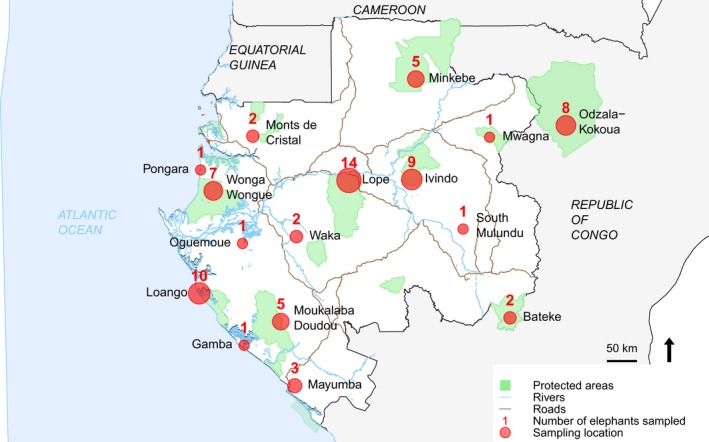
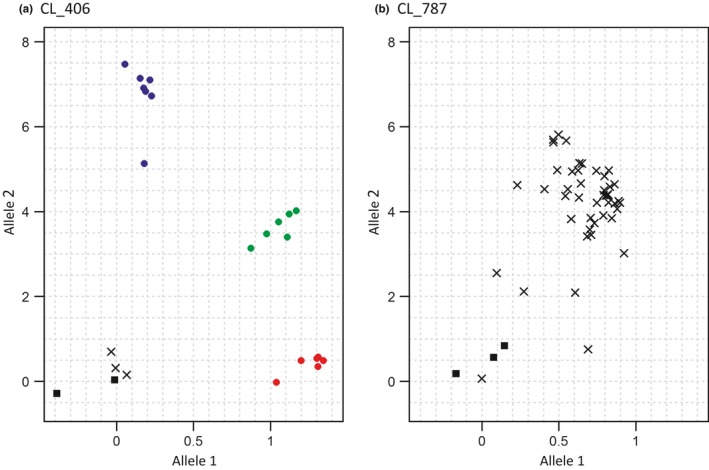
The continuing decline in forest elephant () numbers due to poaching and habitat reduction is driving the search for new tools to inform management and conservation. For dense rainforest species, basic ecological data on populations and threats can be challenging and expensive to collect, impeding conservation action in the field. As such, genetic monitoring is being increasingly implemented to complement or replace more burdensome field techniques. Single-nucleotide polymorphisms (SNPs) are particularly cost-effective and informative markers that can be used for a range of practical applications, including population census, assessment of human impact on social and genetic structure, and investigation of the illegal wildlife trade. SNP resources for elephants are scarce, but next-generation sequencing provides the opportunity for rapid, inexpensive generation of SNP markers in nonmodel species. Here, we sourced forest elephant DNA from 23 samples collected from 10 locations within Gabon, Central Africa, and applied double-digest restriction-site-associated DNA (ddRAD) sequencing to discover 31,851 tags containing SNPs that were reduced to a set of 1,365 high-quality candidate SNP markers. A subset of 115 candidate SNPs was then selected for assay design and validation using 56 additional samples. Genotyping resulted in a high conversion rate (93%) and a low per allele error rate (0.07%). This study provides the first panel of 107 validated SNP markers for forest elephants. This resource presents great potential for new genetic tools to produce reliable data and underpin a step-change in conservation policies for this elusive species.
由于偷猎和栖息地减少,森林象数量持续下降,这推动了人们寻找新工具来为管理和保护工作提供信息。对于茂密雨林中的物种而言,收集有关种群和威胁的基础生态数据既具有挑战性又成本高昂,这阻碍了实地保护行动。因此,基因监测正越来越多地被用于补充或取代更为繁琐的实地技术。单核苷酸多态性(SNP)是特别具有成本效益且信息丰富的标记,可用于一系列实际应用,包括种群普查、评估人类对社会和遗传结构的影响以及调查非法野生动物贸易。大象的SNP资源稀缺,但新一代测序技术为在非模式物种中快速、低成本地生成SNP标记提供了机会。在这里,我们从非洲中部加蓬10个地点采集的23个样本中获取森林象的DNA,并应用双酶切限制性位点关联DNA(ddRAD)测序技术,发现了31851个包含SNP的标签,这些标签被缩减为一组1365个高质量的候选SNP标记。然后从115个候选SNP中选取一个子集,使用另外56个样本进行检测设计和验证。基因分型产生了较高的转化率(93%)和较低的等位基因错误率(0.07%)。本研究为森林象提供了首个包含107个经过验证的SNP标记的面板。这一资源为新的基因工具带来了巨大潜力,能够产生可靠的数据,并为这一难以捉摸的物种的保护政策带来重大变革。