Steyer Katharina, Tiesmeyer Annika, Muñoz-Fuentes Violeta, Nowak Carsten
Conservation Genetics Group Senckenberg Research Institute and Natural History Museum Frankfurt Gelnhausen Germany.
Institute of Ecology, Evolution and Diversity Goethe-University Frankfurt Frankfurt am Main Germany.
Ecol Evol. 2018 Jan 27;8(4):2290-2304. doi: 10.1002/ece3.3650. eCollection 2018 Feb.
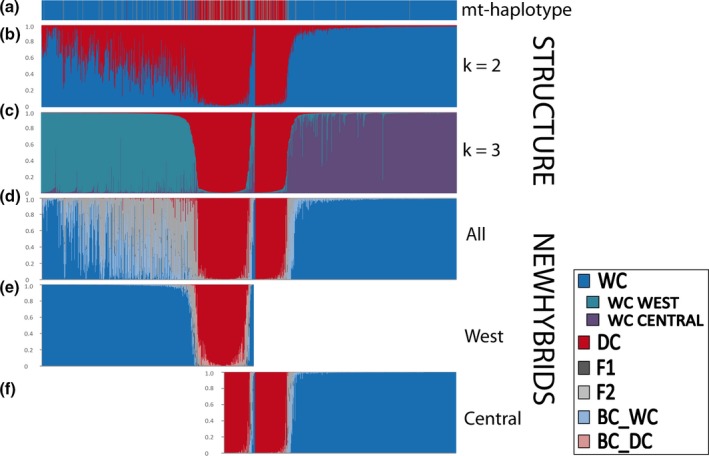
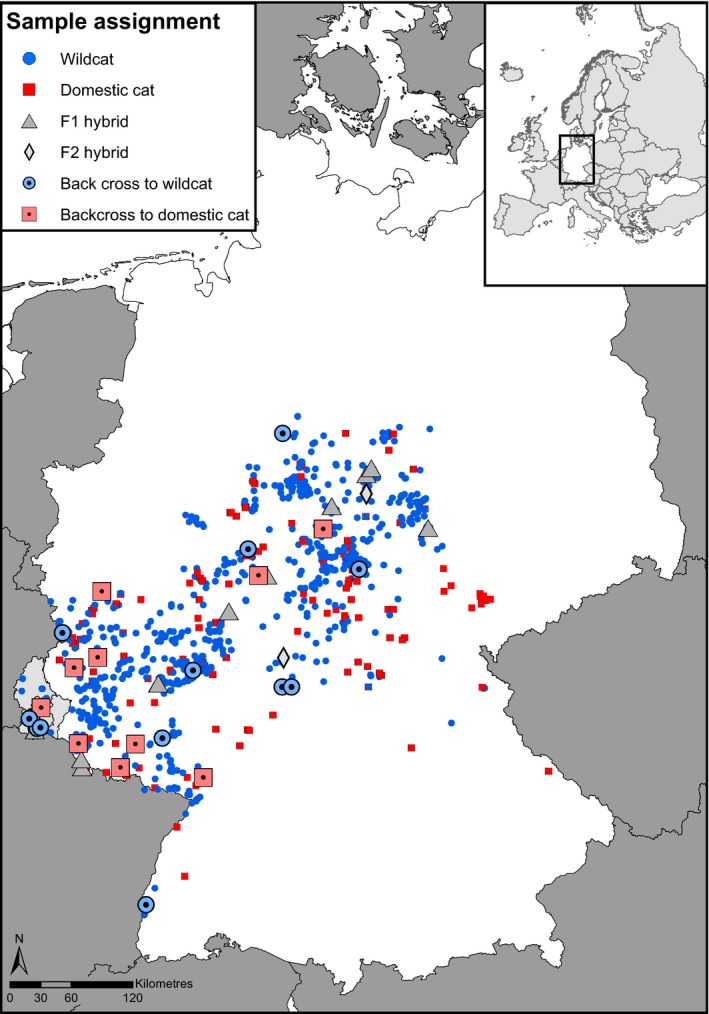
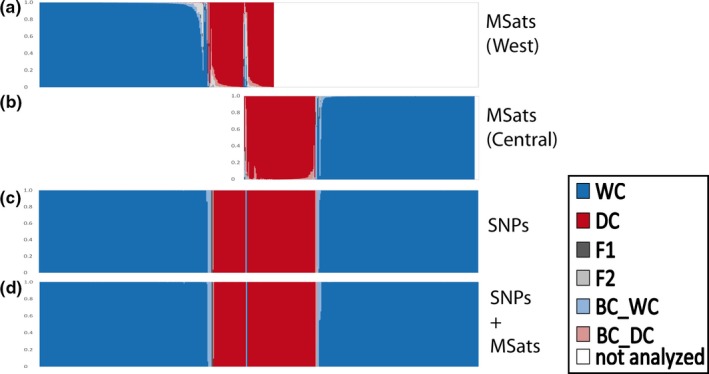
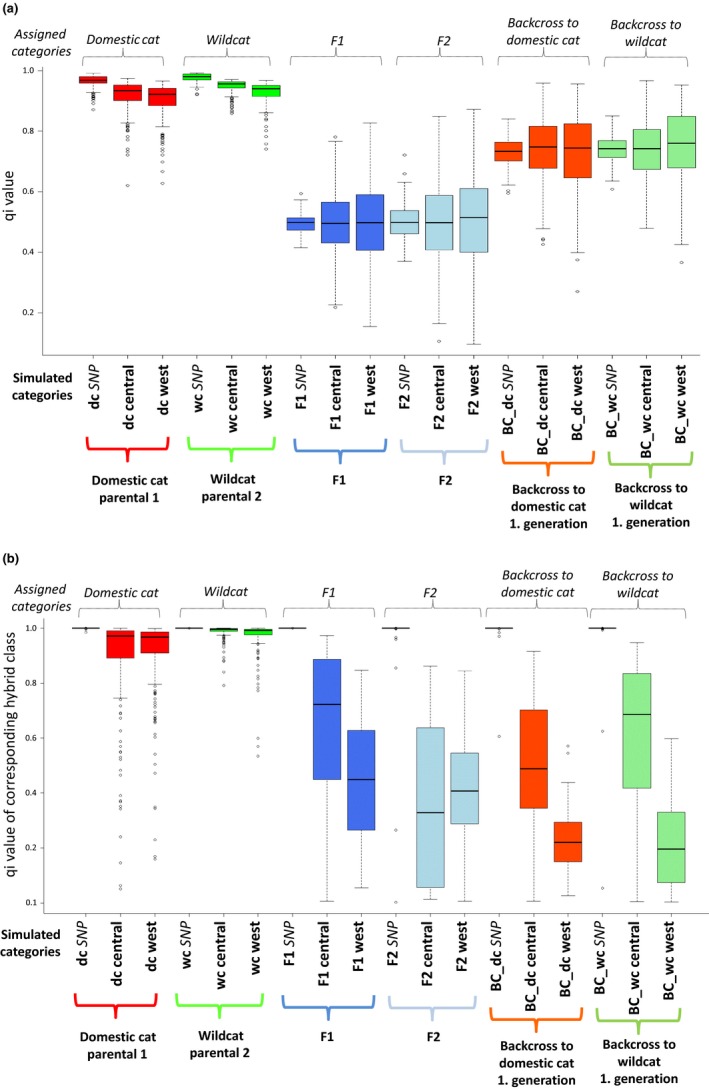
Hybridization between wild species and their domestic congeners is considered a major threat for wildlife conservation. Genetic integrity of the European wildcat, for instance, is a concern as they are outnumbered by domestic cats by several orders of magnitude throughout its range. We genotyped 1,071 individual wildcat samples obtained from hair traps and roadkills collected across the highly fragmented forests of western Central Europe, in Germany and Luxembourg, to assess domestic cat introgression in wildcats in human-dominated landscapes. Analyses using a panel of 75 autosomal SNPs suggested a low hybridization rate, with 3.5% of wildcat individuals being categorized as F1, F2, or backcrosses to either parental taxon. We report that results based on a set of SNPs were more consistent than on a set of 14 microsatellite markers, showed higher accuracy to detect hybrids and their class in simulation analyses, and were less affected by underlying population structure. Our results strongly suggest that very high hybridization rates previously reported for Central Europe may be partly due to inadequate choice of markers and/or sampling design. Our study documents that an adequately selected SNP panel for hybrid detection may be used as an alternative to commonly applied microsatellite markers, including studies relying on noninvasively collected samples. In addition, our finding of overall low hybridization rates in Central European wildcats provides an example of successful wildlife coexistence in human-dominated, fragmented landscapes.
野生物种与其家养同类之间的杂交被认为是野生动物保护面临的主要威胁。例如,欧洲野猫的基因完整性令人担忧,因为在其整个分布范围内,家猫的数量比野猫多出几个数量级。我们对从德国和卢森堡中西欧高度碎片化森林中设置的毛发陷阱和路毙动物采集的1071份野猫个体样本进行了基因分型,以评估在人类主导景观中家猫基因渗入野猫的情况。使用一组75个常染色体单核苷酸多态性(SNP)的分析表明杂交率较低,3.5%的野猫个体被归类为F1、F2或与任一亲本分类群的回交后代。我们报告称,基于一组SNP的结果比基于一组14个微卫星标记的结果更一致,在模拟分析中检测杂种及其类别时显示出更高的准确性,并且受潜在种群结构的影响较小。我们的结果有力地表明,先前报道的中欧非常高的杂交率可能部分归因于标记选择不当和/或采样设计问题。我们的研究证明,为检测杂交而适当选择的SNP面板可作为常用微卫星标记的替代方法,包括依赖非侵入性采集样本的研究。此外,我们在中欧野猫中发现总体杂交率较低,这为人类主导、碎片化景观中野生动物的成功共存提供了一个例子。