Beirão José, Lewis Jason A, Wringe Brendan F, Purchase Craig F
Department of Biology Memorial University St. John's NL Canada.
Present address: Faculty of Biosciences and Aquaculture Nord University Bodø Norway.
Ecol Evol. 2018 Jan 29;8(4):2343-2349. doi: 10.1002/ece3.3783. eCollection 2018 Feb.
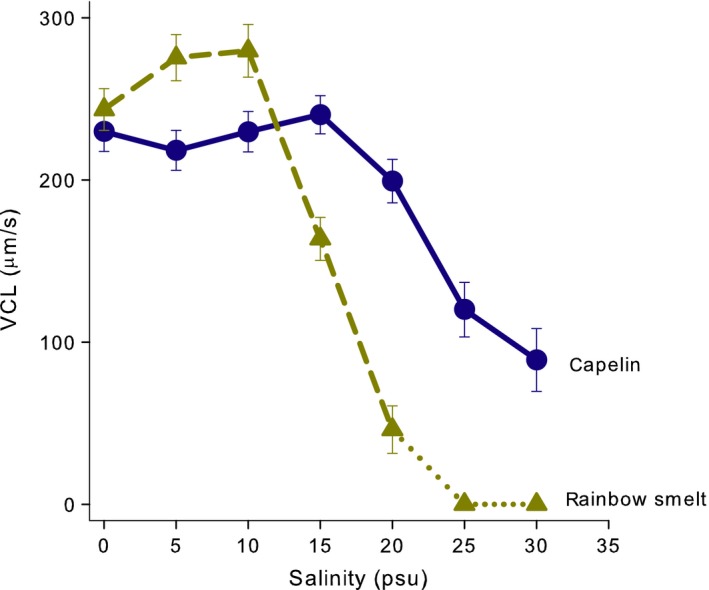
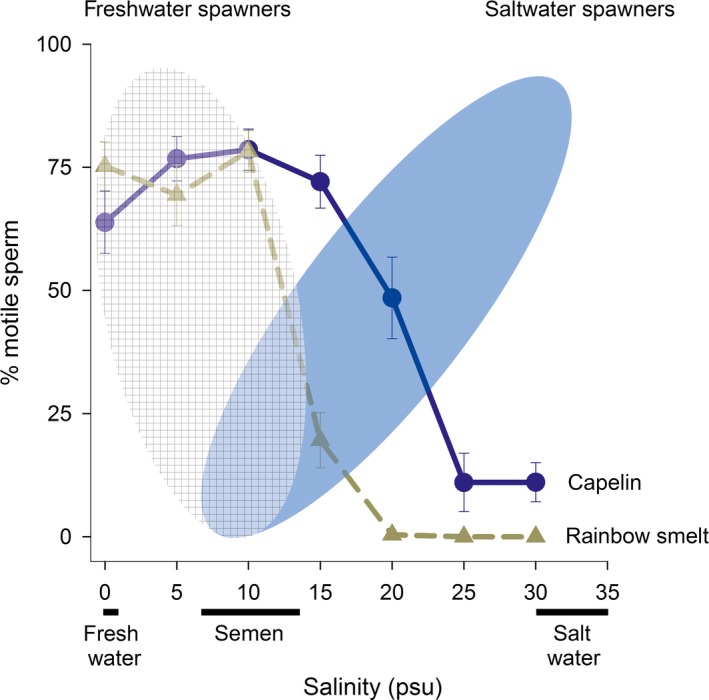
Reproduction of external fertilizing vertebrates is typically constrained to either fresh or salt water, not both. For all studied amphibians and fishes, this constraint includes immotile sperm that are activated after ejaculation only by the specific chemistry of the fertilizing medium in which the species evolved (fresh, brackish, or salt water). No amphibians can reproduce in the sea. Although diadromous fishes may migrate between salt and fresh water, they are shackled to their natal environment for spawning in part because of sperm activation. Here, we report for the first time among all documented external fertilizing vertebrates, that in the absence of any external media, sperm are motile at ejaculation in a marine spawning fish (Osmeridae, capelin, ). To illuminate why, we evaluated sperm behavior at different salinities in as well as the related freshwater spawning anadromous rainbow smelt (). Surprisingly, sperm performance was superior in fresh water for both species. spend their entire life at sea but our results show that their sperm are deactivated by sea water, suggesting a freshwater ancestry. By circumventing constraining water chemistry, we interpret the unique pre-ejaculatory sperm activation in this species as a novel adaptation that enables fertilization in the marine environment. These findings also contribute to understanding the persistence of anadromy, despite great energetic costs to adult fishes.
体外受精脊椎动物的繁殖通常局限于淡水或咸水其中一种环境,而非两者皆可。对于所有已研究的两栖动物和鱼类而言,这种限制包括精子在射精后仅能被该物种进化所处特定受精介质(淡水、微咸水或咸水)的化学性质激活,且精子不具备游动能力。没有两栖动物能够在海洋中繁殖。尽管洄游鱼类可能在咸水和淡水之间洄游,但它们部分由于精子激活的原因,仍受限于其出生地产卵。在此,我们首次在所有已记录的体外受精脊椎动物中报告,在没有任何外部介质的情况下,一种海洋产卵鱼类(胡瓜鱼科,毛鳞鱼)的精子在射精时具有游动能力。为了阐明原因,我们评估了毛鳞鱼在不同盐度下的精子行为,以及相关的淡水产卵溯河产卵虹鳟。令人惊讶的是,这两个物种的精子在淡水中表现更优。毛鳞鱼一生都生活在海洋中,但我们的结果表明其精子会被海水失活,这表明它们有淡水祖先。通过规避限制精子活性的水化学条件,我们将该物种独特的射精前精子激活现象解释为一种新的适应性特征,使其能够在海洋环境中受精。这些发现也有助于理解尽管成年鱼类洄游会付出巨大能量代价,但溯河产卵现象仍持续存在的原因。