Sørensen T M, Bjørnvad C R, Cordoba G, Damborg P, Guardabassi L, Siersma V, Bjerrum L, Jessen L R
Department of Veterinary Clinical Sciences, University of Copenhagen, Denmark.
The Research Unit for General Practice and Section of General Practice, Department of Public Health, University of Copenhagen, Denmark.
J Vet Intern Med. 2018 Mar;32(2):743-751. doi: 10.1111/jvim.15048. Epub 2018 Feb 22.
Clinical signs of urinary tract disease in dogs often lead to prescription of antibiotics. Appropriate diagnostic work-up could optimize treatment and reduce the risk of inappropriate use of antibiotics.
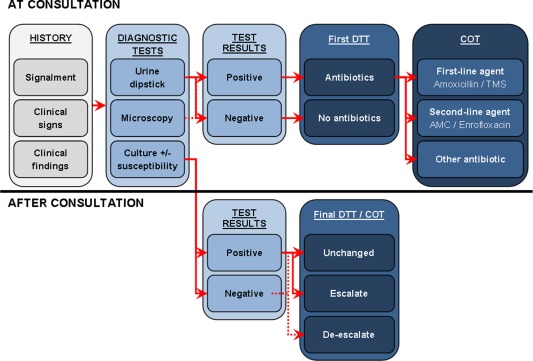
HYPOTHESIS/OBJECTIVES: To describe and evaluate the impact of diagnostic work-up on decision to treat (DTT) and choice of antibiotic treatment (COT) for dogs presenting with clinical signs of urinary tract disease.
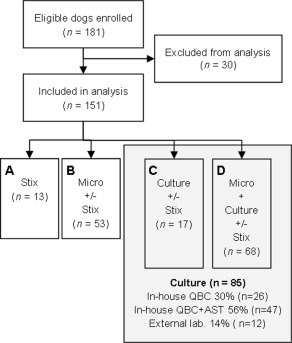
One hundred and fifty-one dogs presenting to 52 Danish veterinary practices.
Prospective, observational study. Clinical signs, diagnostic work-up, and prescriptions were recorded. Urine samples were submitted to a reference laboratory for quantitative bacterial culture (QBC) and susceptibility testing. The laboratory results were used as reference for assessing the appropriateness of DTT and COT.
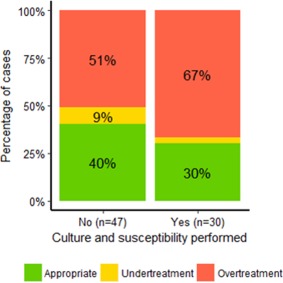
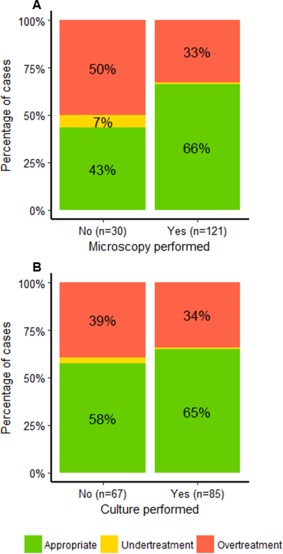
In the majority of dogs, veterinarians performed dipstick (99%), microscopic examination of urine (80%) and bacterial culture (56%). Fifty-one percent of dogs had urinary tract infection (UTI) based on reference QBC. Appropriate DTT was made for 62% of the dogs, while 36% were over-prescribed and 2% under-prescribed. Inappropriate use of second-line agents was found in 57% of the UTI cases. Performing microscopy-but not culture-significantly impacted DTT (P = 0.039) while no difference was seen in COT (P = 0.67). The accuracy of in-house microscopy and culture were 64.5 and 77%, respectively.
Over-prescription of antibiotics was common among dogs with suspected UTI, regardless of the diagnostic work-up performed. Test inaccuracy under practice conditions and incoherence between diagnostic test results and decision-making both explained inappropriate and unnecessary use of antibiotics.
犬类泌尿道疾病的临床症状常常导致抗生素的处方。适当的诊断检查可以优化治疗并降低抗生素不当使用的风险。
假设/目标:描述并评估诊断检查对出现泌尿道疾病临床症状的犬只治疗决策(DTT)和抗生素治疗选择(COT)的影响。
151只犬只,就诊于52家丹麦兽医诊所。
前瞻性观察研究。记录临床症状、诊断检查和处方。将尿液样本提交至参考实验室进行定量细菌培养(QBC)和药敏试验。实验室结果用作评估DTT和COT适宜性的参考。
在大多数犬只中,兽医进行了试纸条检测(99%)、尿液显微镜检查(80%)和细菌培养(56%)。根据参考QBC,51%的犬只患有泌尿道感染(UTI)。62%的犬只做出了适当的DTT,而36%用药过度,2%用药不足。在57%的UTI病例中发现了二线药物的不当使用。进行显微镜检查(而非培养)对DTT有显著影响(P = 0.039),而在COT方面未发现差异(P = 0.67)。内部显微镜检查和培养的准确性分别为64.5%和77%。
在疑似UTI的犬只中,抗生素过度处方很常见,无论进行何种诊断检查。实际操作条件下的检测不准确以及诊断测试结果与决策之间的不一致都解释了抗生素的不当和不必要使用。