Department of Endocrinology and Diabetes Center, The First Affiliated Hospital of Sun Yat-sen University, Guangzhou, China.
J Diabetes Investig. 2018 Sep;9(5):1075-1083. doi: 10.1111/jdi.12824. Epub 2018 Mar 24.
AIMS/INTRODUCTION: Glimepiride is a sulfonylurea known to have unique insulin mimetic and sensitizing effects. We aimed to study the efficacy of glimepiride in a patient with type A insulin resistance syndrome.
A 15-year-old girl with type A insulin resistance syndrome was treated with glimpiride for 6 months. Self-monitoring of blood glucose was recorded, and oral glucose tolerance tests on glucose and insulin were measured during the treatment. Hyperinsulinemic euglycemic clamp was used to evaluate whole-body insulin sensitivity before and after the treatment.
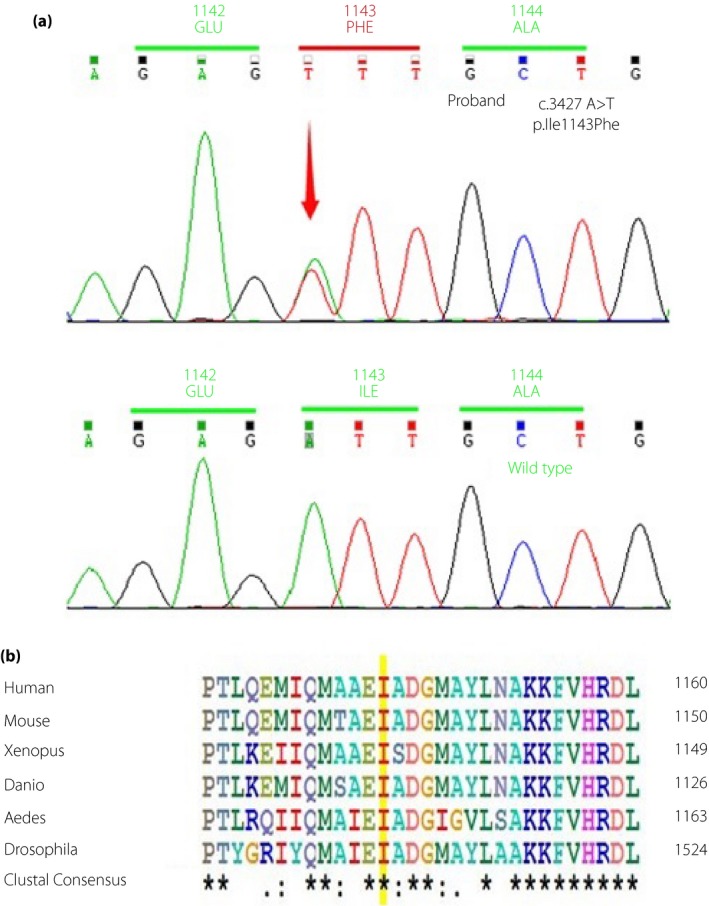
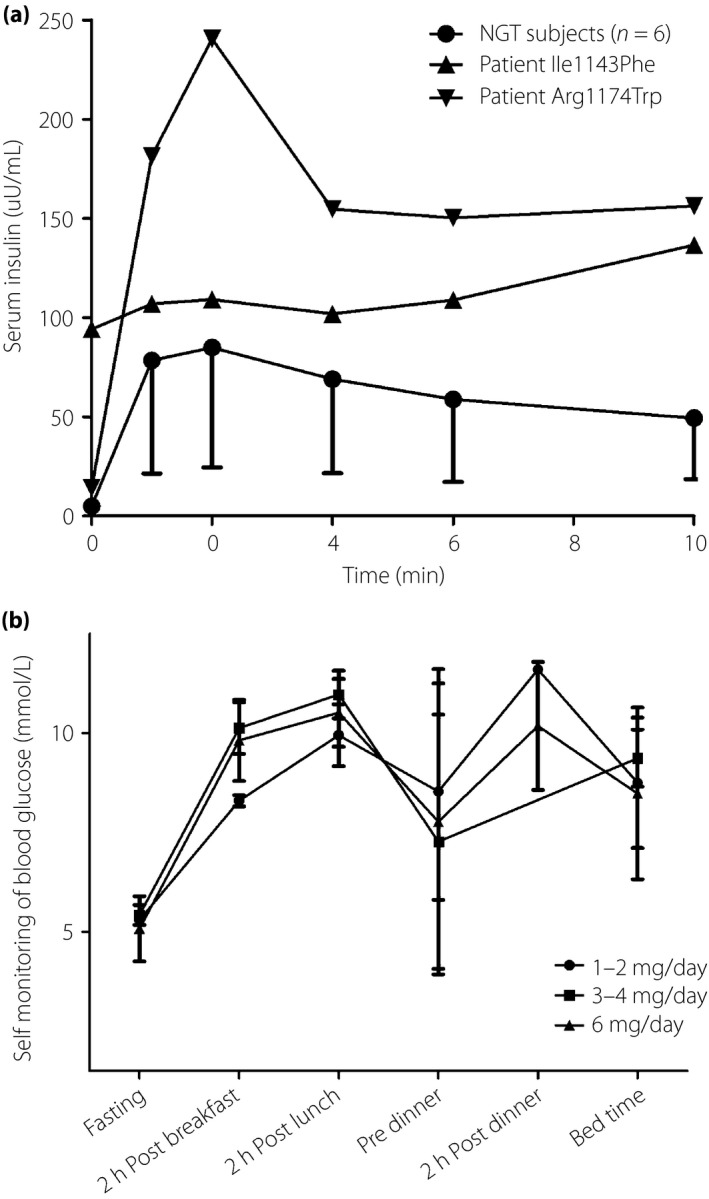
A novel heterozygous missense mutation at exon 19 (c.3427A>T) in the tyrosine kinase domain of the INSR gene was identified, causing an amino acid replacement of phenylalanine for isoleucine at codon 1143 (Ile1143Phe). Before the treatment, the patient's glycated hemoglobin was 7.0%, plasma glucose during oral glucose tolerance test was 6.7, 12.8 and 17.3 mmol/L, and simultaneous serum insulin was 80.7, 137.5 and >300 μU/mL. There were no significant differences between self-monitored blood glucose measured at each time-point among different glimepiride dosages, or during the 14 weeks when glimepiride was used at its maximal dosage (6 mg/day). Oral glucose tolerance test showed little change in plasma glucose and serum insulin. Glycated hemoglobin decreased by 0.8% after the treatment. However, a euglycemic clamp study showed that the M value decreased from 5.25 to 2.90 mg/kg/min, showing increased insulin resistance.
Treatment with glimepiride did not improve insulin sensitivity in a patient with type A insulin resistance syndrome carrying Ile1143Phe heterozygous mutation in the INSR gene. Large-scale long-term studies assembled worldwide are required to optimize treatment algorithms for patients with type A insulin resistance syndrome.
目的/引言:格列美脲是一种磺酰脲类药物,具有独特的胰岛素模拟和敏化作用。我们旨在研究格列美脲在 A 型胰岛素抵抗综合征患者中的疗效。
对一名 15 岁的 A 型胰岛素抵抗综合征患者使用格列美脲进行治疗,持续 6 个月。记录自我监测的血糖值,并在治疗期间测量口服葡萄糖耐量试验中的血糖和胰岛素。在治疗前后使用高胰岛素正葡萄糖钳夹试验评估全身胰岛素敏感性。
在 INSR 基因的外显子 19(c.3427A>T)中发现了一种新的杂合错义突变,导致 1143 密码子处的苯丙氨酸被异亮氨酸取代(Ile1143Phe)。在治疗前,患者的糖化血红蛋白为 7.0%,口服葡萄糖耐量试验中的血浆葡萄糖分别为 6.7、12.8 和 17.3mmol/L,同时血清胰岛素分别为 80.7、137.5 和>300μU/mL。不同格列美脲剂量之间,或在最大剂量(6mg/天)使用 14 周期间,不同时间点的自我监测血糖值之间没有显著差异。口服葡萄糖耐量试验显示血浆葡萄糖和血清胰岛素变化不大。治疗后糖化血红蛋白降低了 0.8%。然而,正葡萄糖钳夹试验显示 M 值从 5.25 降至 2.90mg/kg/min,表明胰岛素抵抗增加。
在携带 INSR 基因 Ile1143Phe 杂合突变的 A 型胰岛素抵抗综合征患者中,格列美脲治疗并未改善胰岛素敏感性。需要全球范围内进行大规模长期研究,以优化 A 型胰岛素抵抗综合征患者的治疗方案。