D'Souza Susan, Faraj Jabar A, Giovagnoli Stefano, DeLuca Patrick P
University of Kentucky College of Pharmacy, Lexington, KY, 40536, USA.
Sunovion Pharmaceuticals Inc, Marlborough, MA, 01752, USA.
Prog Biomater. 2014 Dec;3(2-4):131-142. doi: 10.1007/s40204-014-0029-4. Epub 2014 Dec 2.
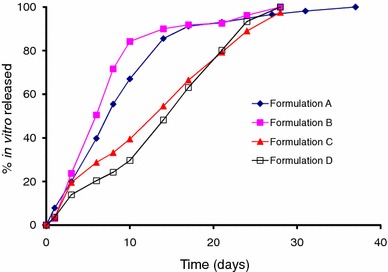
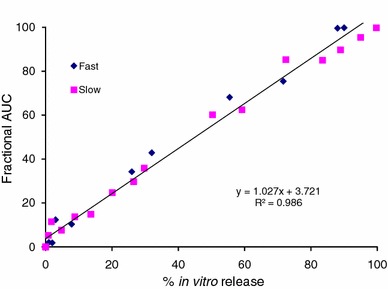
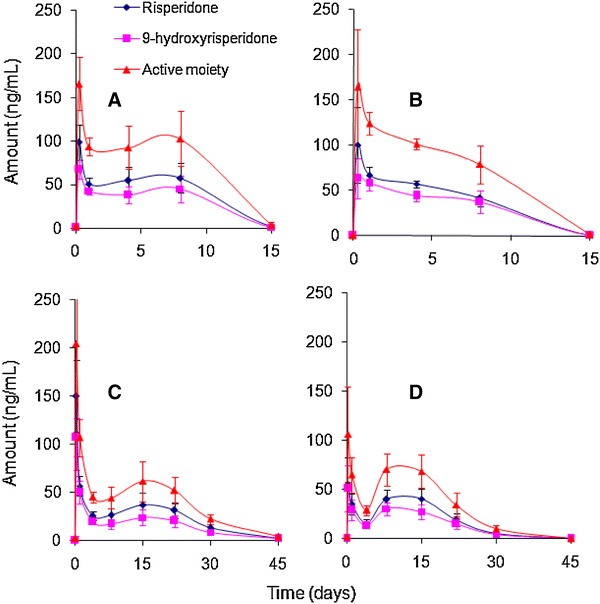
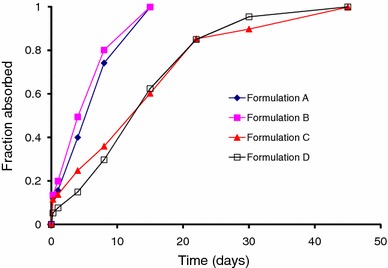
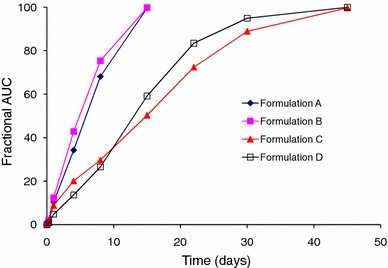
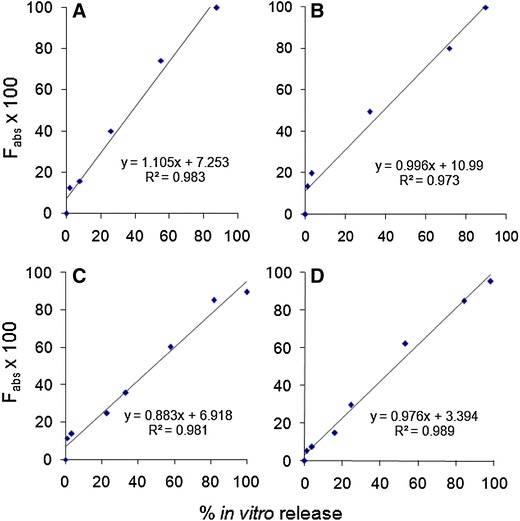
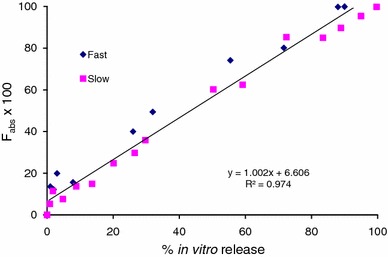
The objective of this study was to compare the in vitro behavior of four long-acting subcutaneous risperidone formulations with in vivo performance, with the intent of establishing an IVIVC. Two copolymers of PLGA (50:50 and 75:25) were used to prepare four microsphere formulations of risperidone, an atypical antipsychotic. In vitro behavior was assessed at the physiological temperature (37 °C) using the 'modified dialysis' technique. The in vitro release profile demonstrated rank order behavior with Formulations A and B, prepared using the 50:50 copolymer, exhibiting rapid drug release, while Formulations C and D, prepared using 75:25 PLGA, released drug in a slower manner. In vivo profiles were obtained by two approaches, i.e., deconvolution using the Nelson-Wagner equation (the FDA recommended approach) and using fractional AUC. With both in vivo approaches, the 50:50 PLGA preparations released drug faster than the 75:25 PLGA microspheres, exhibiting the same rank order observed in vitro. Additionally, profiles for the four formulations obtained using the deconvolution approach were nearly superimposable with fractional AUC, implying that the latter procedure could be used as a substitute for the Nelson-Wagner method. A comparison of drug release profiles for the four formulations revealed that in three of the four formulations, in vivo release was slightly faster than that in vitro, but the results were not statistically significant (P > 0.0001). An excellent linear correlation (R values between 0.97 and 0.99) was obtained when % in vitro release for each formulation was compared with its corresponding in vivo release profile, obtained by using fraction absorbed (Nelson-Wagner method) or fractional AUC. In summary, using the four formulations that exhibited different release rates, a Level A IVIVC was established using the FDA-recommended deconvolution method and fractional AUC approach. The excellent relationship between in vitro drug release and the amount of drug absorbed in vivo in this study was corroborated by the nearly 1:1 correlation (R greater than 0.97) between in vitro release and in vivo performance. Thus, the results of the current study suggest that proper selection of an in vitro method to assess drug release from long-acting injectables will aid in obtaining a Level A IVIVC.
本研究的目的是比较四种长效皮下注射利培酮制剂的体外行为与体内性能,以期建立体外-体内相关性(IVIVC)。使用两种聚乳酸-羟基乙酸共聚物(PLGA)(50:50和75:25)制备了四种非典型抗精神病药物利培酮的微球制剂。在生理温度(37°C)下,采用“改良透析”技术评估体外行为。体外释放曲线显示,使用50:50共聚物制备的制剂A和B呈现出快速释药的排序行为,而使用75:25 PLGA制备的制剂C和D则以较慢的方式释药。通过两种方法获得体内曲线,即使用Nelson-Wagner方程进行反卷积(美国食品药品监督管理局推荐的方法)和使用分数AUC。采用这两种体内方法时,50:50 PLGA制剂的释药速度均快于75:25 PLGA微球,呈现出与体外观察到的相同排序。此外,使用反卷积方法获得的四种制剂的曲线与分数AUC几乎重叠,这意味着后一种方法可替代Nelson-Wagner方法。对四种制剂的药物释放曲线进行比较后发现,在四种制剂中的三种中,体内释放略快于体外,但结果无统计学意义(P>0.0001)。当将每种制剂的体外释放百分比与其通过吸收分数(Nelson-Wagner方法)或分数AUC获得的相应体内释放曲线进行比较时,得到了极好的线性相关性(R值在0.97至0.99之间)。总之,使用表现出不同释放速率的四种制剂,采用美国食品药品监督管理局推荐的反卷积方法和分数AUC方法建立了A级IVIVC。本研究中体外药物释放与体内吸收药量之间的良好关系通过体外释放与体内性能之间近1:1的相关性(R大于0.97)得到了证实。因此,本研究结果表明,正确选择评估长效注射剂药物释放的体外方法将有助于获得A级IVIVC。