Malinowska Magdalena, Tokarz-Deptuła Beata, Deptuła Wiesław
Szczecin University, Szczecin, Poland.
Cent Eur J Immunol. 2017;42(4):399-403. doi: 10.5114/ceji.2017.72806. Epub 2017 Dec 30.
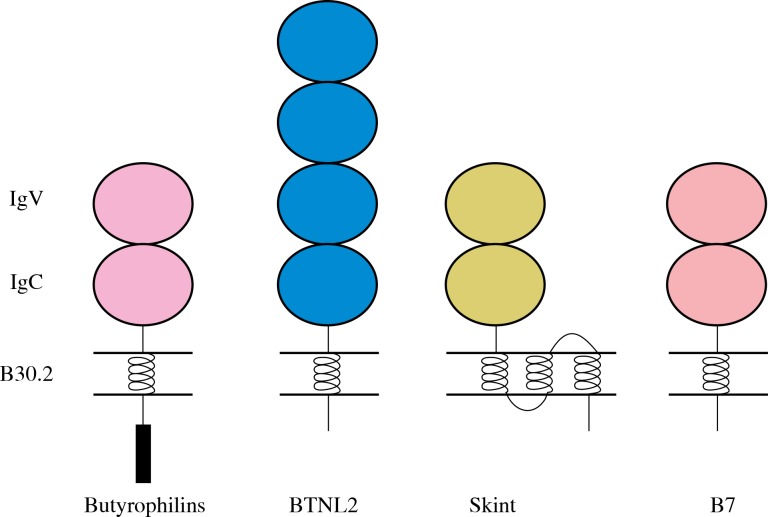
Butyrophilins belonging to the immunoglobulin superfamily are new immune system regulators because they are present on lymphocytes, dendritic cells, monocytes, macrophages, neutrophils and eosinophils, and they exert a stimulatory and (or) inhibitory effect on them. The role of butyrophilins is associated and results from their similarity to the regulatory B7 protein family involved in the modulation of immune phenomena. Butyrophilins are glycoproteins built of two extracellular immunoglobulin domains, stabilized with disulfide bonds: constant IgC, and variable IgV and a transmembrane region. Most of these proteins contain a conserved domain encoded by a single exon - B30.2, also referred to as PRYSPRY. In humans, the family of butyrophilins includes 7 butyrophilin proteins, 5 butyrophilin-like proteins and the SKINT-like factor. Butyrophilins have been also demonstrated to play a role in various infections, e.g. tuberculosis or diseases that include sarcoidosis, systemic lupus erythematosus, rheumatoid arthritis, genetic metabolic diseases, ulcerative colitis, cancer and kidney disease.
属于免疫球蛋白超家族的嗜乳脂蛋白是新型免疫系统调节因子,因为它们存在于淋巴细胞、树突状细胞、单核细胞、巨噬细胞、中性粒细胞和嗜酸性粒细胞上,并对这些细胞发挥刺激和(或)抑制作用。嗜乳脂蛋白的作用与参与免疫现象调节的B7调节蛋白家族相似,并由此产生。嗜乳脂蛋白是由两个细胞外免疫球蛋白结构域组成的糖蛋白,通过二硫键稳定:恒定的IgC、可变的IgV和一个跨膜区域。这些蛋白质中的大多数都包含一个由单个外显子编码的保守结构域——B30.2,也称为PRYSPRY。在人类中,嗜乳脂蛋白家族包括7种嗜乳脂蛋白、5种嗜乳脂蛋白样蛋白和SKINT样因子。嗜乳脂蛋白也已被证明在各种感染(如结核病)或疾病(包括结节病、系统性红斑狼疮、类风湿性关节炎、遗传性代谢疾病、溃疡性结肠炎、癌症和肾脏疾病)中发挥作用。