Shi Yu, Li Jiejing, Chen Chunjiang, Xia Yongwu, Li Yanxi, Zhang Pan, Xu Ying, Li Tingyu, Zhou Weihui, Song Weihong
Department of Clinical Laboratory, Children's Hospital of Chongqing Medical University, Chongqing, China.
Chongqing City Key Lab of Translational Medical Research in Cognitive Development and Learning and Memory Disorders and Ministry of Education Key Lab of Child Development and Disorders, Children's Hospital of Chongqing Medical University, Chongqing, China.
Front Mol Neurosci. 2018 Feb 7;11:9. doi: 10.3389/fnmol.2018.00009. eCollection 2018.
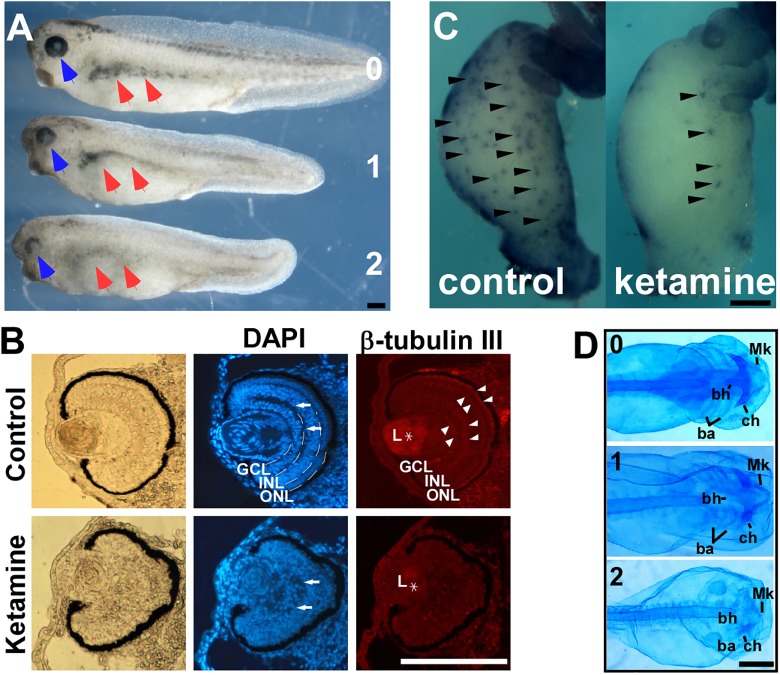
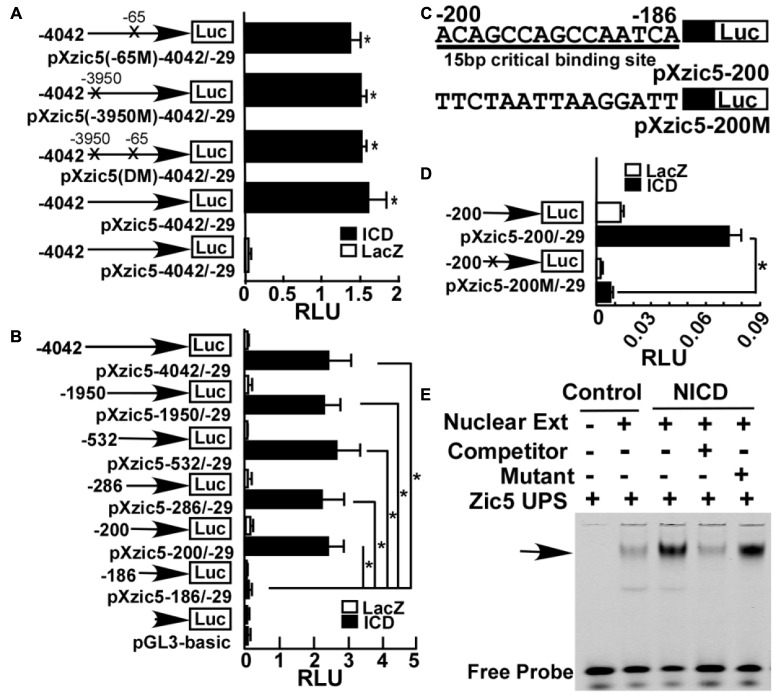
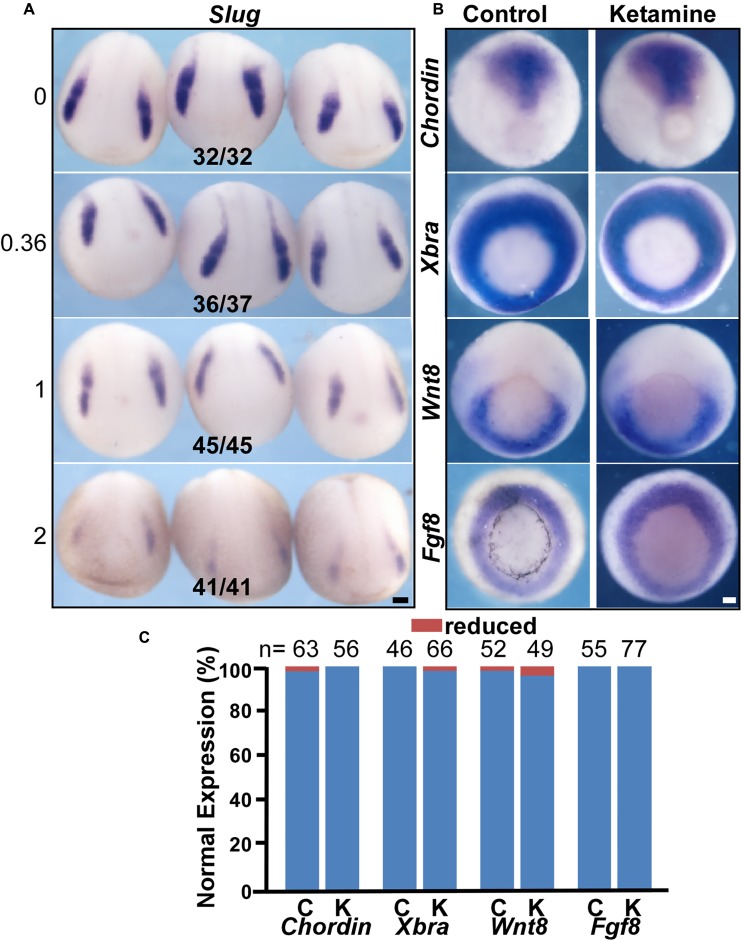
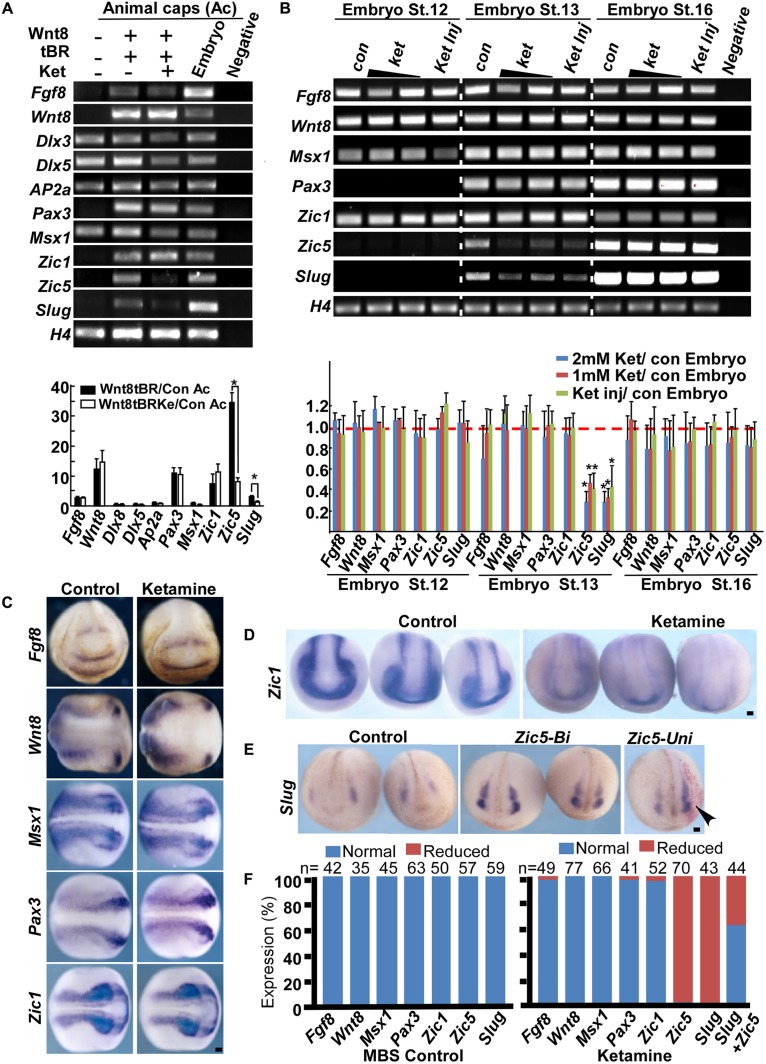
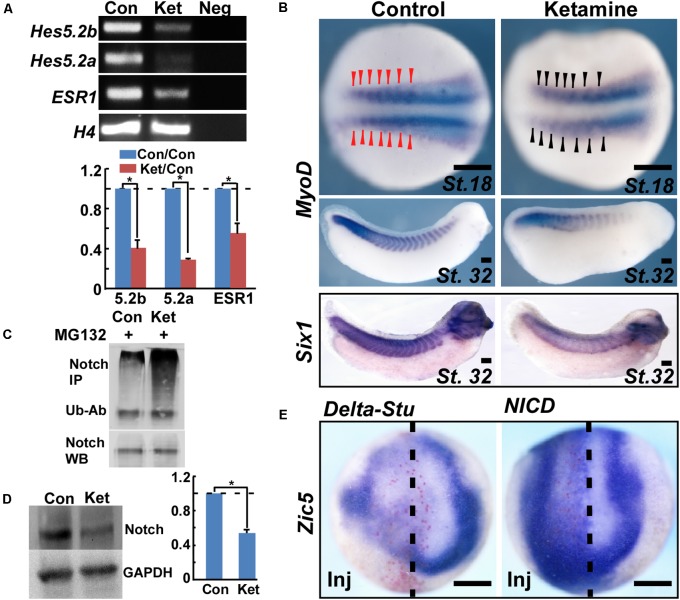
Ketamine is a potent dissociative anesthetic and the most commonly used illicit drug. Many addicts are women at childbearing age. Although ketamine has been extensively studied as a clinical anesthetic, its effects on embryonic development are poorly understood. Here, we applied the model to study the effects of ketamine on development. We found that exposure to ketamine from pre-gastrulation (stage 7) to early neural plate (stage 13.5) resulted in disruption of neural crest (NC) derivatives. Ketamine exposure did not affect mesoderm development as indicated by the normal expression of Chordin, Xbra, Wnt8, and Fgf8. However, ketamine treatment significantly inhibited Zic5 and Slug expression at early neural plate stage. Overexpression of Zic5 rescued ketamine-induced Slug inhibition, suggesting the blockage of NC induction was mediated by Zic5. Furthermore, we found Notch signaling was altered by ketamine. Ketamine inhibited the expression of Notch targeted genes including Hes5.2a, Hes5.2b, and ESR1 and ketamine-treated embryos exhibited Notch-deficient somite phenotypes. A 15 bp core binding element upstream of Zic5 was induced by Notch signaling and caused transcriptional activation. These results demonstrated that Zic5 works as a downstream target gene of Notch signaling in NC induction. Our study provides a novel teratogenic mechanism whereby ketamine disrupts NC induction via targeting a Notch-Zic5 signaling pathway.
氯胺酮是一种强效解离麻醉剂,也是最常用的非法药物。许多成瘾者是育龄妇女。尽管氯胺酮作为临床麻醉剂已被广泛研究,但其对胚胎发育的影响却知之甚少。在此,我们应用该模型研究氯胺酮对发育的影响。我们发现,从原肠胚形成前期(第7阶段)到神经板早期(第13.5阶段)暴露于氯胺酮会导致神经嵴(NC)衍生物的破坏。如Chordin、Xbra、Wnt8和Fgf8的正常表达所示,氯胺酮暴露不影响中胚层发育。然而,氯胺酮处理在神经板早期阶段显著抑制了Zic5和Slug的表达。Zic5的过表达挽救了氯胺酮诱导的Slug抑制,表明NC诱导的阻断是由Zic5介导的。此外,我们发现氯胺酮改变了Notch信号通路。氯胺酮抑制了Notch靶向基因的表达,包括Hes5.2a、Hes5.2b和ESR1,并且经氯胺酮处理的胚胎表现出Notch缺陷的体节表型。Zic5上游的一个15 bp核心结合元件由Notch信号通路诱导并导致转录激活。这些结果表明,Zic5在NC诱导中作为Notch信号通路的下游靶基因发挥作用。我们的研究提供了一种新的致畸机制,即氯胺酮通过靶向Notch-Zic5信号通路破坏NC诱导。