Division of Sports and Rehabilitation Medicine, Ulm University Medical Center, 89075, Ulm, Germany.
Institute of General Medicine, Ulm University, Helmholtzstraße 20, 89081, Ulm, Germany.
BMC Public Health. 2018 Feb 23;18(1):280. doi: 10.1186/s12889-018-5174-6.
Controversial messages of childhood obesity emerge: Levelling off in terms of body mass index (BMI) is foiled by increases in abdominal obesity. Waist-to-height ratio (WHtR) may be used as a screening tool for abdominal obesity in children. The aim of this study was to investigate clinical and socio-environmental correlates of abdominal obesity in primary schoolchildren.
Cross-sectional data from 753 children participating in baseline assessments of the outcome evaluation of a school-based prevention program were analysed. Abdominal obesity was defined as WHtR ≥0.5. According to German age and sex-specific BMI-percentiles, overweight (>90th percentile) and obesity (>97th percentile) were determined. Anthropometric and sonographic measurements, blood pressure and blood samples were taken by clinical staff in a standardized manner. Socio-environmental and lifestyle data were assessed via parental questionnaires. Differences between abdominally obese children and others, and correlations of WHtR with clinical data were tested. Socio-environmental correlates of abdominal obesity were explored in a logistic regression analysis.
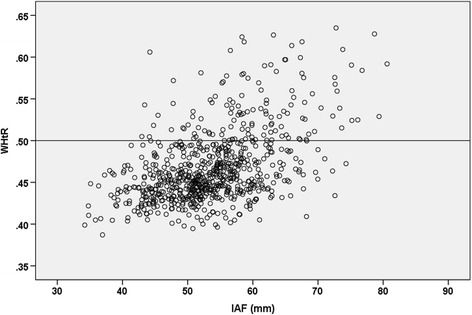
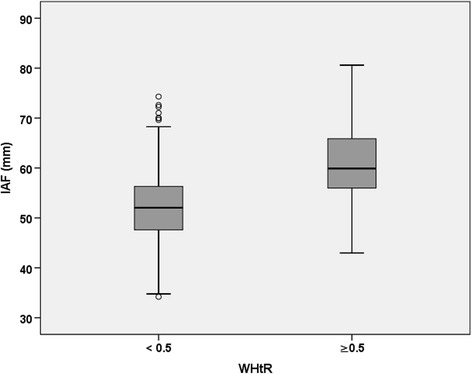
At the time of the examination children were 7.57 ± 0.42 years old. Abdominal obesity was observed in 132 (17.5%) children. According to BMI-percentiles, 22.9% of these children were obese, 38.2% overweight, and 38.2% normal weight. Affected children more often used screen media and less often participated in club sports. Abdominal obesity was associated with higher blood pressure, lower HDL- and higher LDL-cholesterol. WHtR significantly correlated with intra-abdominal fat thickness (IAF). The logistic regression model revealed migration background (odds ratio (OR) 2.12, 95% confidence interval (CI) [1.41, 3.19]), smoking during pregnancy (OR 2.30, 95% CI [1.37, 3.86]), parental obesity (OR 1.95, 95% CI [1.22, 3.10]) and higher educational level (OR 0.64, 95% CI [0.42, 0.98]) to be significantly associated with abdominal obesity in children.
WHtR correlates strongly with IAF. Abdominal obesity in primary schoolchildren is associated with cardio-metabolic risk factors and also occurs in otherwise normal weight children. Against the background of rising numbers of abdominal obesity in children, targeted preventive measures are long overdue. The focus of such measures should be used on children with migration background and involve parents, especially those who are obese and those with lower educational levels.
儿童肥胖的争议信息不断出现:身体质量指数(BMI)的水平趋于平稳,但腹部肥胖却在增加。腰高比(WHtR)可作为儿童腹部肥胖的筛查工具。本研究旨在调查小学生腹部肥胖的临床和社会环境相关性。
对参与基于学校的预防计划效果评估的基线评估的 753 名儿童的横断面数据进行分析。腹部肥胖定义为 WHtR≥0.5。根据德国年龄和性别特异性 BMI 百分位数,确定超重(>第 90 百分位数)和肥胖(>第 97 百分位数)。临床工作人员以标准化方式进行人体测量和超声测量、血压和血液样本采集。通过父母问卷评估社会环境和生活方式数据。测试了腹部肥胖儿童与其他儿童之间的差异,以及 WHtR 与临床数据的相关性。在逻辑回归分析中探讨了腹部肥胖的社会环境相关性。
在检查时,儿童年龄为 7.57±0.42 岁。132 名(17.5%)儿童存在腹部肥胖。根据 BMI 百分位数,其中 22.9%的儿童肥胖,38.2%超重,38.2%体重正常。受影响的儿童更多地使用屏幕媒体,更少地参加俱乐部运动。腹部肥胖与较高的血压、较低的高密度脂蛋白胆固醇和较高的低密度脂蛋白胆固醇有关。WHtR 与腹腔内脂肪厚度(IAF)显著相关。逻辑回归模型显示,移民背景(比值比(OR)2.12,95%置信区间(CI)[1.41,3.19])、怀孕期间吸烟(OR 2.30,95% CI [1.37,3.86])、父母肥胖(OR 1.95,95% CI [1.22,3.10])和较高的教育水平(OR 0.64,95% CI [0.42,0.98])与儿童腹部肥胖显著相关。
WHtR 与 IAF 密切相关。小学生腹部肥胖与心血管代谢危险因素有关,即使在体重正常的儿童中也会发生。在儿童腹部肥胖人数不断增加的背景下,急需采取有针对性的预防措施。此类措施的重点应针对有移民背景的儿童,并应涉及父母,尤其是肥胖和教育程度较低的父母。