Wills Eye Hospital, Philadelphia, PA, USA.
Birmingham City Hospital, Birmingham, UK.
Adv Ther. 2018 Mar;35(3):395-407. doi: 10.1007/s12325-018-0666-4. Epub 2018 Feb 23.
This study evaluates long-term outcomes of two trabecular micro-bypass stents, one suprachoroidal stent, and postoperative prostaglandin in eyes with refractory open angle glaucoma (OAG).
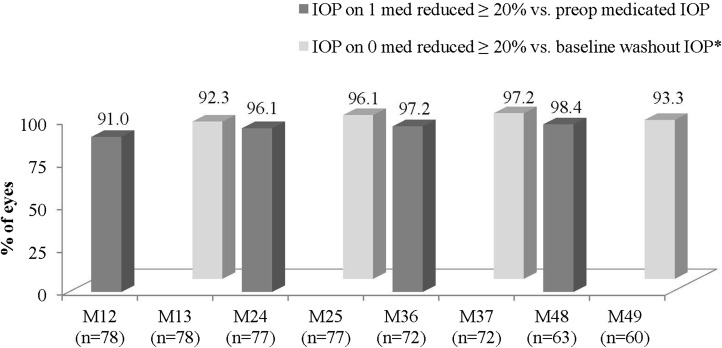
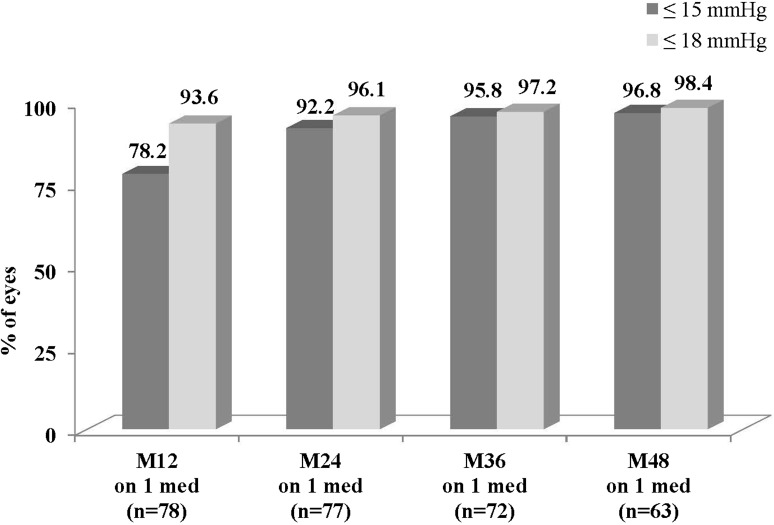
Prospective ongoing 5-year study of 80 eligible subjects (70 with 4-year follow-up) with OAG and IOP ≥ 18 mmHg after prior trabeculectomy and while taking 1-3 glaucoma medications. Subjects received two iStent trabecular micro-bypass stents, one iStent Supra suprachoroidal stent, and postoperative travoprost. Postoperative IOP was measured with medication and annually following medication washouts. Performance was measured by the proportion of eyes with ≥ 20% IOP reduction on one medication (the protocol-specified prostaglandin) versus preoperative medicated IOP (primary outcome); and the proportion of eyes with postoperative IOP ≤ 15 and ≤ 18 mmHg on one medication (secondary outcome). Additional clinical and safety data included medications, visual field, pachymetry, gonioscopy, adverse events, visual acuity, and slit-lamp and fundus examinations.
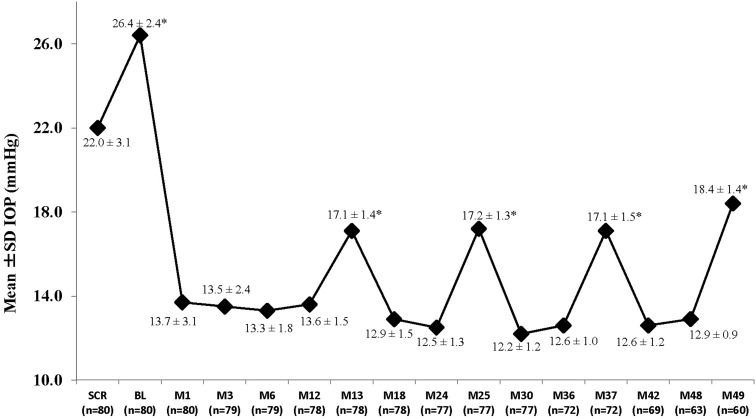
Preoperatively, mean medicated IOP was 22.0 ± 3.1 mmHg on 1.2 ± 0.4 medications, and mean unmedicated IOP was 26.4 ± 2.4 mmHg. Postoperatively, among eyes without later cataract surgery, mean medicated IOP at all visits through 48 months was ≤ 13.7 mmHg (≥ 37% reduction), and annual unmedicated IOP was ≤ 18.4 mmHg (reductions of ≥ 30% vs. preoperative unmedicated IOP and ≥ 16% vs. preoperative medicated IOP). At all postoperative visits among eyes without additional surgery or medication, ≥ 91% of eyes had ≥ 20% IOP reduction on one medication versus preoperative medicated IOP. At month 48, 97 and 98% of eyes achieved IOP ≤ 15 and ≤ 18 mmHg, respectively, on one medication. Six eyes required additional medication, no eyes required additional glaucoma surgery, and safety measurements were favorable throughout follow-up.
IOP control was achieved safely with two trabecular micro-bypass stents, one suprachoroidal stent, and postoperative prostaglandin. This microinvasive, ab interno approach introduces a possible new treatment option for refractory disease.
NCT01456390.
Glaukos Corporation.
本研究评估了两种小梁微分流支架、一种脉络膜上支架和术后前列腺素在难治性开角型青光眼(OAG)患者中的长期疗效。
前瞻性、正在进行的 5 年研究纳入了 80 名符合条件的 OAG 患者(70 名患者有 4 年随访),这些患者在接受小梁切除术和 1-3 种青光眼药物治疗后,眼压(IOP)仍≥18mmHg。所有患者均接受了 2 个 iStent 小梁微分流支架、1 个 iStent Supra 脉络膜上支架和术后曲伏前列素治疗。术后使用药物治疗,并在停药后每年测量眼压。通过比较(1)使用一种药物(规定的前列腺素)后眼压较术前用药时降低≥20%的眼比例(主要结局);(2)使用一种药物后眼压≤15mmHg 和≤18mmHg 的眼比例(次要结局),评估治疗效果。此外,还记录了其他临床和安全性数据,包括药物、视野、角膜厚度、房角镜检查、不良事件、视力、裂隙灯和眼底检查结果。
术前,平均用药眼压为 22.0±3.1mmHg,用药 1.2±0.4 种;平均未用药眼压为 26.4±2.4mmHg。术后,在未接受白内障手术的眼,所有随访至 48 个月时,平均用药眼压均≤13.7mmHg(降低≥37%),且每年未用药眼压均≤18.4mmHg(较术前未用药眼压降低≥30%,较术前用药眼压降低≥16%)。在所有未接受额外手术或药物治疗的眼,术后各随访时间点,使用一种药物后眼压较术前用药时降低≥20%的眼比例≥91%。术后 48 个月,分别有 97%和 98%的眼眼压可通过一种药物控制在≤15mmHg 和≤18mmHg。有 6 只眼需要加用药物治疗,无眼需要行额外的青光眼手术,且整个随访过程中安全性指标均良好。
通过植入两种小梁微分流支架、一种脉络膜上支架和术后前列腺素,可以安全地控制眼压。这种微创、经内路的方法为难治性疾病提供了一种新的治疗选择。
NCT01456390。
Glaukos 公司。