Department of Integrative Bioscience and Biotechnology, Pohang University of Science and Technology, Pohang, Korea.
Institute of Plant Science and Resources, Okayama University, Kurashiki, Japan.
Plant Biotechnol J. 2018 Oct;16(10):1691-1699. doi: 10.1111/pbi.12905. Epub 2018 Mar 25.
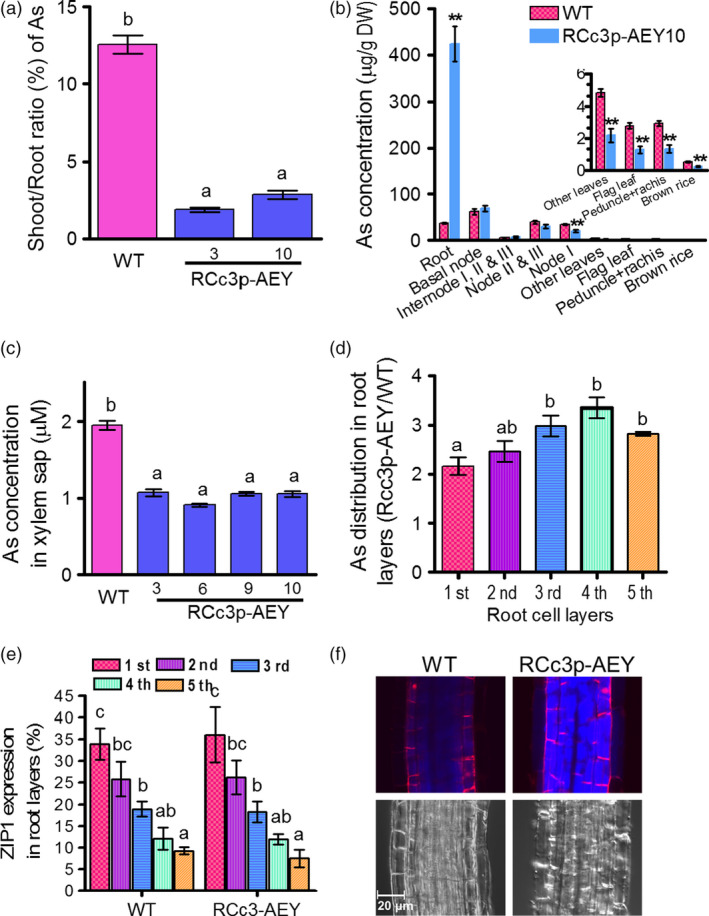
Arsenic (As) is a poisonous element that causes severe skin lesions and cancer in humans. Rice (Oryza sativa L.) is a major dietary source of As in humans who consume this cereal as a staple food. We hypothesized that increasing As vacuolar sequestration would inhibit its translocation into the grain and reduce the amount of As entering the food chain. We developed transgenic rice plants expressing two different vacuolar As sequestration genes, ScYCF1 and OsABCC1, under the control of the RCc3 promoter in the root cortical and internode phloem cells, along with a bacterial γ-glutamylcysteine synthetase driven by the maize UBI promoter. The transgenic rice plants exhibited reduced root-to-shoot and internode-to-grain As translocation, resulting in a 70% reduction in As accumulation in the brown rice without jeopardizing agronomic traits. This technology could be used to reduce As intake, particularly in populations of South East Asia suffering from As toxicity and thereby improve human health.
砷(As)是一种有毒元素,会导致人类严重的皮肤损伤和癌症。大米(Oryza sativa L.)是人类摄入的主要砷来源,因为大米是这些地区的主食。我们假设增加砷的液泡隔离会抑制其向谷物中的转移,并减少进入食物链的砷含量。我们开发了在根皮层和节间韧皮部细胞中表达两种不同液泡砷隔离基因 ScYCF1 和 OsABCC1 的转基因水稻植物,其表达受 RCc3 启动子的控制,同时还表达了由玉米 UBI 启动子驱动的细菌γ-谷氨酰半胱氨酸合成酶。转基因水稻植物表现出减少的根到茎和节间到谷物的砷转移,导致糙米中砷积累减少 70%,而不会危及农艺性状。这项技术可用于减少砷的摄入,特别是在遭受砷毒性的东南亚人群中,从而改善人类健康。