Hernandez Cordero Ana I, Carbonetto Peter, Riboni Verri Gioia, Gregory Jennifer S, Vandenbergh David J, P Gyekis Joseph, Blizard David A, Lionikas Arimantas
School of Medicine, Medical Sciences and Nutrition, University of Aberdeen, Aberdeen, United Kingdom.
Research Computing Center and Department of Human Genetics, University of Chicago, Chicago, Illinois.
Physiol Rep. 2018 Feb;6(4). doi: 10.14814/phy2.13561.
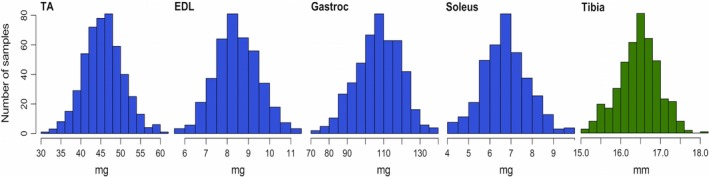
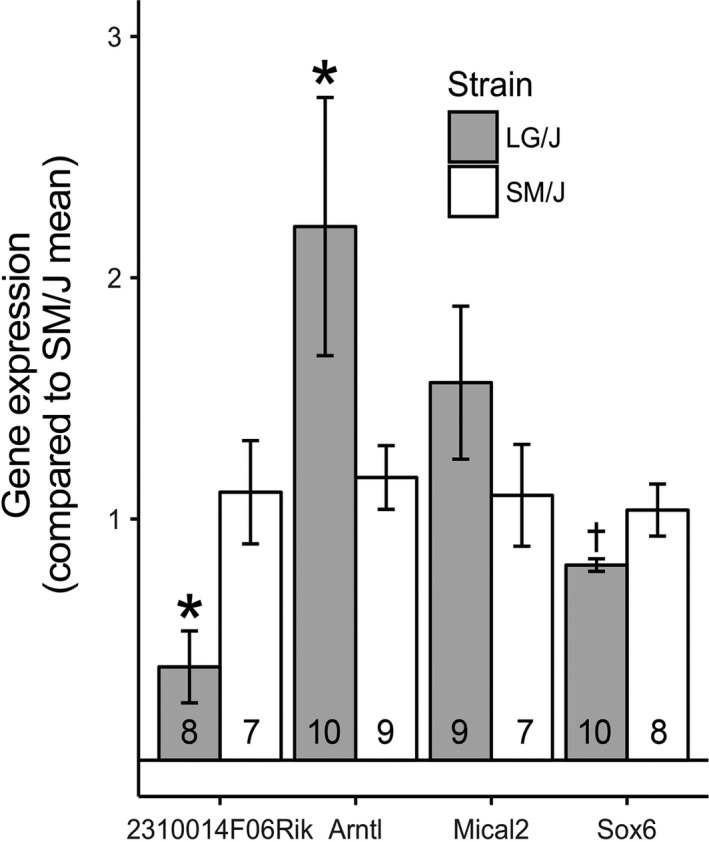
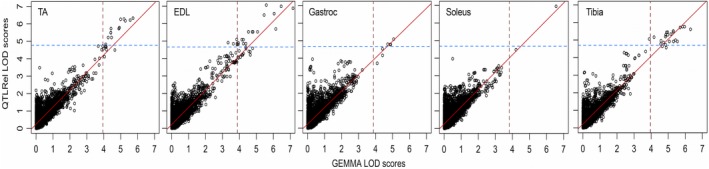
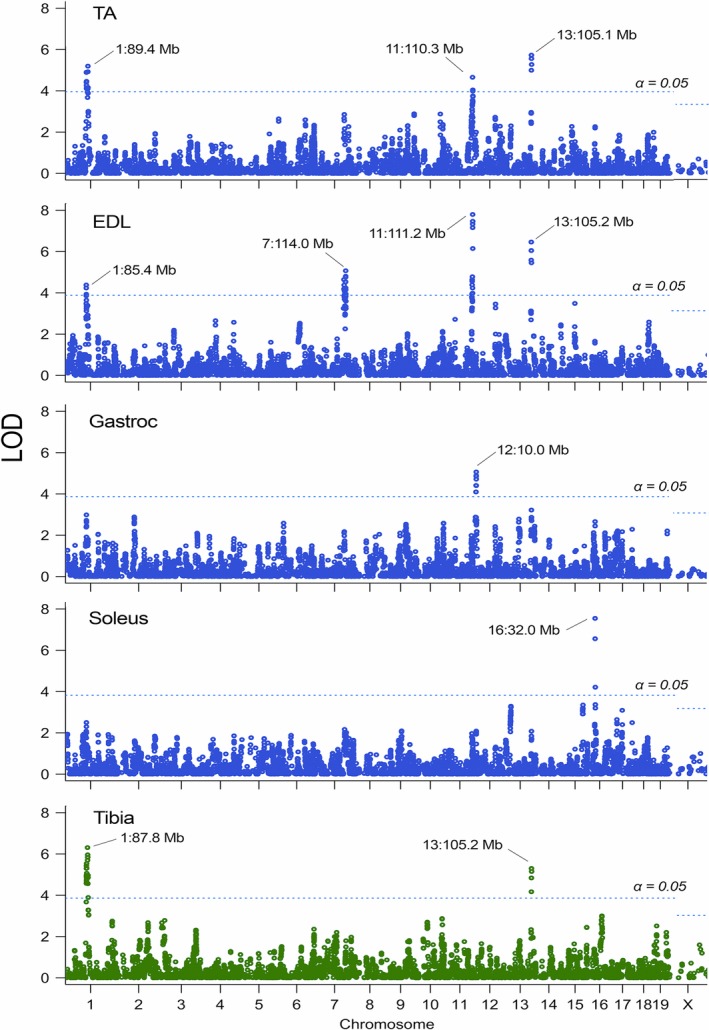
The genetics underlying variation in health-related musculoskeletal phenotypes can be investigated in a mouse model. Quantitative trait loci (QTLs) affecting musculoskeletal traits in the LG/J and SM/J strain lineage remain to be refined and corroborated. The aim of this study was to map muscle and bone traits in males (n = 506) of the 50th filial generation of advanced intercross lines (LG/SM AIL) derived from the two strains. Genetic contribution to variation in all musculoskeletal traits was confirmed; the SNP heritability of muscle mass ranged between 0.46 and 0.56; and the SNP heritability of tibia length was 0.40. We used two analytical software, GEMMA and QTLRel, to map the underlying QTLs. GEMMA required substantially less computation and recovered all the QTLs identified by QTLRel. Seven significant QTLs were identified for muscle weight (Chr 1, 7, 11, 12, 13, 15, and 16), and two for tibia length, (Chr 1 and 13). Each QTL explained 4-5% of phenotypic variation. One muscle and both bone loci replicated previous findings; the remaining six were novel. Positional candidates for the replicated QTLs were prioritized based on in silico analyses and gene expression in muscle tissue. In summary, we replicated existing QTLs and identified novel QTLs affecting muscle weight, and replicated bone length QTLs in LG/SM AIL males. Heritability estimates substantially exceed the cumulative effect of the QTLs, hence a richer genetic architecture contributing to muscle and bone variability could be uncovered with a larger sample size.
健康相关肌肉骨骼表型变异的潜在遗传学可在小鼠模型中进行研究。影响LG/J和SM/J品系谱系中肌肉骨骼性状的数量性状基因座(QTL)仍有待完善和确证。本研究的目的是对源自这两个品系的第50代高级杂交系(LG/SM AIL)雄性小鼠(n = 506)的肌肉和骨骼性状进行定位。证实了所有肌肉骨骼性状变异的遗传贡献;肌肉质量的SNP遗传力在0.46至0.56之间;胫骨长度的SNP遗传力为0.40。我们使用了两种分析软件GEMMA和QTLRel来定位潜在的QTL。GEMMA所需的计算量大幅减少,并找回了QTLRel识别出的所有QTL。确定了7个影响肌肉重量的显著QTL(位于第1、7、11、12、13、15和16号染色体),以及2个影响胫骨长度的QTL(位于第1和13号染色体)。每个QTL解释了4-5%的表型变异。一个肌肉和两个骨骼基因座重复了先前的发现;其余六个是新发现的。根据计算机分析和肌肉组织中的基因表达,对重复QTL的位置候选基因进行了优先排序。总之,我们在LG/SM AIL雄性小鼠中重复了现有的QTL并鉴定出影响肌肉重量的新QTL,以及重复了骨骼长度QTL。遗传力估计值大大超过了QTL的累积效应,因此,通过更大的样本量可能会发现更丰富的导致肌肉和骨骼变异性的遗传结构。