Departamento de Parasitologia, Instituto de Ciências Biológicas, Universidade Federal de Minas Gerais, Belo Horizonte, Brazil.
Departamento de Patologia Geral, Instituto de Ciências Biológicas, Universidade Federal de Minas Gerais, Belo Horizonte, Brazil.
Parasit Vectors. 2018 Feb 27;11(1):113. doi: 10.1186/s13071-018-2710-2.
Angiostrongylus vasorum has different freshwater aquatic and terrestrial gastropod molluscs as an intermediate host, e.g. Arion spp. The mollusc Achatina fulica is a danger to public health, given the large diversity of nematodes utilizing it as an intermediate host, such as the parasites of the genus Angiostrongylus, of importance in human and veterinary medicine. Achatina fulica has been shown to have an excellent capacity for maintaining outbreaks and natural infections with A. cantonensis in Asia. Within the mollusc, the nematode parasites activate haemocytes and/or haemolymph factors and in some invertebrates, phenoloxidase (PO), that induces the release of toxic elements and eliminates the parasites. Despite the importance of A. fulica in the life-cycle of nematodes, little is known regarding the defence mechanisms involving PO in molluscs infected with nematodes. Here, the presence of PO and nitric oxide (NO) in the haemolymph and haemocytes of A. fulica infected with first-stage (L1) larvae of Angiostrongylus vasorum was evaluated, together with the presence of melanin in the cephalopod mollusc tissue.
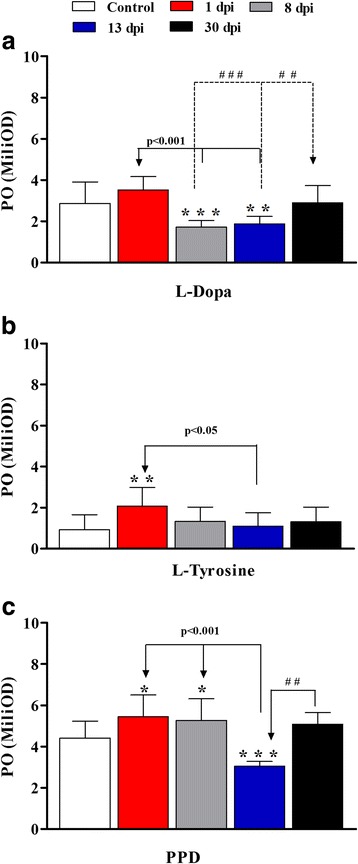
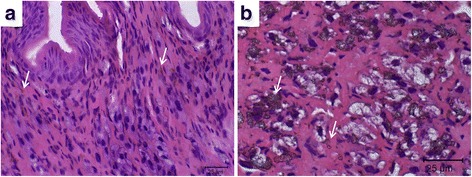
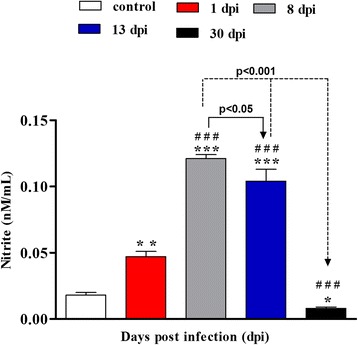
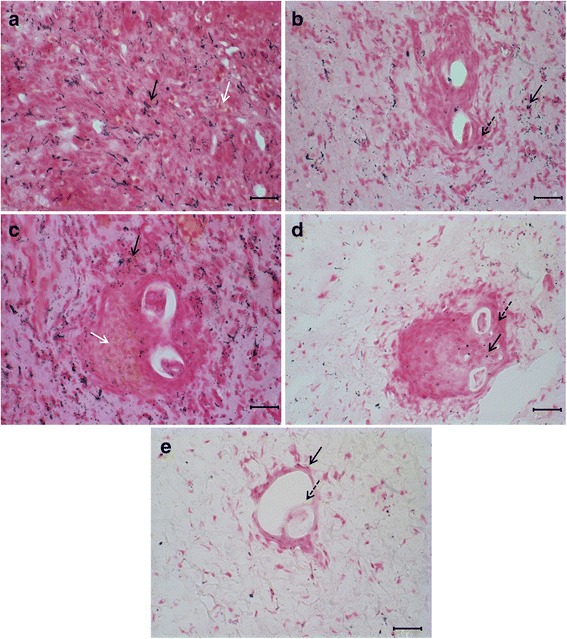
An increase in PO at one day post infection (dpi), in comparison with the control using the substrates L-tyrosine (F = 6.73, P = 0.00006), L-DOPA (F = 22.67, P = 0.02) and p-phenylenediamine (PPD) (F = 27.58, P = 0.0019), was observed. PO increase coincided with the presence of melanin in the cephalopodal tissue. At 8 dpi, PO activity, compared to L-DOPA (F = 22.67, P = 0.00002) and PPD (F = 27.58, P = 0.079) decreased, while melanin increased. At 13 dpi, PO decreased with PPD (F = 27.58, P = 0.000015) and also the amount of melanin observed in histology. At 30 dpi, PO increased along with the substrates L-DOPA and PPD, while melanin decreased. NO levels increased until 8 dpi, and decreased after 13 dpi.
To our knowledge, this is the first study that illustrates PO activity in a helminth-infected A. fulica and provides the first observation of an L-tyrosine dependent PO activity in molluscs infected with A. vasorum. This work suggests that PO pathway may help to control A. vasorum infection in A. fulica.
血管圆线虫有不同的淡水水生和陆生腹足纲软体动物作为中间宿主,例如 Arion 属。蜗牛 Achatina fulica 对公共健康构成威胁,因为有大量的线虫利用它作为中间宿主,例如在人类和兽医医学中很重要的血管圆线虫属寄生虫。在亚洲,已证明 Achatina fulica 具有维持盘尾丝虫病和自然感染的出色能力。在软体动物中,线虫寄生虫激活血球和/或血淋巴因子,在某些无脊椎动物中,酚氧化酶(PO)会诱导有毒元素的释放并消除寄生虫。尽管 Achatina fulica 在线虫的生命周期中很重要,但对于感染线虫的软体动物中涉及 PO 的防御机制知之甚少。在这里,评估了感染血管圆线虫第一阶段(L1)幼虫的 Achatina fulica 的血淋巴和血细胞中 PO 和一氧化氮(NO)的存在情况,以及头足类软体动物组织中黑色素的存在情况。
与使用 L-酪氨酸(F=6.73,P=0.00006)、L-DOPA(F=22.67,P=0.02)和对苯二胺(PPD)(F=27.58,P=0.0019)作为底物相比,感染后第 1 天(dpi)PO 增加。观察到 PO 增加与头足类组织中黑色素的存在一致。在第 8 dpi 时,与 L-DOPA(F=22.67,P=0.00002)和 PPD(F=27.58,P=0.079)相比,PO 活性降低,而黑色素增加。在第 13 dpi 时,PO 随 PPD(F=27.58,P=0.000015)和组织学中观察到的黑色素量减少而减少。在第 30 dpi 时,PO 随 L-DOPA 和 PPD 增加,而黑色素减少。NO 水平一直增加到第 8 dpi,然后在第 13 dpi 后下降。
据我们所知,这是第一项阐明感染 A. vasorum 的 A. fulica 中 PO 活性的研究,并首次观察到 A. vasorum 感染的软体动物中依赖 L-酪氨酸的 PO 活性。这项工作表明,PO 途径可能有助于控制 A. vasorum 感染 A. fulica。