Department of Anatomy and Neurobiology, University of Maryland School of Medicine, 22 Penn Street HSFII-S259, Baltimore, MD 21201 USA.
Mol Autism. 2018 Feb 22;9:13. doi: 10.1186/s13229-018-0196-6. eCollection 2018.
Met receptor tyrosine kinase regulates neurogenesis, differentiation, migration, connectivity, and synaptic plasticity. The human gene has been identified as a prominent risk factor for autism spectrum disorder (ASD). Met gene-altered mice serve as useful models for mechanistic studies of ASD. Inactivation of in excitatory cortical neurons in mice ( mice) yields a phenotype in which significantly decreased GABA receptor-mediated inhibition shifts the excitation/inhibition (E/I) balance toward excitation in the somatosensory cortex. Further, unlike that seen in wild-type mice, insulin does not increase inhibition in the mutant cortex, suggesting that one of the consequences of kinase inactive gene could be desensitization of insulin receptors. To test this hypothesis, we investigated the effects of insulin receptor sensitizer, pioglitazone, on inhibition in the somatosensory thalamocortical circuitry.
We used whole-cell patch clamp electrophysiology and analyzed excitatory and inhibitory responses of cortical layer IV excitatory cells following stimulation of their thalamic input in thalamocortical pathway intact brain slices. We applied insulin alone and insulin + a thiazolidinedione, pioglitazone (PIO), to test the effects of sensitizing insulin receptors on inhibitory responses mediated by GABA receptors in the somatosensory cortex of mice.
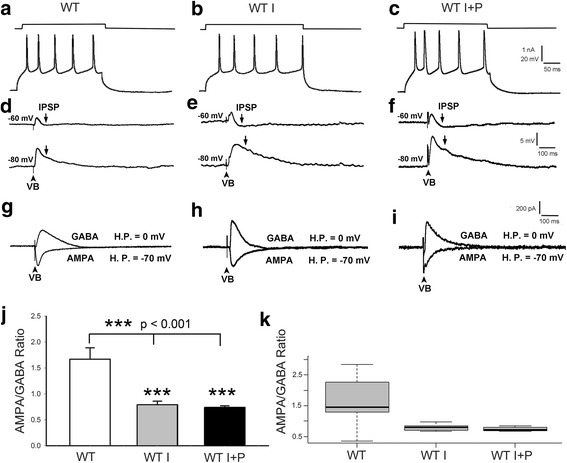
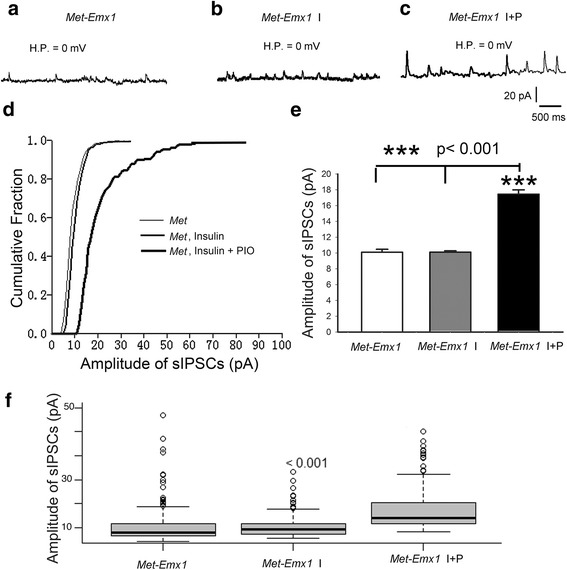
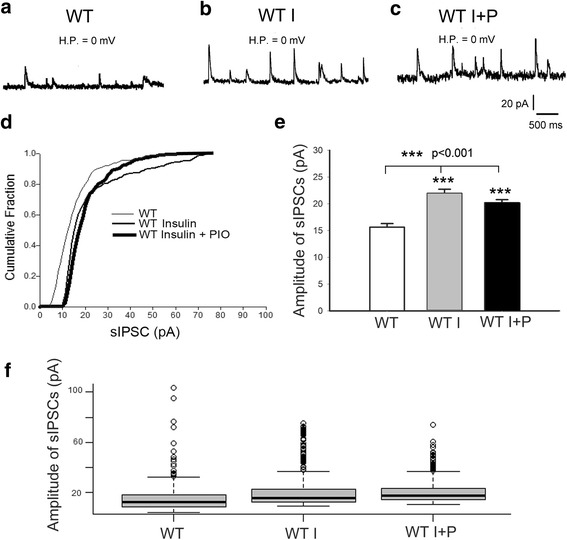
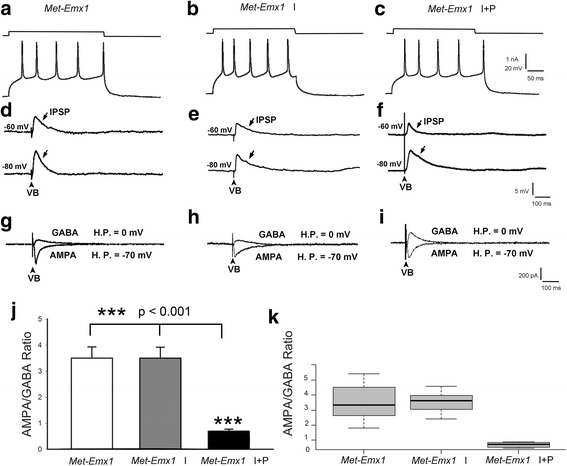
In WT brain slices, application of insulin together with PIO did not enhance the effect of insulin alone. In contrast, PIO application induced a much larger inhibition than that of insulin alone in -defective cortex. Thus, insulin resistance of GABA receptor-mediated response in mutant mice may result from desensitized insulin receptors.
Sporadic clinical studies reported improved behavioral symptoms in children with autism following PIO treatment. We show that PIO can aid in normalization of the E/I balance in the primary somatosensory cortex, a potential physiological mechanism underlying the positive effects of PIO treatment.
Met 受体酪氨酸激酶调节神经发生、分化、迁移、连接和突触可塑性。人类基因已被确定为自闭症谱系障碍(ASD)的主要风险因素。Met 基因改变的小鼠可作为 ASD 机制研究的有用模型。在小鼠兴奋性皮质神经元中失活(Met 基因敲除小鼠)会产生一种表型,其中 GABA 受体介导的抑制显著减少,导致体感皮层中的兴奋/抑制(E/I)平衡向兴奋转移。此外,与野生型小鼠不同的是,胰岛素不会增加突变皮质中的抑制,这表明激酶失活 Met 基因的后果之一可能是胰岛素受体脱敏。为了验证这一假设,我们研究了胰岛素受体敏化剂吡格列酮对体感丘脑皮质回路抑制的影响。
我们使用全细胞膜片钳电生理学技术,在完整的丘脑皮质通路脑片中,通过刺激其丘脑输入,分析皮质第 IV 层兴奋性细胞的兴奋性和抑制性反应。我们单独应用胰岛素和胰岛素+噻唑烷二酮吡格列酮(PIO),以测试敏化胰岛素受体对体感皮质中 GABA 受体介导的抑制反应的影响。
在 WT 脑片中,胰岛素与 PIO 一起应用不会增强胰岛素的单独作用。相比之下,在 Met 缺陷皮质中,PIO 应用诱导的抑制作用比胰岛素单独应用大得多。因此,Met 突变小鼠 GABA 受体介导的反应胰岛素抵抗可能是由于胰岛素受体脱敏所致。
偶发的临床研究报告称,自闭症儿童在接受吡格列酮治疗后行为症状有所改善。我们表明,PIO 可以帮助正常化初级体感皮层的 E/I 平衡,这是 PIO 治疗产生积极效果的潜在生理机制。