Hoshikawa Masako, Uchida Sunao, Hirano Yuichi
Department of Sport Research, Japan Institute of Sport Sciences, 3-15-1 Nishigaoka, Kita-ku, Tokyo, 115-0056, Japan.
Faculty of Sport Sciences, Waseda University, Mitakajima, Tokorozawa, Saitama, Japan.
Sports Med Open. 2018 Feb 26;4(1):10. doi: 10.1186/s40798-018-0122-7.
The amount, quality, and timing of sleep are considered important for athletes' ability to train, maximize training responses, and recover. However, some research has shown that elite athletes do not obtain sufficient sleep. Based on this background, researchers recently started to assess and manage sleep in elite athletes. The purpose of this study was to clarify the prevalence of poor sleep quality and its associated factors amongst elite Japanese athletes.
Eight hundred and ninety-one candidates for the 17th Asian Games Incheon 2014, who were over 20 years old, participated in this study. They completed a questionnaire that included the Pittsburgh Sleep Quality Index (PSQI), Epworth Sleepiness Scale, two-question case-finding instruments, and a checklist for sleep hygiene. Data from 817 of the 891 athletes (91.7%) with no missing values were analyzed.
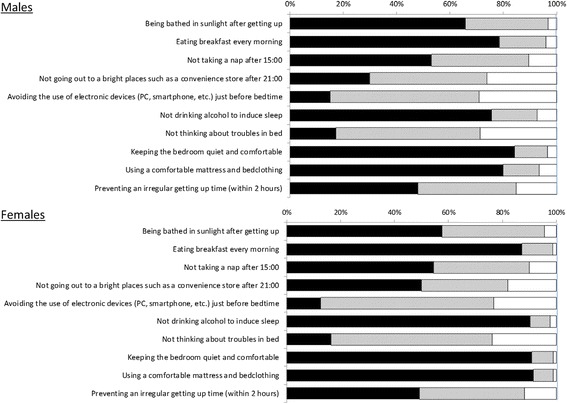
The mean time in bed was 7 h and 29 min. Two hundred and twenty-nine (28.0%) athletes showed a PSQI global score above the clinical criteria. A multiple logistic analysis revealed that sleep quality was significantly associated with five factors: "time in bed," "eating breakfast every morning," "avoiding the use of electronic devices (PC, smartphone, etc.) just before bedtime," "depressive mood", and "not thinking about troubles while in bed." Forty percent of athletes reported they had been informed by someone about "snoring loudly" and/or "leg twitching or jerking during sleep."
The results of this study demonstrate that 28% of the athletes showed the PSQI score above the cutoff for poor sleep quality (> 5.5), which suggests that there may be a high prevalence of poor sleep quality in this population of athletes. To improve athletes' sleep, the five factors associated with sleep quality should be emphasized in athletes' sleep education. Furthermore, in medical evaluations of athletes, it may be desirable to include screening for sleep disorders.
睡眠的时长、质量和时间安排被认为对运动员的训练能力、使训练反应最大化以及恢复能力至关重要。然而,一些研究表明,优秀运动员并未获得充足的睡眠。基于这一背景,研究人员最近开始评估和管理优秀运动员的睡眠。本研究的目的是阐明日本优秀运动员中睡眠质量差的患病率及其相关因素。
891名20岁以上的2014年第17届仁川亚运会参赛候选人参与了本研究。他们完成了一份问卷,其中包括匹兹堡睡眠质量指数(PSQI)、爱泼华嗜睡量表、两个问题的病例发现工具以及一份睡眠卫生检查表。对891名运动员中817名(91.7%)无缺失值的数据进行了分析。
平均卧床时间为7小时29分钟。229名(28.0%)运动员的PSQI总分高于临床标准。多因素逻辑分析显示,睡眠质量与五个因素显著相关:“卧床时间”、“每天吃早餐”、“睡前避免使用电子设备(电脑、智能手机等)”、“抑郁情绪”以及“卧床时不想烦心事”。40%的运动员报告称有人告知他们“打鼾声大”和/或“睡眠时腿部抽搐或颤动”。
本研究结果表明,28%的运动员PSQI得分高于睡眠质量差的临界值(>5.5),这表明该运动员群体中睡眠质量差的患病率可能较高。为改善运动员的睡眠,应在运动员的睡眠教育中强调与睡眠质量相关的五个因素。此外,在对运动员的医学评估中,可能需要纳入睡眠障碍筛查。