Cancer Biology & Epigenetics Group-Research Center (CI-IPOP), Research Center-LAB 3, Portuguese Oncology Institute of Porto (IPO Porto), F Bdg, 1st Floor, Rua Dr António Bernardino de Almeida, 4200-072, Porto, Portugal.
Departments of Pathology, Portuguese Oncology Institute of Porto (IPO Porto), Porto, Portugal.
J Transl Med. 2018 Feb 27;16(1):45. doi: 10.1186/s12967-018-1415-9.
Colorectal cancer (CRC) is one of the most incident cancers, associated with significant morbidity and mortality, and usually classified into three main molecular pathways: chromosomal instability, microsatellite instability (MSI) and CpG island methylator phenotype (CIMP). Currently, available screening methods are either costly or of limited specificity, impairing global implementation. More cost-effective strategies, including DNA methylation-based tests, might prove advantageous. Although some are already available, its performance is suboptimal, entailing the need for better candidate biomarkers. Herein, we tested whether combined use of APC, IGF2, MGMT, RASSF1A, and SEPT9 promoter methylation might accurately detect CRC irrespective of molecular subtype.
Selected genes were validated using formalin-fixed paraffin-embedded tissues from 214 CRC and 50 non-malignant colorectal mucosae (CRN). Promoter methylation levels were assessed using real-time quantitative methylation-specific PCR. MSI and CIMP status were determined. Molecular data were correlated with standard clinicopathological features. Diagnostic and prognostic performances were evaluated by receiver operator characteristics curve and survival analyses, respectively.
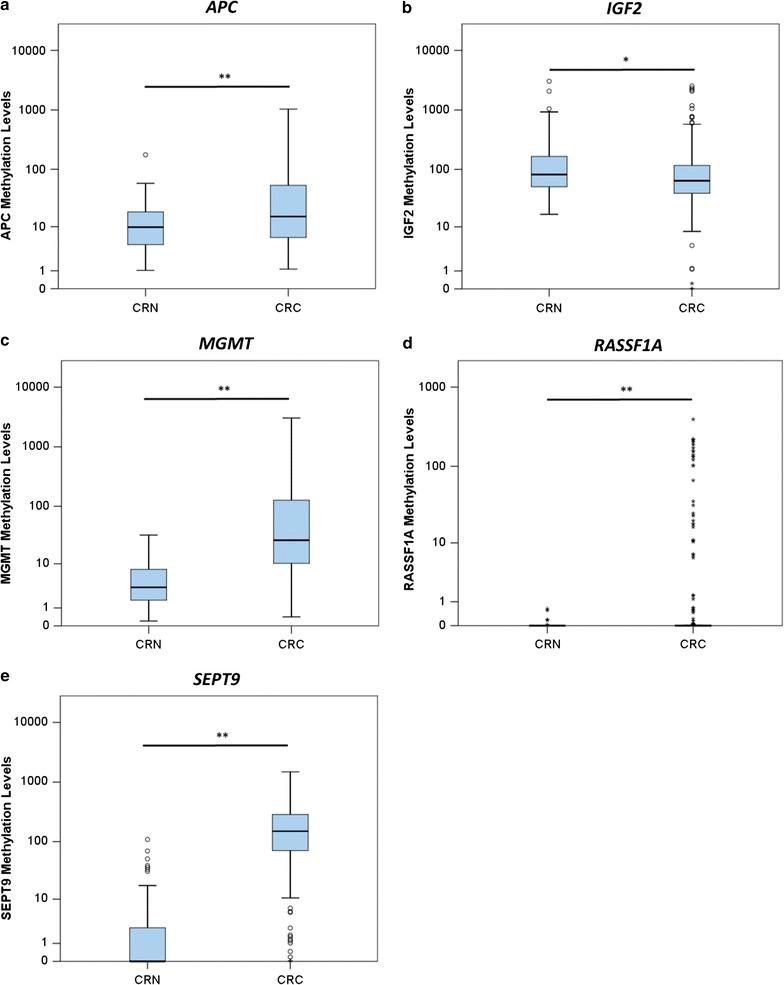
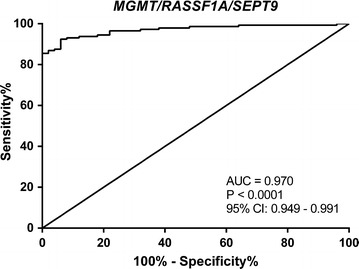
Except for IGF2, promoter methylation levels were significantly higher in CRC compared to CRN. A three-gene panel (MGMT, RASSF1A, SEPT9) identified malignancy with 96.6% sensitivity, 74.0% specificity and 91.5 positive predictive value (area under the curve: 0.97), independently of tumor location, stage, and molecular pathway.
Combined promoter methylation analysis of MGMT/RASSF1A/SEPT9 displays a better performance than currently available epigenetic-based biomarkers for CRC, providing the basis for the development of a non-invasive assay to detect CRC irrespective of the molecular pathway.
结直肠癌(CRC)是最常见的癌症之一,与显著的发病率和死亡率相关,通常分为三个主要的分子途径:染色体不稳定性、微卫星不稳定(MSI)和 CpG 岛甲基化表型(CIMP)。目前,可用的筛查方法要么成本高,要么特异性有限,阻碍了全球的实施。包括 DNA 甲基化检测在内的更具成本效益的策略可能具有优势。尽管已经有一些方法,但它们的性能并不理想,需要更好的候选生物标志物。在此,我们测试了 APC、IGF2、MGMT、RASSF1A 和 SEPT9 启动子甲基化的联合使用是否可以准确检测 CRC,而不论分子亚型如何。
使用 214 例 CRC 和 50 例非恶性结直肠黏膜(CRN)的福尔马林固定石蜡包埋组织验证了选定的基因。使用实时定量甲基化特异性 PCR 评估启动子甲基化水平。确定 MSI 和 CIMP 状态。将分子数据与标准临床病理特征相关联。通过接受者操作特征曲线和生存分析分别评估诊断和预后性能。
除 IGF2 外,CRC 中的启动子甲基化水平明显高于 CRN。一个三基因组合(MGMT、RASSF1A、SEPT9)以 96.6%的敏感性、74.0%的特异性和 91.5%的阳性预测值(曲线下面积:0.97)识别恶性肿瘤,独立于肿瘤位置、分期和分子途径。
MGMT/RASSF1A/SEPT9 联合启动子甲基化分析比目前基于表观遗传的 CRC 生物标志物具有更好的性能,为开发一种非侵入性检测方法提供了基础,可以检测 CRC,而不受分子途径的影响。