Yasui Atsutaka, Lee Ganghyuck, Hirase Tetsuaki, Kaneko Tatsuroh, Kaspers Stefan, von Eynatten Maximilian, Okamura Tomoo
Nippon Boehringer Ingelheim Co. Ltd., Tokyo, Japan.
Eli Lilly Japan K.K., Kobe, Japan.
Diabetes Ther. 2018 Apr;9(2):863-871. doi: 10.1007/s13300-018-0385-5. Epub 2018 Feb 27.
Empagliflozin, a sodium glucose co-transporter 2 (SGLT2) inhibitor, ameliorates hyperglycemia in patients with type 2 diabetes (T2D) by inducing sustained glucosuria. Empagliflozin treatment was previously associated with a transient increase in 24-h urine volume in Caucasian patients with T2D, however comparable evidence in Japanese T2D individuals is scarce. We therefore assessed acute and chronic changes in 24-h urine volume and fluid intake with empagliflozin in Japanese patients with T2D.
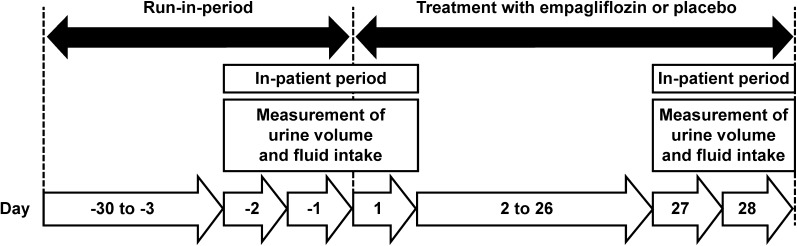
In this randomized, double-blind, placebo-controlled, parallel-group, multiple-dose, 4-week trial, 100 Japanese patients with T2D were randomized to receive either 1, 5, 10, or 25 mg empagliflozin or placebo once-daily. Changes from baseline in 24-h urine volume and fluid intake were assessed at days 1, 27, and 28 after the initiation of empagliflozin.
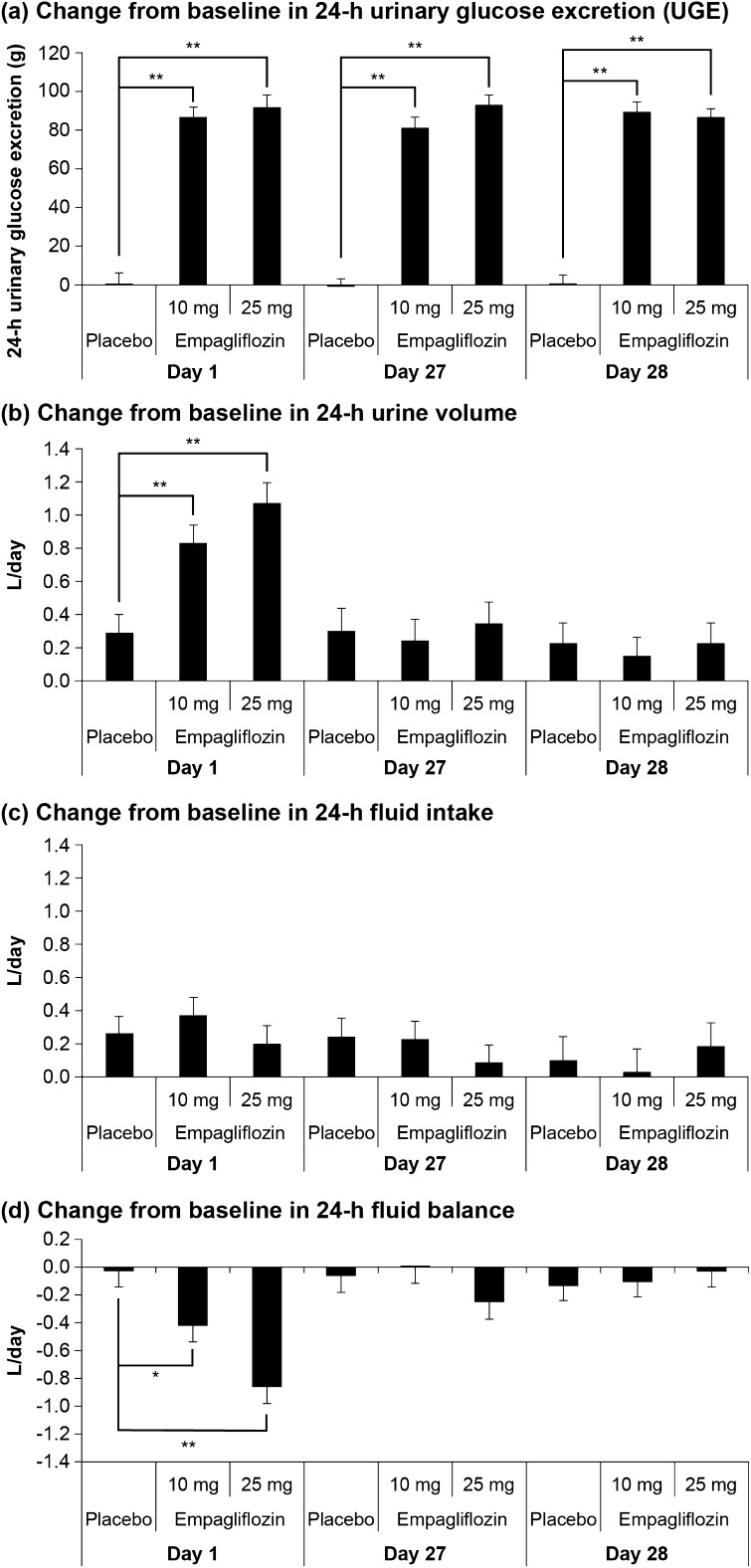
The 24-h urine volume and fluid intake were comparable across all treatment groups at baseline. Patients treated with either 10 or 25 mg empagliflozin (i.e., the licensed doses in Japan) showed a significant increase in 24-h urine volume compared to placebo at day 1 (mean change from baseline: + 0.83, + 1.08, and + 0.29 L/day in the empagliflozin 10 and 25 mg groups and the placebo group, respectively; both p < 0.001 vs. placebo). However, 24-h urine volume levels in the empagliflozin groups were comparable to placebo at day 27 and 28 (differences vs placebo < 0.1 L/day; p > 0.05). The 24-h fluid intake was comparable across all study groups throughout the entire study period. No events consistent with dehydration were reported during empagliflozin treatment.
Treatment initiation with empagliflozin in Japanese patients with T2D was associated with transient diuresis; however, overall urine volume returned towards baseline levels within 4 weeks of treatment. These findings are consistent with a physiological, adaptive mechanism of the kidney to maintain overall body fluid balance in response to treatment initiation with a SGLT2 inhibitor.
NCT00885118.
Nippon Boehringer Ingelheim Co., Ltd.
恩格列净是一种钠-葡萄糖协同转运蛋白2(SGLT2)抑制剂,通过诱导持续性糖尿来改善2型糖尿病(T2D)患者的高血糖。此前,恩格列净治疗与高加索T2D患者24小时尿量短暂增加有关,然而,在日本T2D个体中的类似证据却很少。因此,我们评估了恩格列净对日本T2D患者24小时尿量和液体摄入量的急性和慢性变化。
在这项随机、双盲、安慰剂对照、平行组、多剂量、为期4周的试验中,100名日本T2D患者被随机分组,每日一次接受1、5、10或25mg恩格列净或安慰剂治疗。在开始使用恩格列净后的第1、27和28天评估24小时尿量和液体摄入量相对于基线的变化。
所有治疗组在基线时的24小时尿量和液体摄入量相当。与安慰剂相比,接受10或25mg恩格列净(即日本的许可剂量)治疗的患者在第1天24小时尿量显著增加(恩格列净10mg组和25mg组相对于基线的平均变化分别为+0.83、+1.08和+0.29L/天,安慰剂组为+0.29L/天;与安慰剂相比,p均<0.001)。然而,恩格列净组在第27天和28天的24小时尿量水平与安慰剂相当(与安慰剂的差异<0.1L/天;p>0.05)。在整个研究期间,所有研究组的24小时液体摄入量相当。在恩格列净治疗期间未报告与脱水一致的事件。
日本T2D患者开始使用恩格列净治疗与短暂利尿有关;然而,治疗4周内总体尿量恢复至基线水平。这些发现与肾脏的一种生理适应性机制一致,即肾脏对SGLT2抑制剂治疗启动做出反应以维持总体体液平衡。
NCT00885118。
日本勃林格殷格翰公司。