Section of Molecular Hematology and Therapy, Department of Leukemia, The University of Texas MD Anderson Cancer Center, Houston, Texas.
Daiichi Sankyo Co., Ltd., Hiromachi, Shinagawa-ku, Tokyo, Japan.
Cancer Res. 2018 May 15;78(10):2721-2731. doi: 10.1158/0008-5472.CAN-17-0949. Epub 2018 Feb 28.
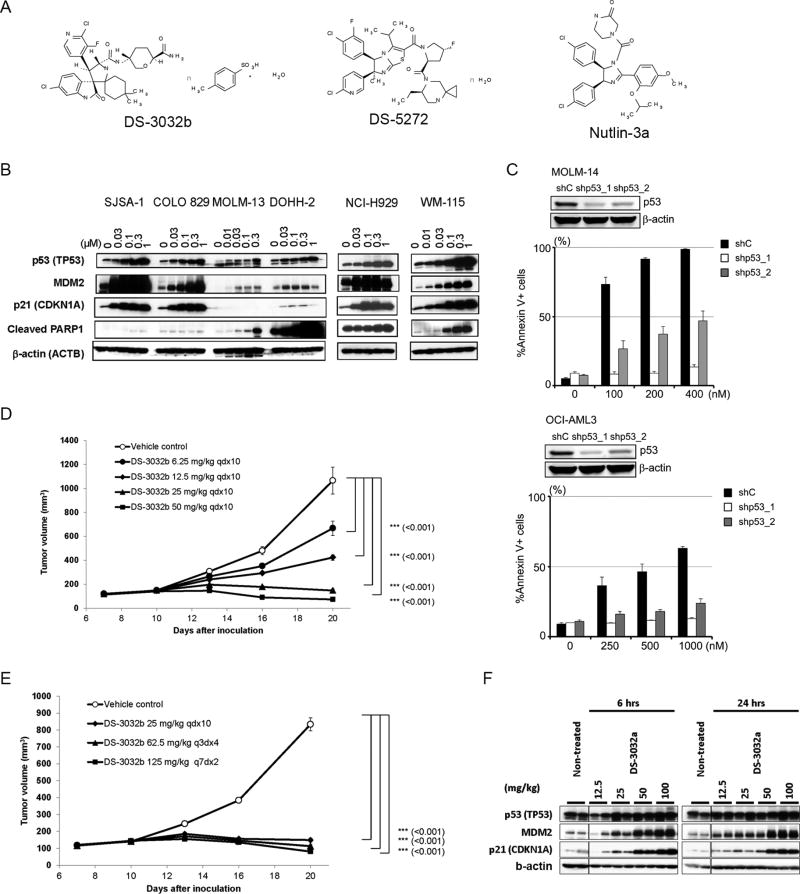
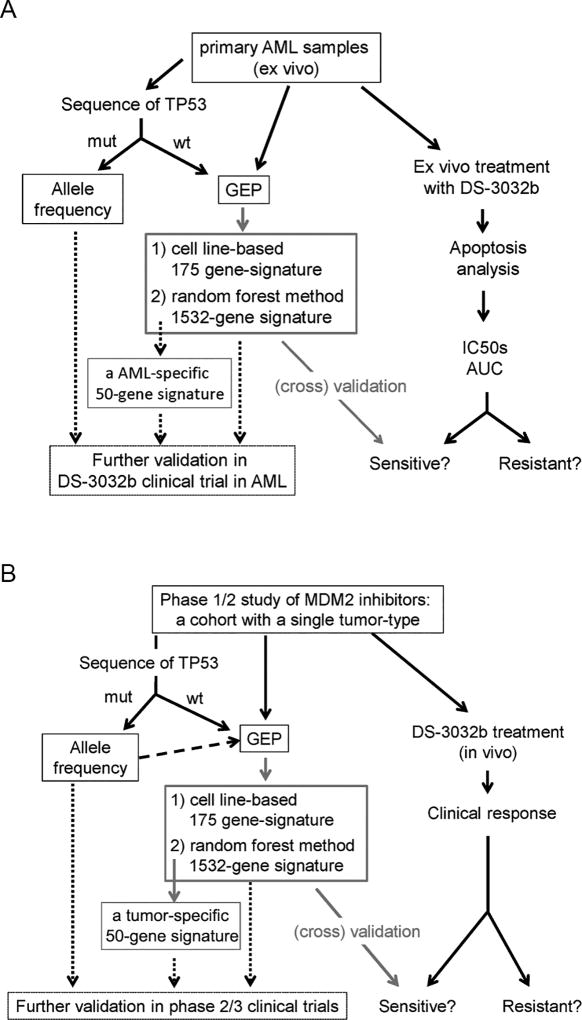
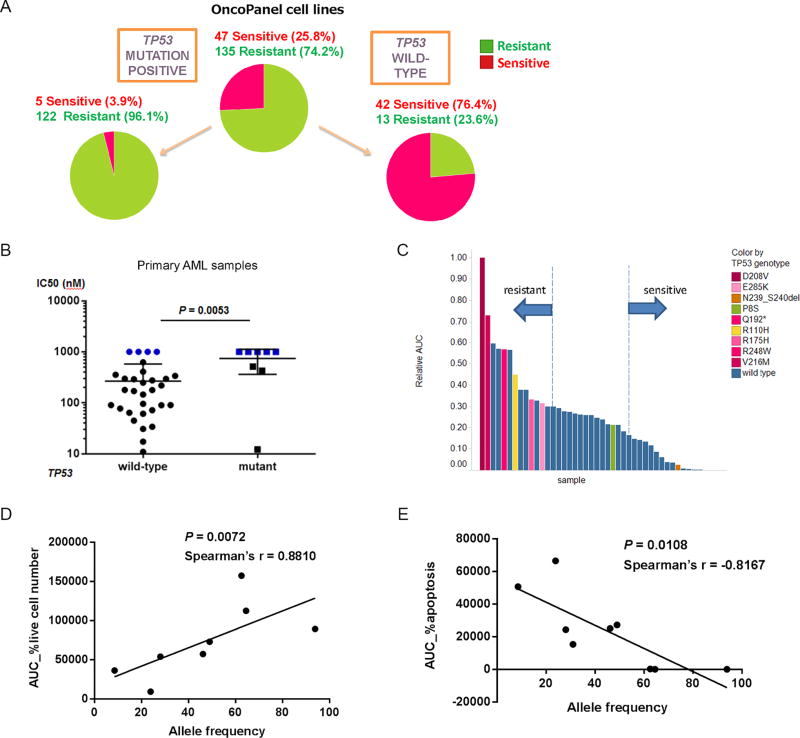
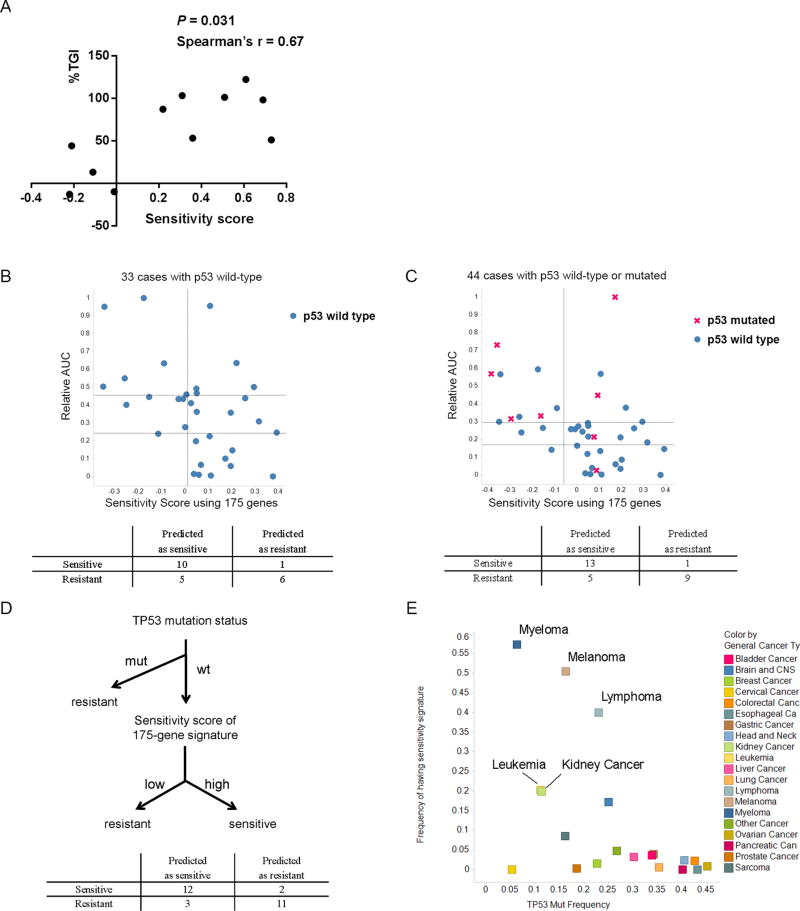
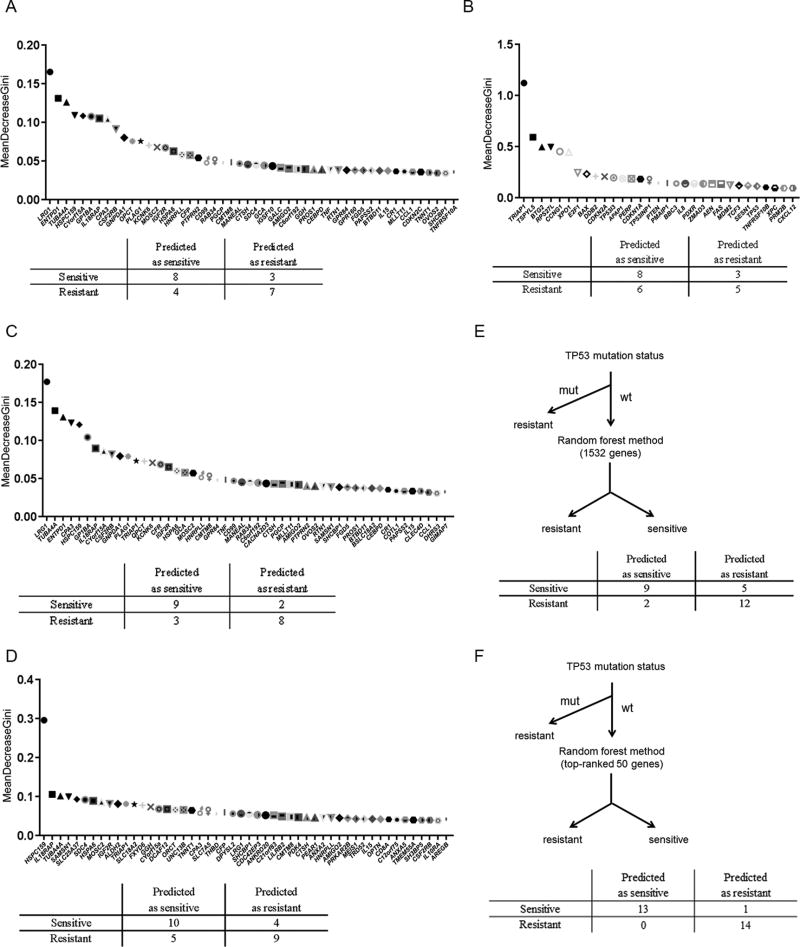
Early clinical trials using murine double minute 2 (MDM2) inhibitors demonstrated proof-of-concept of p53-induced apoptosis by MDM2 inhibition in cancer cells; however, not all wild-type tumors are sensitive to MDM2 inhibition. Therefore, more potent inhibitors and biomarkers predictive of tumor sensitivity are needed. The novel MDM2 inhibitor DS-3032b is 10-fold more potent than the first-generation inhibitor nutlin-3a. mutations were predictive of resistance to DS-3032b, and allele frequencies of mutations were negatively correlated with sensitivity to DS-3032b. However, sensitivity to DS-3032b of wild-type tumors varied greatly. We thus used two methods to create predictive gene signatures. First, by comparing sensitivity to MDM2 inhibition with basal mRNA expression profiles in 240 cancer cell lines, a 175-gene signature was defined and validated in patient-derived tumor xenograft models and human acute myeloid leukemia (AML) cells. Second, an AML-specific 1,532-gene signature was defined by performing random forest analysis with cross-validation using gene expression profiles of 41 primary AML samples. The combination of mutation status with the two gene signatures provided the best positive predictive values (81% and 82%, compared with 62% for mutation status alone). In addition, the top-ranked 50 genes selected from the AML-specific 1,532-gene signature conserved high predictive performance, suggesting that a more feasible size of gene signature can be generated through this method for clinical implementation. Our model is being tested in ongoing clinical trials of MDM2 inhibitors. This study demonstrates that gene expression profiling combined with mutational status predicts antitumor effects of MDM2 inhibitors and .
早期的临床研究使用鼠双微体 2 (MDM2) 抑制剂,证明了 MDM2 抑制在癌细胞中诱导 p53 诱导的细胞凋亡的概念;然而,并非所有野生型肿瘤对 MDM2 抑制敏感。因此,需要更有效的抑制剂和预测肿瘤敏感性的生物标志物。新型 MDM2 抑制剂 DS-3032b 比第一代抑制剂 nutlin-3a 强 10 倍。MDM2 突变预测对 DS-3032b 的耐药性,并且 MDM2 突变的等位基因频率与对 DS-3032b 的敏感性呈负相关。然而,野生型肿瘤对 DS-3032b 的敏感性差异很大。因此,我们使用两种方法来创建预测基因特征。首先,通过比较 240 种癌细胞系中 MDM2 抑制的敏感性与基础 mRNA 表达谱,在患者来源的肿瘤异种移植模型和人类急性髓系白血病 (AML) 细胞中定义并验证了一个 175 个基因的特征。其次,通过使用 41 个原发性 AML 样本的基因表达谱进行随机森林分析和交叉验证,定义了 AML 特异性的 1532 个基因特征。与单独的 MDM2 突变状态相比,MDM2 突变状态与两个基因特征的组合提供了最佳的阳性预测值(81%和 82%,而 MDM2 突变状态为 62%)。此外,从 AML 特异性的 1532 个基因特征中选择的前 50 个基因保留了较高的预测性能,这表明通过这种方法可以生成更可行的基因特征大小,以便在临床实施中使用。我们的模型正在进行中的 MDM2 抑制剂临床试验中进行测试。这项研究表明,基因表达谱分析结合 MDM2 突变状态预测了 MDM2 抑制剂的抗肿瘤作用,并为治疗选择提供了一种潜在的方法。