Reyes-Urueña Juliana Maria, Campbell Colin N J, Vives Núria, Esteve Anna, Ambrosioni Juan, Tural Cristina, Ferrer Elena, Navarro Gemma, Force Lluis, García Isabel, Masabeu Àngels, Vilaró Josep M, García de Olalla Patricia, Caylà Joan Artur, Miró Josep M, Casabona Jordi
Dept Salut, Generalitat de Catalunya, Centre Estudis Epidemiologics sobre les Infeccions de Transmissio Sexual i Sida de Catalunya (CEEISCAT), Badalona, Spain.
CIBER Epidemiologia y Salud Pública (CIBERESP), Barcelona, Spain.
BMJ Open. 2018 Feb 28;8(2):e018533. doi: 10.1136/bmjopen-2017-018533.
Undiagnosed HIV continues to be a hindrance to efforts aimed at reducing incidence of HIV. The objective of this study was to provide an estimate of the HIV undiagnosed population in Catalonia and compare the HIV care cascade with this step included between high-risk populations.
To estimate HIV incidence, time between infection and diagnosis and the undiagnosed population stratified by CD4 count, we used the ECDC HIV Modelling Tool V.1.2.2. This model uses data on new HIV and AIDS diagnoses from the Catalan HIV/AIDS surveillance system from 2001 to 2013. Data used to estimate the proportion of people enrolled, on ART and virally suppressed in the HIV care cascade were derived from the PISCIS cohort.
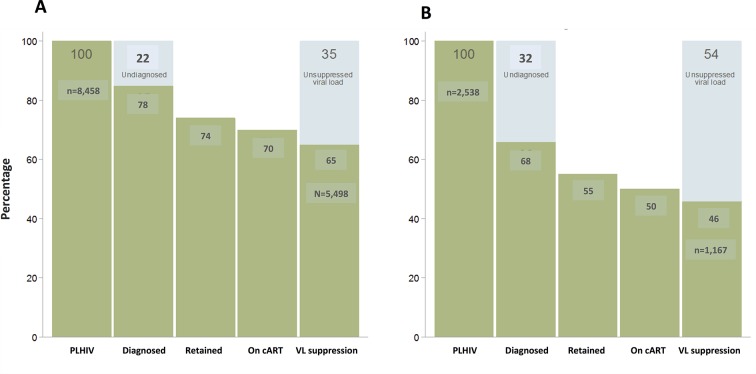
The total number of people living with HIV (PLHIV) in Catalonia in 2013 was 34 729 (32 740 to 36 827), with 12.3% (11.8 to 18.1) of whom were undiagnosed. By 2013, there were 8458 (8101 to 9079) Spanish-born men who have sex with men (MSM) and 2538 (2334 to 2918) migrant MSM living with HIV in Catalonia. A greater proportion of migrant MSM than local MSM was undiagnosed (32% vs 22%). In the subsequent steps of the HIV care cascade, migrants MSM experience greater losses than the Spanish-born MSM: in retention in care (74% vs 55%), in the proportion on combination antiretroviral treatment (70% vs 50%) and virally suppressed (65% vs 46%).
By the end of 2013, there were an estimated 34 729 PLHIV in Catalonia, of whom 4271 were still undiagnosed. This study shows that the Catalan epidemic of HIV has continued to expand with the key group sustaining HIV transmission being MSM living with undiagnosed HIV.
未诊断出的艾滋病病毒(HIV)仍然是降低HIV发病率努力的一个障碍。本研究的目的是估计加泰罗尼亚未诊断出HIV的人群数量,并将HIV治疗级联与高危人群中包含这一步骤的情况进行比较。
为了估计HIV发病率、感染与诊断之间的时间以及按CD4细胞计数分层的未诊断人群,我们使用了欧洲疾病预防控制中心(ECDC)HIV建模工具V.1.2.2。该模型使用了2001年至2013年加泰罗尼亚HIV/艾滋病监测系统中新增HIV和艾滋病诊断的数据。用于估计HIV治疗级联中登记、接受抗逆转录病毒治疗(ART)和病毒得到抑制的人群比例的数据来自PISCIS队列。
2013年加泰罗尼亚的HIV感染者(PLHIV)总数为34729人(32740至36827人),其中12.3%(11.8%至18.1%)未被诊断出来。到2013年,加泰罗尼亚有8458名(8101至9079名)在西班牙出生的男男性行为者(MSM)感染HIV,以及2538名(2334至2918名)移民MSM感染HIV。未被诊断出的移民MSM比例高于本地MSM(32%对22%)。在HIV治疗级联的后续步骤中,移民MSM比在西班牙出生的MSM经历了更大的流失:在治疗留存率方面(74%对55%)、在接受联合抗逆转录病毒治疗的比例方面(70%对50%)以及病毒得到抑制方面(65%对46%)。
到2013年底,加泰罗尼亚估计有34729名PLHIV,其中4271人仍未被诊断出来。这项研究表明,加泰罗尼亚的HIV疫情持续蔓延,未诊断出HIV的MSM仍是维持HIV传播的关键群体。