Carretero-González Alberto, Lora David, Ghanem Ismael, Zugazagoitia Jon, Castellano Daniel, Sepúlveda Juan M, López-Martin José A, Paz-Ares Luis, de Velasco Guillermo
Medical Oncology Service, University Hospital 12 de Octubre, Madrid, Spain.
Clinical Research Unit (imas12-CIBERESP), University Hospital 12 de Octubre, Madrid, Spain.
Oncotarget. 2018 Jan 20;9(9):8706-8715. doi: 10.18632/oncotarget.24283. eCollection 2018 Feb 2.
Anti-PD1/PD-L1 monoclonal antibodies (mAbs) increase overall survival compared to standard of care (SOC) in different tumors. However, a proportion of patients (pts) will have progressive disease (PD) as best response. We conducted a meta-analysis to study the rates of response comparing these antibodies with SOC.
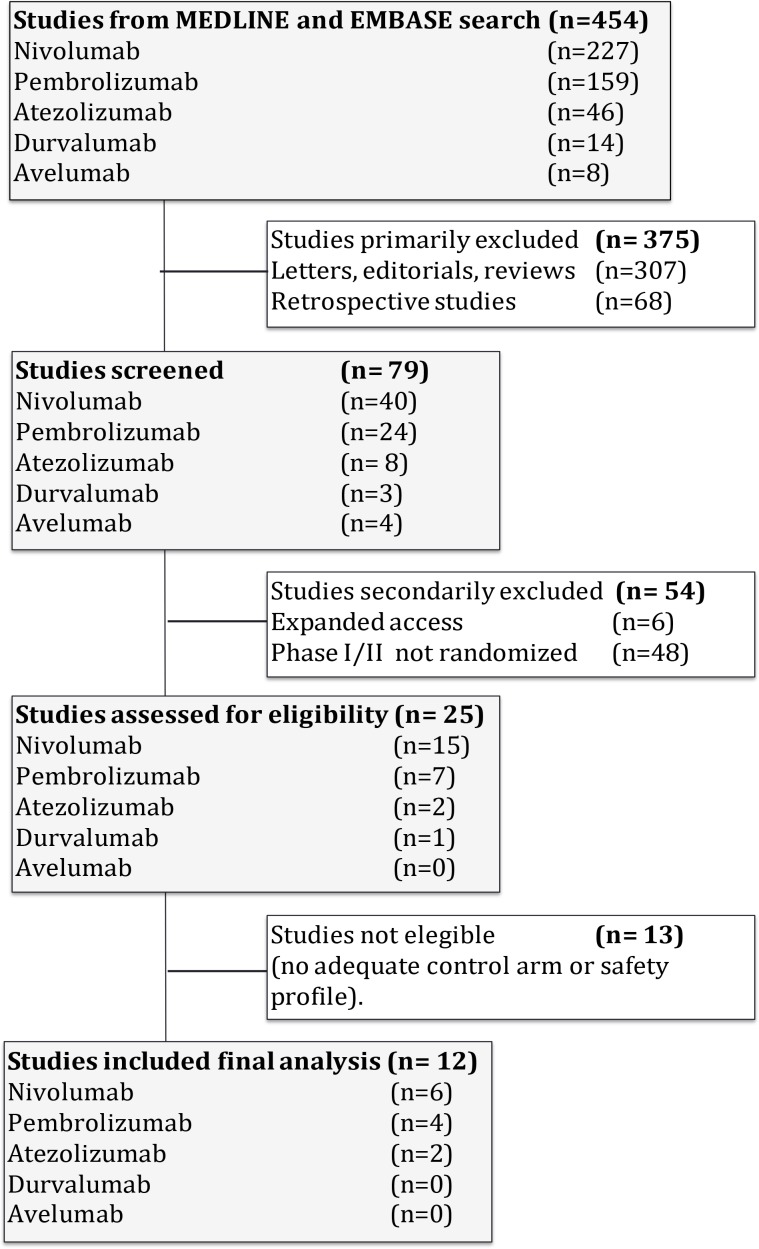
A search of published trials in MEDLINE and EMBASE analyzing anti-PD1/PD-L1mAbs monotherapy compared to SOC. Relative risk (RR) with 95% confidence interval (CI) of response rates between groups was estimated. Subgroup analyses for location of primary tumor, number of previous treatment lines, selected population by PD-L1 expression and type of radiological assessment were made.
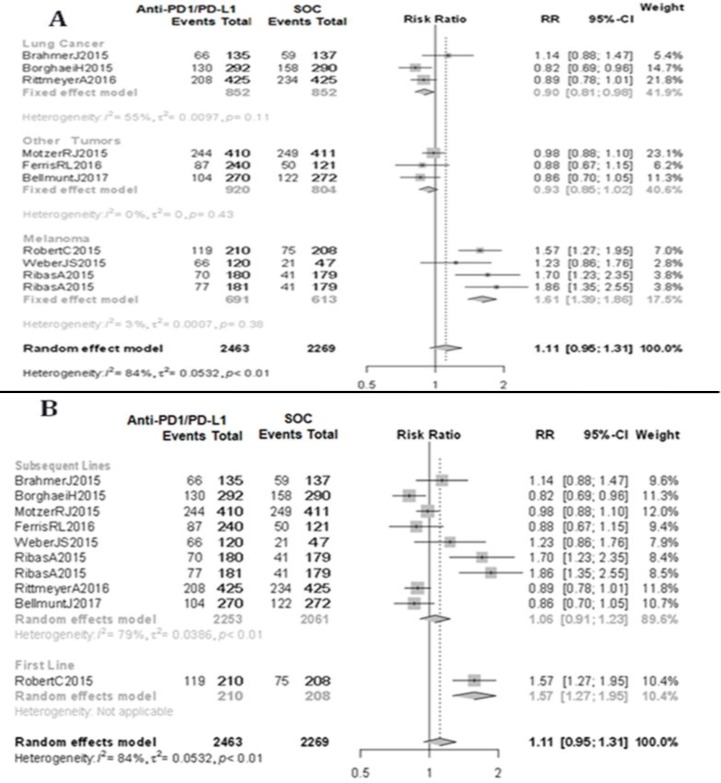
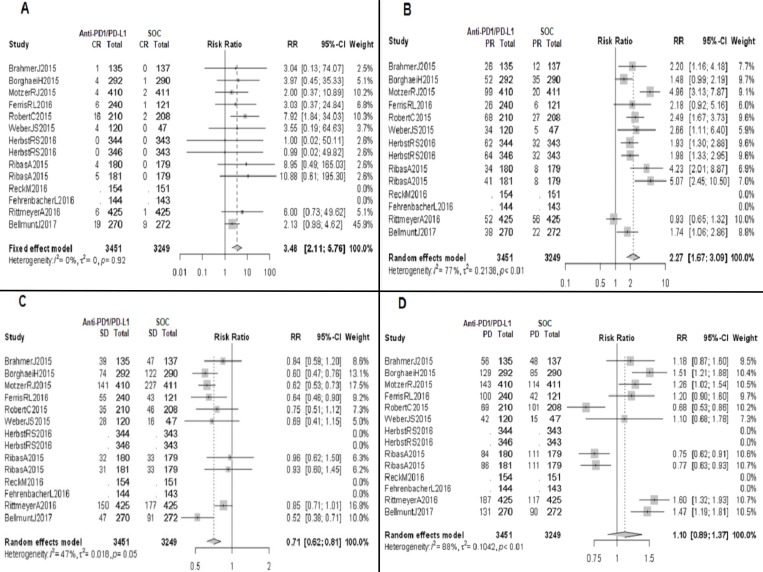
Twelve studies accounting for 6,700 pts were included (anti-PD1/PD-L1 mAbs: 3,451 pts; SOC: 3,249 pts [2,823 pts: chemotherapy, 426 pts: targeted therapy]). Adjusted response rates were (N, %): Complete Response (CR) (69/3153, 2.19%), Partial Response (PR) (596/3153, 18.90%), Stable Disease (SD) (632/2463, 25.66%) and PD (1027/2463, 41.70%); and CR (16/2955, 0.54%), PR (263/2955, 8.90%), SD (835/2269, 36.80%) and PD (834/2269, 36.76%) with anti-PD1/PD-L1 mAbs and SOC, respectively. Anti-PD1/PD-L1 mAbs improved CR rate (RR 3.48) and PR rate (RR 2.27). There were no differences in the PD rate between groups (RR 1.10). Subgroup analyses showed an improvement in clinical benefit with anti-PD1/PD-L1 mAbs for melanoma (RR 1.59; 1.37-1.84 95% CI) and those treated in the first line setting (RR 1.57; 1.27-1.95 95% CI).
Anti-PD1/PD-L1 mAbs increase overall response rate compared to SOC without an increase in PD rate. Melanoma and pts treated in first line setting seem to have greater benefit with anti-PD1/PD-L1 mAbs.
In this systematic meta-analysis, anti-PD1/PD-L1 mAbs were associated with a greater overall response rate. Patients with melanoma and those managed in the first line setting seem to have an additional benefit with anti-PD1/PD-L1 mAbs.
与不同肿瘤的标准治疗(SOC)相比,抗PD1/PD-L1单克隆抗体(mAbs)可提高总生存率。然而,一部分患者(pts)的最佳反应将是疾病进展(PD)。我们进行了一项荟萃分析,以研究将这些抗体与SOC进行比较时的反应率。
检索MEDLINE和EMBASE中已发表的试验,分析抗PD1/PD-L1 mAbs单药治疗与SOC的比较。估计组间反应率的相对风险(RR)及95%置信区间(CI)。对原发肿瘤部位、既往治疗线数、根据PD-L1表达选择的人群以及放射学评估类型进行亚组分析。
纳入了12项研究,共6700例患者(抗PD1/PD-L1 mAbs:3451例;SOC:3249例[2823例:化疗,426例:靶向治疗])。调整后的反应率为(N,%):完全缓解(CR)(69/3153,2.19%)、部分缓解(PR)(596/3153,18.90%)、疾病稳定(SD)(632/2463,25.66%)和疾病进展(PD)(1027/2463,41.70%);抗PD1/PD-L1 mAbs组和SOC组的CR分别为(16/2955,0.54%)、PR(263/2955,8.90%)、SD(835/2269,- 36.80%)和PD(834/2269,36.76%)。抗PD1/PD-L1 mAbs提高了CR率(RR 3.48)和PR率(RR 2.27)。两组间的PD率无差异(RR 1.10)。亚组分析显示,抗PD1/PD-L1 mAbs对黑色素瘤(RR 1.59;95%CI 1.37 - 1.84)和一线治疗患者(RR 1.57;95%CI 1.27 - 1.95)的临床获益有所改善。
与SOC相比,抗PD1/PD-L1 mAbs提高了总反应率,且未增加PD率。黑色素瘤患者和一线治疗患者似乎从抗PD1/PD-L1 mAbs中获益更大。
在这项系统性荟萃分析中,抗PD1/PD-L1 mAbs与更高的总反应率相关。黑色素瘤患者和一线治疗患者似乎从抗PD1/PD-L1 mAbs中获得了额外的益处。