Liang Zhiwen, Liu Hongyuan, Xue Jun, Hu Bin, Zhu Bin, Li Qin, Zhang Sheng, Wu Gang
Cancer Center, Union Hospital, Tongji Medical College, Huazhong University of Science and Technology, Wuhan, China.
J Appl Clin Med Phys. 2018 May;19(3):94-100. doi: 10.1002/acm2.12292. Epub 2018 Feb 28.
Tumor motion amplitude varies during treatment. The purpose of the study was to evaluate the intra- and interfraction tumor motion and variability in patients with liver cancer treated with fiducial-based real-time tracking stereotactic body radiotherapy (SBRT).
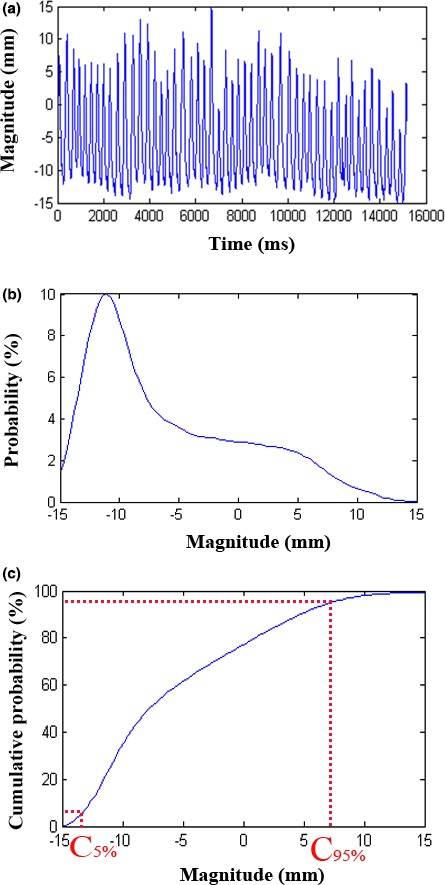
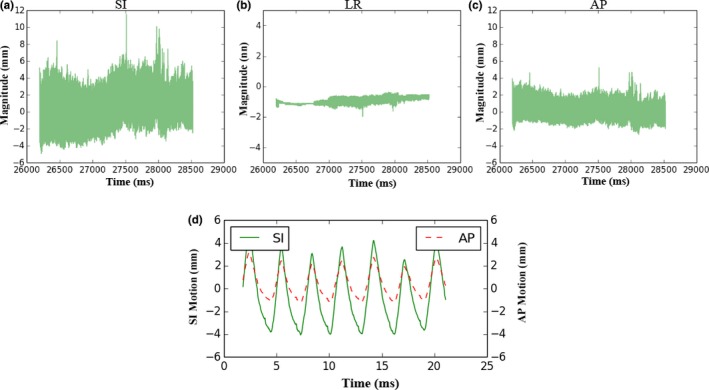
Fourteen liver patients were treated with SBRT using a CyberKnife. Two to four fiducial markers implanted near the tumor were used for real-time monitoring using the Synchrony system. The tumor motion information during treatment was extracted from the log files recorded by the Synchrony system. Logfile-based amplitudes in the superior-posterior (SI), left-right (LR) and anterior-posterior (AP) directions were compared to the 4DCT-based amplitudes. The intra- and interfraction amplitude variations and the incidence of baseline shifts were analyzed for 66 fractions administered to 14 patients.
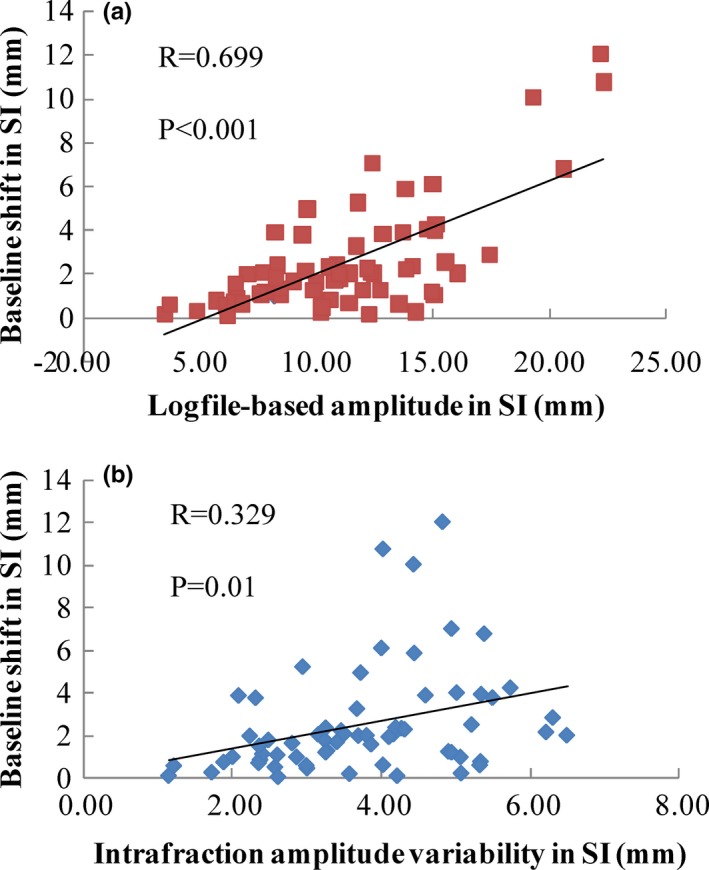
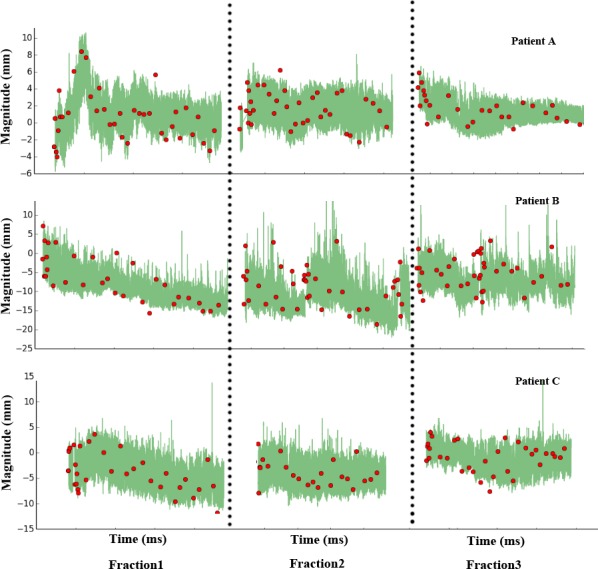
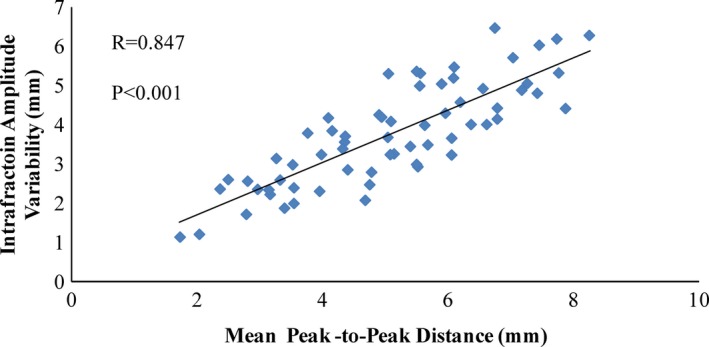
The median (range) logfile-based liver motion amplitudes for all patients were 11.9 (5.1-17.3) mm, 1.3 (0.4-4) mm and 3.8 (0.9-7.7) mm in the SI, LR and AP directions, respectively. Compared with the logfile-based amplitude, the 4DCT-based amplitude was underestimated (P < 0.05). The median (range) intra- and interfraction liver motion amplitude variations were 4.3 (1.6-6.0) mm (SI), 0.5 (0.2-2.2) mm(LR) and 1.5 (0.3-3.3) mm (AP) and 1.7 (0.5-4.6) mm (SI), 0.3 (0.1-3.0) mm (LR) and 0.7 (0.3-2.7) mm (AP), respectively. Baseline shifts exceeding 2 mm, 3 mm and 5 mm were observed in 27.3%, 7.6% and 3% of the measurements, respectively, within 10 min, and in 66.7%, 38.1% and 19%, respectively, within 30 min for the square root of the sum of the squares of the distances in the SI, LR and AP directions (3D). The tumor motion amplitude was found to be correlated with the baseline shift.
Most patients showed significant intra- and interfraction liver motion amplitude variations over the entire course of radiation. More caution is needed for patients with large tumor motion amplitudes.
肿瘤运动幅度在治疗过程中会发生变化。本研究的目的是评估基于基准的实时跟踪立体定向体部放疗(SBRT)治疗的肝癌患者肿瘤的分次内及分次间运动情况和变异性。
14例肝癌患者接受了射波刀SBRT治疗。在肿瘤附近植入2至4个基准标记物,使用同步系统进行实时监测。从同步系统记录的日志文件中提取治疗期间的肿瘤运动信息。将基于日志文件的头脚(SI)、左右(LR)和前后(AP)方向的幅度与基于4DCT的幅度进行比较。分析了14例患者接受的66次分次治疗的分次内及分次间幅度变化以及基线偏移的发生率。
所有患者基于日志文件的肝脏运动幅度中位数(范围)在SI、LR和AP方向分别为11.9(5.1 - 17.3)mm、1.3(0.4 - 4)mm和3.8(0.9 - 7.7)mm。与基于日志文件的幅度相比,基于4DCT的幅度被低估(P < 0.05)。分次内及分次间肝脏运动幅度变化的中位数(范围)在SI方向分别为4.3(1.6 - 6.0)mm、0.5(0.2 - 2.2)mm(LR)和1.5(0.3 - 3.3)mm(AP)以及1.7(0.5 - 4.6)mm(SI)、0.3(0.1 - 3.0)mm(LR)和0.7(0.3 - 2.7)mm(AP)。在10分钟内,SI、LR和AP方向距离平方和的平方根(3D)测量中,分别有27.3%、7.6%和3%的测量出现超过2 mm、3 mm和5 mm的基线偏移,在30分钟内分别为66.7%、38.1%和19%。发现肿瘤运动幅度与基线偏移相关。
大多数患者在整个放疗过程中显示出显著的分次内及分次间肝脏运动幅度变化。对于肿瘤运动幅度大的患者需要更加谨慎。