Kim Chang-Kyung, Yang Vincent W, Bialkowska Agnieszka B
1Department of Medicine, Stony Brook University School of Medicine, HSC T-17, Rm. 090, Stony Brook, NY 11794 USA.
2Department of Physiology and Biophysics, Stony Brook University School of Medicine, Stony Brook, NY 11794 USA.
Curr Stem Cell Rep. 2017;3(4):320-332. doi: 10.1007/s40778-017-0103-7. Epub 2017 Oct 5.
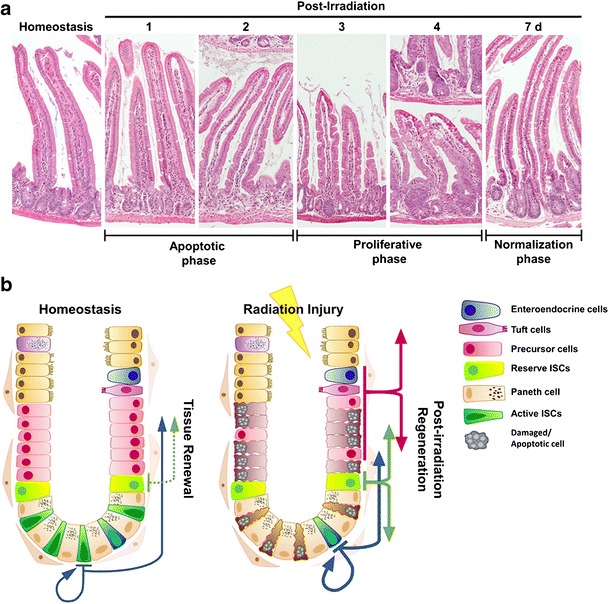
Intestinal epithelial cells show remarkable plasticity in regenerating the epithelium following radiation injury. In this review, we explore the regenerative capacity and mechanisms of various populations of intestinal stem cells (ISCs) in response to ionizing radiation.
Ionizing radiation targets mitotic cells that include "active" ISCs and progenitor cells. Lineage-tracing experiments showed that several different cell types identified by a single or combination of markers are capable of regenerating the epithelium, confirming that ISCs exhibit a high degree of plasticity. However, the identities of the contributing cells marked by various markers require further validation.
Following radiation injury, quiescent and/or radioresistant cells become active stem cells to regenerate the epithelium. Looking forward, understanding the mechanisms by which ISCs govern tissue regeneration is crucial to determine therapeutic approaches to promote intestinal epithelial regeneration following injury.
肠道上皮细胞在辐射损伤后再生上皮方面表现出显著的可塑性。在本综述中,我们探讨了各种肠道干细胞(ISC)群体在应对电离辐射时的再生能力和机制。
电离辐射靶向包括“活跃”ISC和祖细胞在内的有丝分裂细胞。谱系追踪实验表明,通过单一标记或标记组合鉴定的几种不同细胞类型能够再生上皮,证实ISC具有高度可塑性。然而,各种标记所标记的贡献细胞的身份需要进一步验证。
辐射损伤后,静止和/或抗辐射细胞成为活跃的干细胞以再生上皮。展望未来,了解ISC调控组织再生的机制对于确定促进损伤后肠道上皮再生的治疗方法至关重要。