Institute for Emerging Infections, Department of Zoology, University of Oxford, The Peter Medawar Building for Pathogen Research, South Parks Road, Oxford, United Kingdom.
Division of Infectious Diseases, Northwestern University Feinberg School of Medicine, Chicago, Illinois, United States of America.
PLoS Comput Biol. 2018 Mar 2;14(3):e1006028. doi: 10.1371/journal.pcbi.1006028. eCollection 2018 Mar.
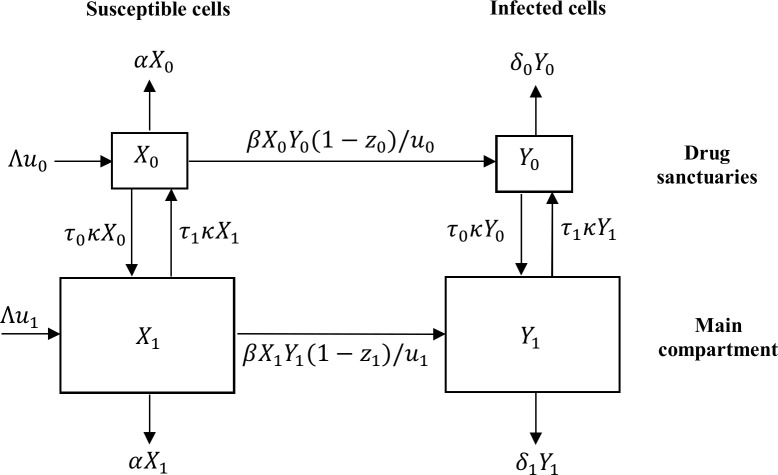
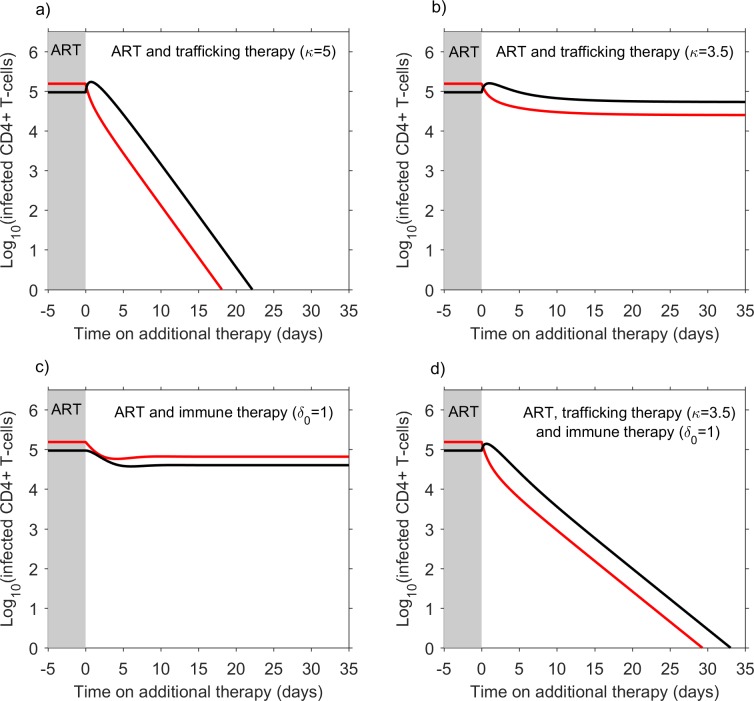
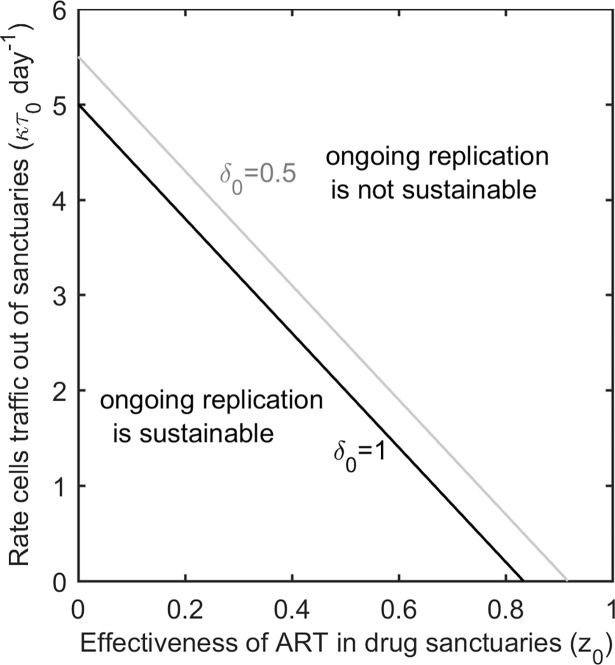
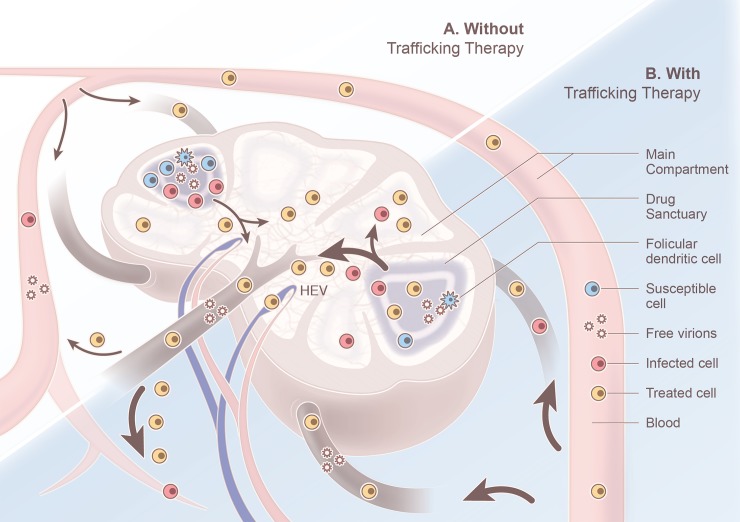
Although antiretroviral drug therapy suppresses human immunodeficiency virus-type 1 (HIV-1) to undetectable levels in the blood of treated individuals, reservoirs of replication competent HIV-1 endure. Upon cessation of antiretroviral therapy, the reservoir usually allows outgrowth of virus and approaches to targeting the reservoir have had limited success. Ongoing cycles of viral replication in regions with low drug penetration contribute to this persistence. Here, we use a mathematical model to illustrate a new approach to eliminating the part of the reservoir attributable to persistent replication in drug sanctuaries. Reducing the residency time of CD4 T cells in drug sanctuaries renders ongoing replication unsustainable in those sanctuaries. We hypothesize that, in combination with antiretroviral drugs, a strategy to orchestrate CD4 T cell trafficking could contribute to a functional cure for HIV-1 infection.
虽然抗逆转录病毒药物治疗可将接受治疗个体血液中的人类免疫缺陷病毒 1 型(HIV-1)抑制到无法检测的水平,但仍存在具有复制能力的 HIV-1 储存库。停止抗逆转录病毒治疗后,储存库通常会允许病毒生长,而针对储存库的方法收效有限。药物渗透度低的区域中持续的病毒复制会导致这种持续存在。在这里,我们使用数学模型来说明一种新方法来消除与药物避难所中持续复制有关的储存库的一部分。减少 CD4 T 细胞在药物避难所中的居留时间会使这些避难所中的持续复制变得不可持续。我们假设,与抗逆转录病毒药物联合使用,协调 CD4 T 细胞迁移的策略可能有助于实现 HIV-1 感染的功能性治愈。