Heerman William J, Bennett Wendy L, Kraschnewski Jennifer L, Nauman Elizabeth, Staiano Amanda E, Wallston Kenneth A
1Vanderbilt University Medical Center, 2146 Belcourt Ave, 2nd Floor, Nashville, TN 37212 USA.
2The Johns Hopkins University School of Medicine, Baltimore, MD USA.
BMC Obes. 2018 Mar 1;5:10. doi: 10.1186/s40608-018-0187-3. eCollection 2018.
Since 2014 the Patient Centered Outcomes Research Institute (PCORI) has funded 13 Clinical Data Research Networks (CDRNs) around the country to support large-scale comparative effectiveness research and pragmatic clinical trials. To provide guidance for future recruitment efforts among CDRNs this study described differential willingness to participate in weight-related research by body mass index (BMI) and sociodemographic characteristics.
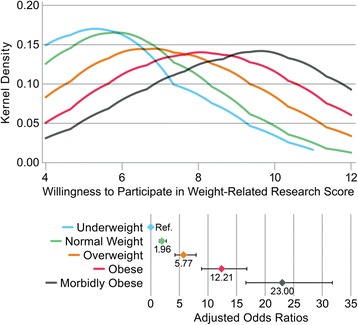
During 2014-2016 we surveyed participants from three CDRNs including the Mid-South CDRN, REACHnet, and the PaTH Network, representing 14 medical centers. Participants were eligible if they were ≥18 years, had ≥2 weights and ≥1 height in the electronic health record. Respondents were recruited face-to-face in primary care and specialty clinics, and via email from doctors' offices, patient registries and health systems' patient portals. Data was collected on willingness to participate in weight-related research (four items combined into a single scale; range 4-12), BMI, and sociodemographics (age, sex, number of people in household, marital status, education level, race, and ethnicity). Adjusted ordinal regression models tested associations between participant characteristics and willingness to participate in weight-related research.
Among 11,624 respondents, mean BMI was 29.6 (SD 7.6) kg/m. Mean willingness to participate in weight-related research was 7.1 (SD 2.5). More respondents were willing to participate in studies with lower burden: healthy lifestyles (82.2%), genetics (71.3%), medication (52.2%), and surgery (22.6%). In adjusted models, higher BMI was associated with greater willingness to participate in weight-related research (OR = 1.13) as were younger age (OR = 0.98), being a woman (OR 1.59), and college education (OR = 1.72) (all < 0.001).
Associations among BMI, age, sex, and education level with willingness to participate in weight-related research highlight the need for future research to reduce barriers for populations less willing to engage in weight-related research.
自2014年以来,以患者为中心的结果研究协会(PCORI)已资助了全国13个临床数据研究网络(CDRN),以支持大规模的比较效果研究和实用临床试验。为了为CDRN未来的招募工作提供指导,本研究描述了按体重指数(BMI)和社会人口统计学特征划分的参与体重相关研究的不同意愿。
在2014年至2016年期间,我们对来自三个CDRN(包括中南CDRN、REACHnet和PaTH网络)的参与者进行了调查,这三个网络代表了14个医疗中心。如果参与者年龄≥18岁,电子健康记录中有≥2次体重和≥1次身高记录,则符合入选条件。通过在初级保健和专科诊所进行面对面招募,以及通过医生办公室、患者登记处和卫生系统的患者门户网站发送电子邮件的方式招募受访者。收集了关于参与体重相关研究的意愿(四个项目合并为一个单一量表;范围为4 - 12)、BMI和社会人口统计学信息(年龄、性别、家庭人口数、婚姻状况、教育水平、种族和民族)的数据。调整后的有序回归模型测试了参与者特征与参与体重相关研究意愿之间的关联。
在11,624名受访者中,平均BMI为29.6(标准差7.6)kg/m²。参与体重相关研究的平均意愿为7.1(标准差2.5)。更多受访者愿意参与负担较轻的研究:健康生活方式(82.2%)、遗传学(71.3%)、药物治疗(52.2%)和手术(22.6%)。在调整后的模型中,较高的BMI与参与体重相关研究的意愿更高相关(比值比[OR]=1.13),年龄较小(OR = 0.98)、女性(OR = 1.59)和大学教育程度(OR = 1.72)也与参与意愿更高相关(所有P均<0.001)。
BMI、年龄、性别和教育水平与参与体重相关研究意愿之间的关联突出表明,未来研究需要减少那些不太愿意参与体重相关研究的人群的障碍。