Bittar Alice, Sengupta Urmi, Kayed Rakez
1Mitchell Center for Neurodegenerative Diseases, University of Texas Medical Branch, Galveston, TX 77555 USA.
2Departments of Neurology, Neuroscience and Cell Biology, University of Texas Medical Branch, Galveston, TX 77555 USA.
NPJ Vaccines. 2018 Feb 27;3:9. doi: 10.1038/s41541-018-0046-8. eCollection 2018.
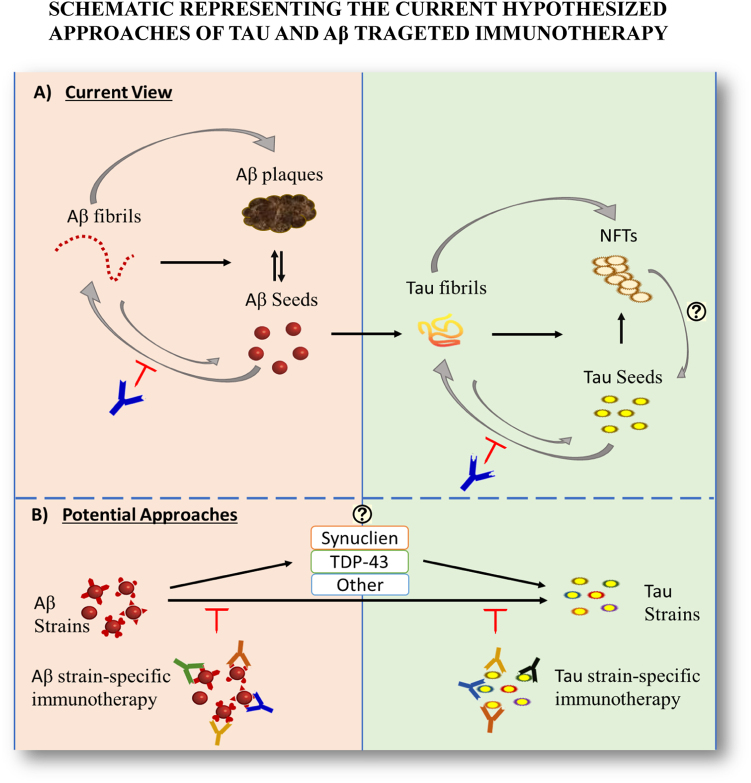
With increasing age, as the incidence of Alzheimer's disease is increasing, finding a therapeutic intervention is becoming critically important to either prevent or slow down the progression of the disease. Passive immunotherapy has been demonstrated as a successful way of reducing large aggregates and improving cognition in animal models of both tauopathies and Alzheimer's disease. However, with all the continuous attempts and significant success of immunotherapy in preclinical studies, finding a successful clinical therapy has been a great challenge, possibly indicating a lack of accuracy in targeting the toxic species. Both active and passive immunotherapy approaches in transgenic animals have been demonstrated to have pros and cons. Passive immunotherapy has been favored and many mechanisms have been shown to clear toxic amyloid and tau aggregates and improve memory. These mechanisms may differ depending on the antibodie's' target and administration route. In this regard, deciding on affinity vs. specificity of the antibodies plays a significant role in terms of avoiding the clearance of the physiological forms of the targeted proteins and reducing adverse side effects. In addition, knowing that a single protein can exist in different conformational states, termed as strains, with varying degrees of neurotoxicity and seeding properties, presents an additional level of complexity. Therefore, immunotherapy targeting specifically the toxic strains will aid in developing potential strategies for intervention. Moreover, an approach of combinatorial immunotherapies against different amyloidogenic proteins, at distinct levels of the disease progression, might offer an effective therapy in many neurodegenerative diseases.
随着年龄的增长,阿尔茨海默病的发病率不断上升,因此找到一种治疗性干预措施对于预防或减缓该疾病的进展变得至关重要。在tau蛋白病和阿尔茨海默病的动物模型中,被动免疫疗法已被证明是减少大聚集体和改善认知的一种成功方法。然而,尽管免疫疗法在临床前研究中不断尝试并取得了显著成功,但找到一种成功的临床治疗方法一直是一个巨大的挑战,这可能表明在靶向有毒物质方面缺乏准确性。转基因动物中的主动和被动免疫疗法都已证明有其优缺点。被动免疫疗法更受青睐,并且已显示出许多清除有毒淀粉样蛋白和tau聚集体以及改善记忆的机制。这些机制可能因抗体的靶点和给药途径而异。在这方面,决定抗体的亲和力与特异性在避免清除靶向蛋白的生理形式和减少不良副作用方面起着重要作用。此外,由于单一蛋白质可以以不同的构象状态存在,即所谓的毒株,具有不同程度的神经毒性和种子特性,这又增加了一层复杂性。因此,特异性靶向有毒毒株的免疫疗法将有助于制定潜在的干预策略。此外,在疾病进展的不同阶段针对不同淀粉样蛋白生成蛋白的联合免疫疗法可能为许多神经退行性疾病提供一种有效的治疗方法。