Cat Drop Foundation, Boorn 45, 9204 AZ Drachten, Netherlands.
Department of Natural Resources and Environment, Naresuan University, 99 Moo 9 Phitsanulok-Nakhonsawan Road, Tambon Tapho, Muang Phitsanulok 65000, Thailand.
Sci Adv. 2018 Feb 21;4(2):eaap9534. doi: 10.1126/sciadv.aap9534. eCollection 2018 Feb.
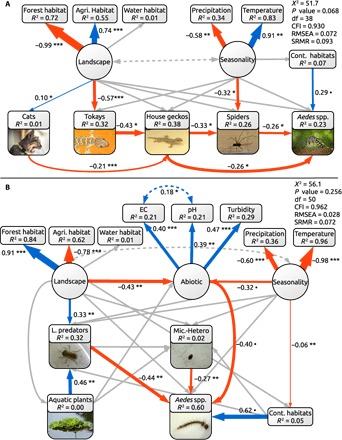
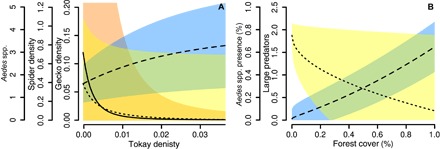
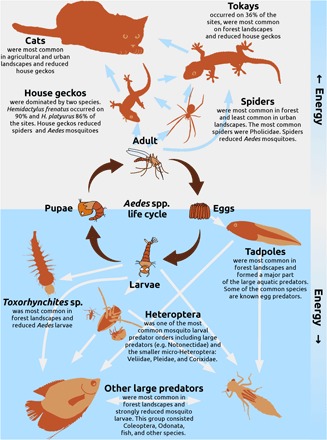
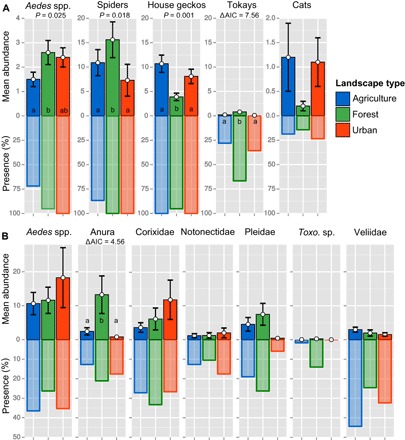
The epidemiology of vector-borne diseases is governed by a structured array of correlative and causative factors, including landscape (for example, rural versus urban), abiotic (for example, weather), and biotic (for example, food web) factors. Studies of mosquito-borne diseases rarely address these multiple factors at large spatial scales, which limits insights into how human alterations of landscapes and food webs alter mosquito abundance. We used structural equation modeling to identify the relative magnitude and direction of landscape, abiotic, and food web factors on larvae and adults across 70 sites in northern Thailand. Food web factors were modeled as mosquito-predator trophic cascades. Landscape context affected mosquito-predator communities in aquatic and terrestrial environments via cascading food web interactions. Several mosquito predators within these food webs showed potential as biocontrol agents in mosquito population control, but their potentials for control were landscape-dependent. In terrestrial food webs, the habitat-sensitive tokay gecko structured mosquito-predator communities, indicating that a conservation approach to vector control could be a useful addition to existing control efforts.
病媒传播疾病的流行病学受一系列相关和因果因素的支配,包括景观(例如,农村与城市)、非生物(例如,天气)和生物(例如,食物网)因素。蚊虫传播疾病的研究很少在大的空间尺度上考虑这些多种因素,这限制了人们对人类改变景观和食物网如何改变蚊子数量的深入了解。我们使用结构方程模型来确定泰国北部 70 个地点的幼虫和成虫的景观、非生物和食物网因素的相对大小和方向。食物网因素被建模为蚊子-捕食者营养级联。景观背景通过级联的食物网相互作用影响水生和陆地环境中的蚊子-捕食者群落。这些食物网中的几种蚊子捕食者具有控制蚊子种群的潜在生物控制作用,但它们的控制潜力取决于景观。在陆地食物网中,对生境敏感的蛤蚧结构了蚊子-捕食者群落,表明控制病媒的保护方法可能是对现有控制工作的有益补充。