Health Graduate Program, Health Science Center; Federal University of Rio Grande do Norte, Natal, RN, Brazil.
Institute of Tropical Medicine of Rio Grande do Norte, Federal University of Rio Grande do Norte; Natal, RN, Brazil.
PLoS Negl Trop Dis. 2018 Mar 6;12(3):e0006164. doi: 10.1371/journal.pntd.0006164. eCollection 2018 Mar.
Visceral leishmaniasis (VL) caused by Leishmania infantum became a disease of urban areas in Brazil in the last 30 years and there has been an increase in asymptomatic L. infantum infection with these areas.
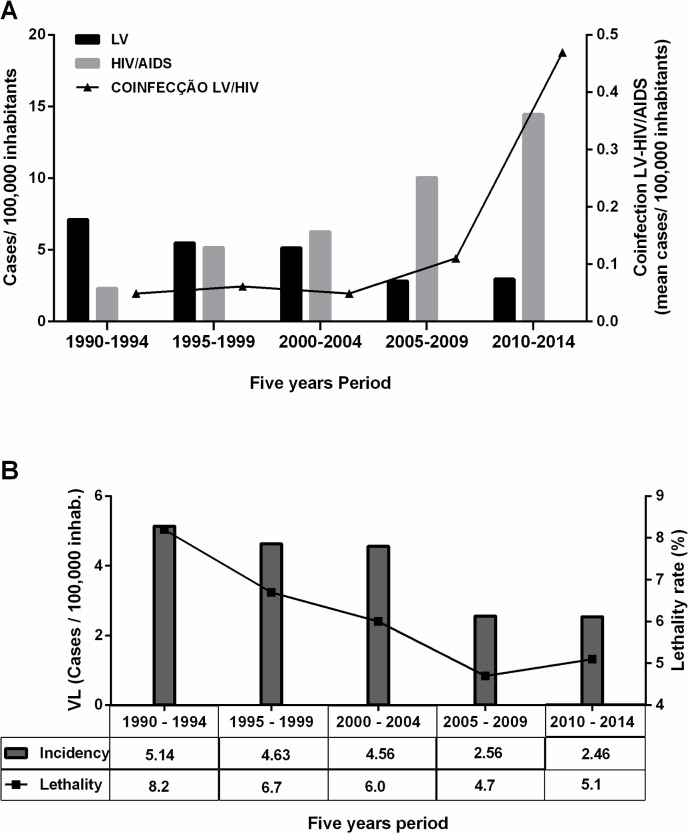
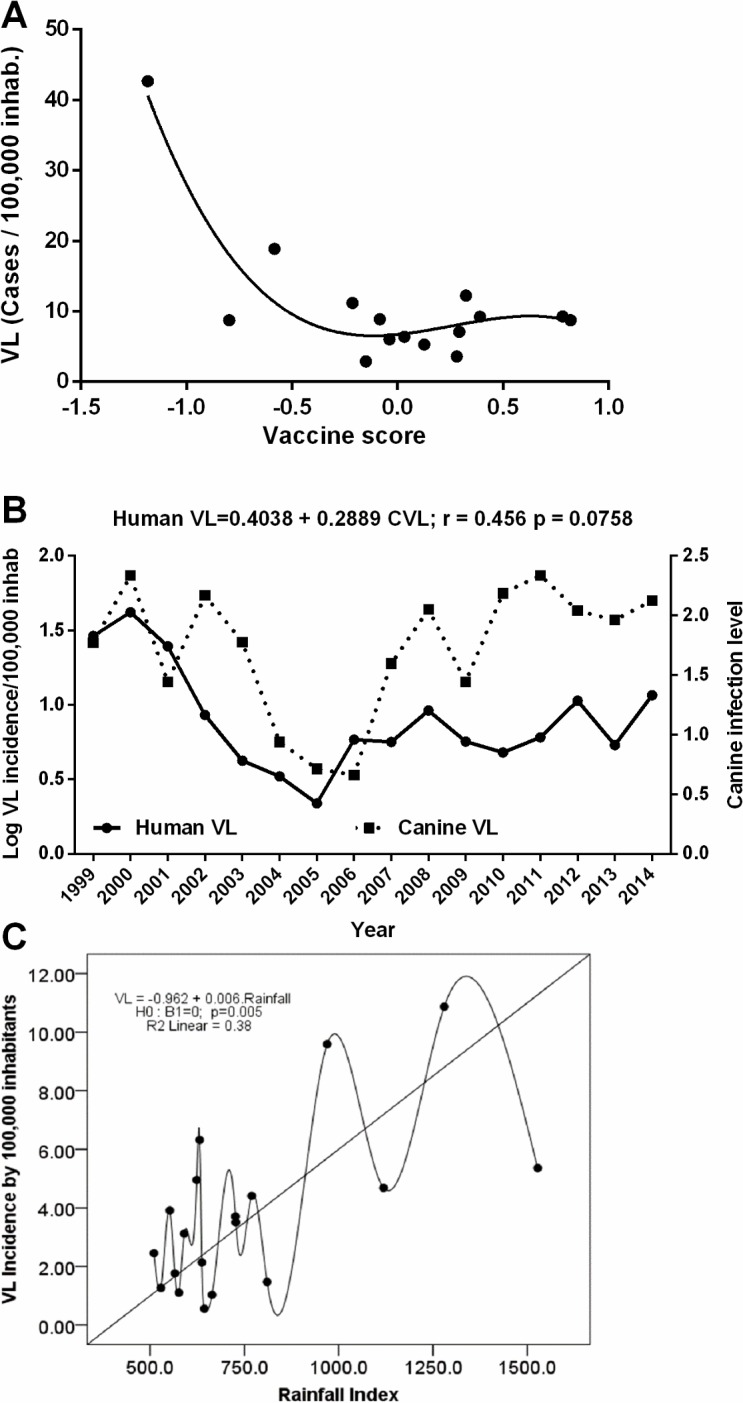
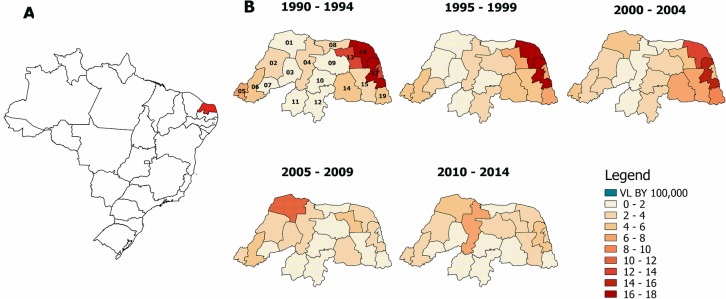
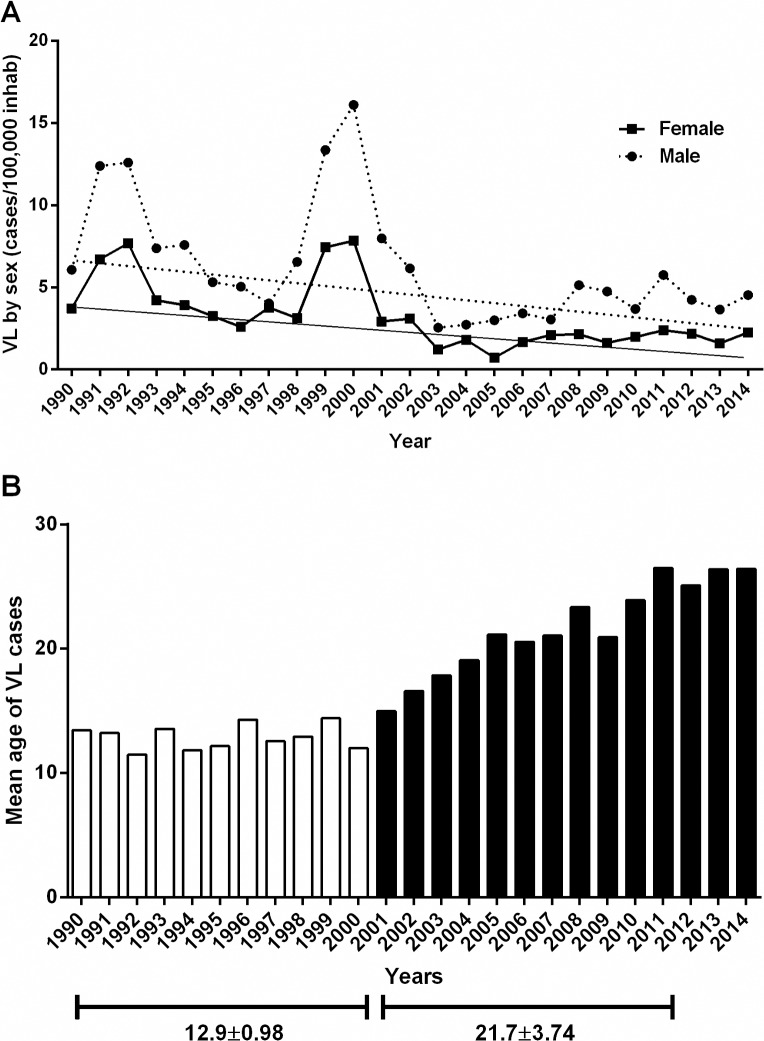
METHODOLOGY/PRINCIPAL FINDINGS: A retrospective study of human VL was performed in the state of Rio Grande do Norte, Brazil, for the period of 1990-2014. The data were divided into five-time periods. For all VL cases, data on sex, age, nutritional status and childhood vaccination were collected. Geographic information system tools and statistical models were used to analyze the dispersion of human VL. The mean annual incidence of VL was 4.6 cases/100,000 inhabitants, with total 3,252 cases reported. The lethality rate was 6.4%. Over time the annual incidence of VL decreased in the 0-4 years (p<0.0001) and 5-9 (p <0.0001) age groups, but increased in ages 20-39 (p<0.001) and >40 years (p<0.0001). VL occurred more often in males (β2 = 2.5; p<0.0001). The decreased incidence of VL in children was associated with improved nutritional status and childhood immunizations including measles, poliomyelitis, BCG, and hepatitis B. Human VL correlated temporally and geographically with canine L. infantum infection (p = 0.002, R2 = 0.438), with rainfall and with Lutzomyia longipalpis density (r = 0.762). Overall, the incidence of VL decreased, while VL-AIDS increased, especially between 2010-2014. VL was more frequently found in areas that lacked urban infrastructure, detected by lack of garbage collection and sewers, whereas HIV infection was associated with higher levels of schooling and evidence of higher socioeconomic status.
CONCLUSION/SIGNIFICANCE: The demographics of VL in northeastern Brazil have changed. Disease incidence has decreased in children and increased in adults. They were associated with improvements in nutrition, socioeconomic status and immunization rates. Concurrent VL-AIDS poses a serious challenge for the future.
内脏利什曼病(VL)由利什曼原虫引起,在过去 30 年中已成为巴西城市地区的一种疾病,这些地区的无症状利什曼原虫感染有所增加。
方法/主要发现:对巴西北里奥格兰德州 1990-2014 年期间的人类内脏利什曼病进行了回顾性研究。将数据分为五个时间段。对所有 VL 病例,收集了性别、年龄、营养状况和儿童疫苗接种数据。利用地理信息系统工具和统计模型分析了人类 VL 的分布情况。VL 的年平均发病率为每 100,000 居民 4.6 例,共报告 3252 例。死亡率为 6.4%。随着时间的推移,0-4 岁(p<0.0001)和 5-9 岁(p<0.0001)年龄组的 VL 年发病率下降,但 20-39 岁(p<0.001)和>40 岁(p<0.0001)年龄组的 VL 发病率增加。VL 更常见于男性(β2 = 2.5;p<0.0001)。儿童 VL 发病率下降与营养状况改善以及麻疹、脊髓灰质炎、卡介苗和乙型肝炎等儿童免疫接种有关。人类 VL 与犬内脏利什曼原虫感染呈时间和空间相关(p = 0.002,R2 = 0.438),与降雨量和长角血蜱密度相关(r = 0.762)。总体而言,VL 的发病率下降,而 VL-AIDS 增加,尤其是在 2010-2014 年之间。VL 在缺乏城市基础设施的地区更为常见,表现为缺乏垃圾收集和下水道,而 HIV 感染与更高的教育程度和更高的社会经济地位有关。
结论/意义:巴西东北部的 VL 人口统计学特征发生了变化。疾病发病率在儿童中下降,在成人中上升。这些变化与营养改善、社会经济地位提高和疫苗接种率提高有关。同时发生的 VL-AIDS 对未来构成了严重挑战。