Department of Radiology, Severance Hospital, Research Institute of Radiological Science Yonsei University College of Medicine, Seoul, Republic of Korea.
Department of Radiology, Severance Hospital, Research Institute of Radiological Science and Center for Clinical Imaging Data Science, Yonsei University College of Medicine, Seoul, Republic of Korea.
PLoS One. 2018 Mar 6;13(3):e0193883. doi: 10.1371/journal.pone.0193883. eCollection 2018.
The aim of this study was to find useful metabolites to predict lymph node (LN) metastasis in patients with papillary thyroid cancer (PTC) through a metabolomics approach and investigate the potential role of metabolites as a novel prognostic marker.
Fifty-two consecutive patients (median age: 41.5 years, range 15-74 years) were enrolled who underwent total thyroidectomy and central LN dissection with or without lateral LN dissection in Severance Hospital between October 2013 and July 2015. The study specimens were provided by the Severance Hospital Gene Bank, and consisted of PTC from each patient. The specimens were prepared for proton nuclear magnetic resonance (1H-NMR) spectroscopy. Spectral data by 1H-NMR spectroscopy were acquired, processed, and analyzed. Patients were grouped in three ways, according to the presence of LN metastasis, central LN metastasis and lateral LN metastasis. Chi-square test and the student t-test were used to analyze categorical variables and continuous variables, respectively. The Mann-Whitney U test was used for univariate analysis of metabolites. Orthogonal projections to latent structure discriminant analysis (OPLS-DA) was used for multivariate analysis to discriminate metabolic differences between the two groups.
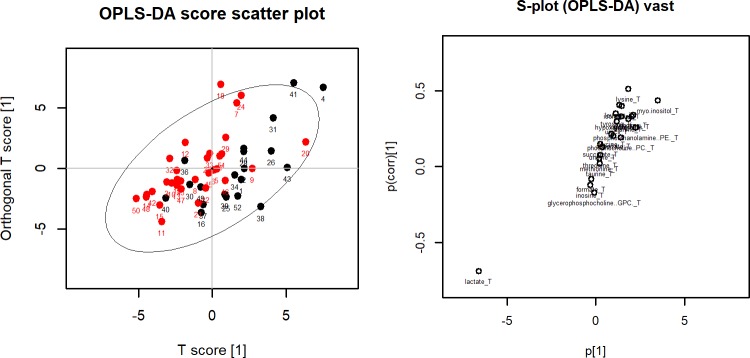
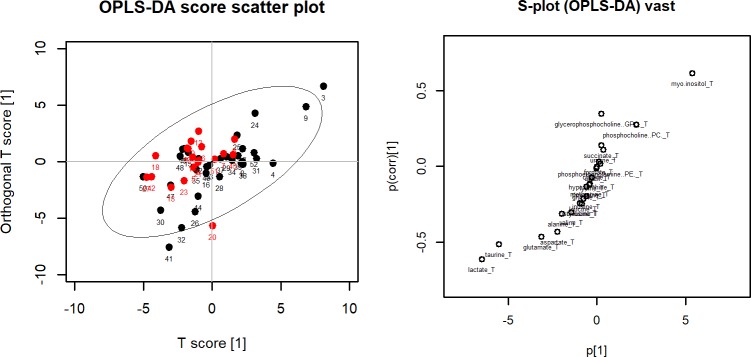
Among 52 patients, 32 had central LN metastasis and 19 had lateral LN metastasis. No clinical or histopathological characteristic was significantly different for all comparisons. On univariate analysis, no metabolite showed significant difference for all comparisons. On multivariate analysis, OPLS-DA did not discriminate the presence and absence of LN metastasis. Lactate was found to be the most promising metabolite.
No metabolite could discriminate the presence of LN metastasis. However, lactate was found to be the most promising metabolite for discrimination. Further studies with larger sample sizes are needed to elucidate significant metabolites which can indicate the presence of LN metastasis in patients with PTC.
本研究旨在通过代谢组学方法寻找预测甲状腺乳头状癌(PTC)患者淋巴结(LN)转移的有用代谢物,并探讨代谢物作为一种新的预后标志物的潜在作用。
2013 年 10 月至 2015 年 7 月,在 Severance 医院连续纳入 52 例(中位年龄:41.5 岁,范围 15-74 岁)接受全甲状腺切除术和中央 LN 清扫术加或不加侧方 LN 清扫术的患者。研究标本由 Severance 医院基因库提供,包括每位患者的 PTC。标本制备用于质子磁共振(1H-NMR)波谱分析。采集、处理和分析 1H-NMR 光谱的光谱数据。根据 LN 转移、中央 LN 转移和侧方 LN 转移的存在情况,将患者分为三组。卡方检验和学生 t 检验分别用于分析分类变量和连续变量。使用 Mann-Whitney U 检验进行代谢物的单变量分析。正交投影到潜在结构判别分析(OPLS-DA)用于两组间代谢差异的多变量分析。
在 52 例患者中,32 例有中央 LN 转移,19 例有侧方 LN 转移。所有比较的临床或组织病理学特征均无显著差异。在单变量分析中,所有比较的代谢物均无显著差异。在多变量分析中,OPLS-DA 无法区分 LN 转移的存在与否。乳酸被认为是最有前途的代谢物。
没有代谢物可以区分 LN 转移的存在。然而,乳酸被认为是区分 LN 转移的最有前途的代谢物。需要进一步进行更大样本量的研究,以阐明能指示 PTC 患者 LN 转移存在的有意义的代谢物。