Neuroscience Research Lab, Research Center for Translational Medicine, Koç University, Istanbul, Turkey.
Graduate School of Health Sciences, Koç University, Istanbul, Turkey.
Curr Neuropharmacol. 2018;16(9):1396-1415. doi: 10.2174/1570159X16666180302115544.
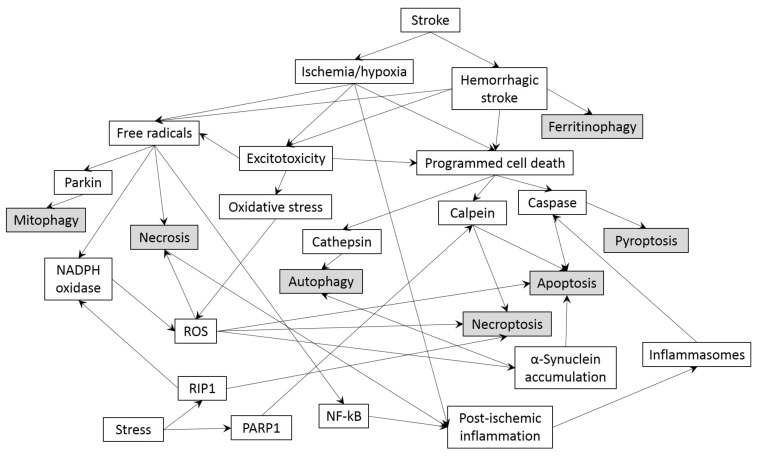
As a result of ischemia or hemorrhage, blood supply to neurons is disrupted which subsequently promotes a cascade of pathophysiological responses resulting in cell loss. Many mechanisms are involved solely or in combination in this disorder including excitotoxicity, mitochondrial death pathways, and the release of free radicals, protein misfolding, apoptosis, necrosis, autophagy and inflammation. Besides neuronal cell loss, damage to and loss of astrocytes as well as injury to white matter contributes also to cerebral injury. The core problem in stroke is the loss of neuronal cells which makes recovery difficult or even not possible in the late states. Acute treatment options that can be applied for stroke are mainly targeting re-establishment of blood flow and hence, their use is limited due to the effective time window of thrombolytic agents. However, if the acute time window is exceeded, neuronal loss starts due to the activation of cell death pathways. This review will explore the most updated cellular death mechanisms leading to neuronal loss in stroke. Ischemic and hemorrhagic stroke as well as subarachnoid hemorrhage will be debated in the light of cell death mechanisms and possible novel molecular and cellular treatment options will be discussed.
由于缺血或出血,神经元的血液供应被中断,随后会引发一系列病理生理反应,导致细胞死亡。许多机制单独或联合参与了这种疾病,包括兴奋性毒性、线粒体死亡途径和自由基的释放、蛋白质错误折叠、细胞凋亡、坏死、自噬和炎症。除了神经元细胞死亡外,星形胶质细胞的损伤和丢失以及白质的损伤也会导致脑损伤。中风的核心问题是神经元细胞的丧失,这使得中风在晚期难以恢复,甚至无法恢复。可用于中风的急性治疗方法主要针对重新建立血流,因此由于溶栓药物的有效时间窗,其使用受到限制。然而,如果超过急性时间窗,由于细胞死亡途径的激活,神经元开始死亡。这篇综述将探讨导致中风神经元丧失的最新细胞死亡机制。将根据细胞死亡机制讨论缺血性和出血性中风以及蛛网膜下腔出血,并讨论可能的新的分子和细胞治疗选择。