School of Business Administration, Zhejiang University of Finance & Economics, Hangzhou 310018, China.
School of Economics, Zhejiang University of Finance & Economics, Hangzhou 310018, China.
Int J Environ Res Public Health. 2018 Mar 8;15(3):471. doi: 10.3390/ijerph15030471.
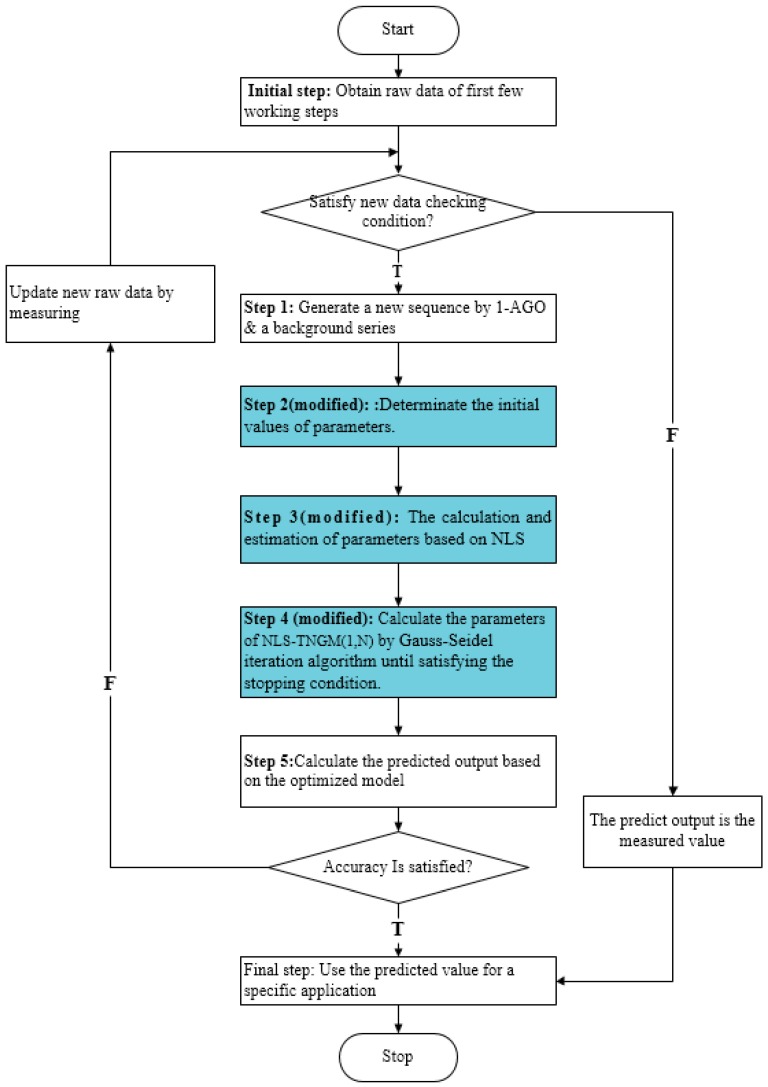
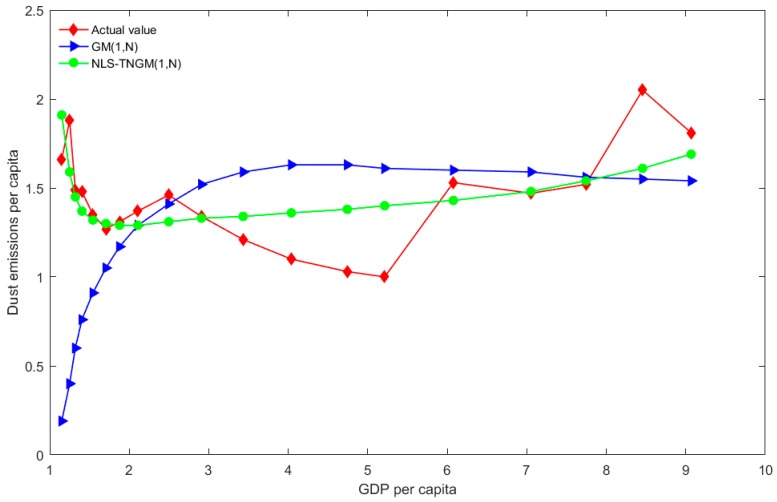
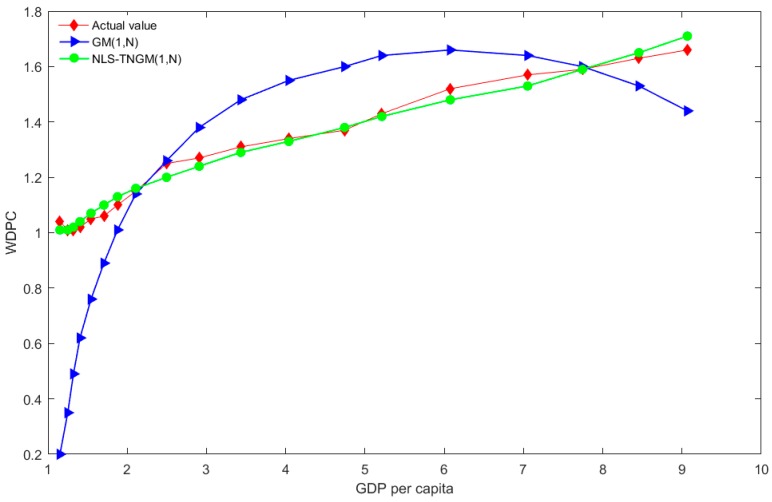
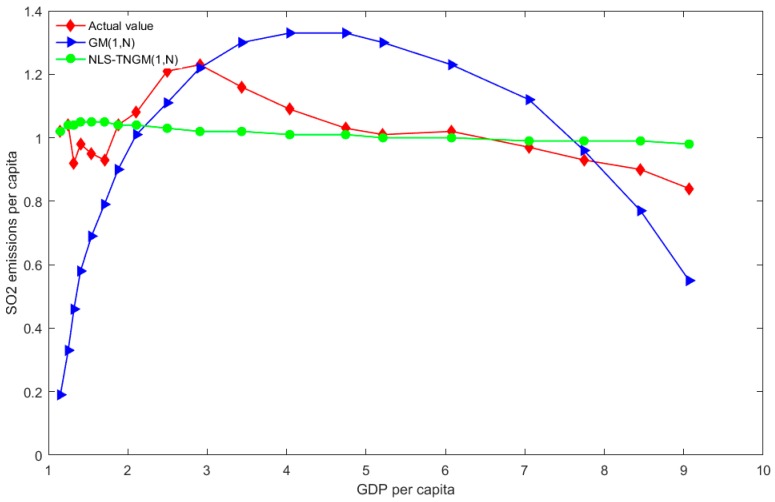
The relationship between pollutant discharge and economic growth has been a major research focus in environmental economics. To accurately estimate the nonlinear change law of China's pollutant discharge with economic growth, this study establishes a transformed nonlinear grey multivariable (TNGM (1, )) model based on the nonlinear least square (NLS) method. The Gauss-Seidel iterative algorithm was used to solve the parameters of the TNGM (1, ) model based on the NLS basic principle. This algorithm improves the precision of the model by continuous iteration and constantly approximating the optimal regression coefficient of the nonlinear model. In our empirical analysis, the traditional grey multivariate model GM (1, ) and the NLS-based TNGM (1, ) models were respectively adopted to forecast and analyze the relationship among wastewater discharge per capita (WDPC), and per capita emissions of SO₂ and dust, alongside GDP per capita in China during the period 1996-2015. Results indicated that the NLS algorithm is able to effectively help the grey multivariable model identify the nonlinear relationship between pollutant discharge and economic growth. The results show that the NLS-based TNGM (1, ) model presents greater precision when forecasting WDPC, SO₂ emissions and dust emissions per capita, compared to the traditional GM (1, ) model; WDPC indicates a growing tendency aligned with the growth of GDP, while the per capita emissions of SO₂ and dust reduce accordingly.
污染物排放与经济增长之间的关系一直是环境经济学的主要研究重点。为了准确估计中国污染物排放与经济增长之间的非线性变化规律,本研究基于非线性最小二乘法(NLS)建立了一个转换非线性灰色多变量(TNGM(1,))模型。基于 NLS 基本原理,采用高斯-塞德尔迭代算法来求解 TNGM(1,)模型的参数。该算法通过连续迭代不断逼近非线性模型的最优回归系数,从而提高模型的精度。在我们的实证分析中,分别采用传统的灰色多变量模型 GM(1,)和基于 NLS 的 TNGM(1,)模型对中国 1996-2015 年人均废水排放量(WDPC)、人均 SO₂和粉尘排放量与人均 GDP 之间的关系进行预测和分析。结果表明,NLS 算法能够有效地帮助灰色多变量模型识别污染物排放与经济增长之间的非线性关系。结果表明,与传统的 GM(1,)模型相比,基于 NLS 的 TNGM(1,)模型在预测 WDPC、SO₂排放和粉尘排放方面具有更高的精度;人均废水排放量与 GDP 增长呈同步增长趋势,而 SO₂和粉尘的人均排放量则相应减少。