Departments of Physiology and Pharmacology and.
Division of Nephrology, and.
Clin J Am Soc Nephrol. 2018 Apr 6;13(4):604-611. doi: 10.2215/CJN.07470717. Epub 2018 Mar 8.
There is a paucity of data available to describe drug dialyzability. Of the available information, most was obtained before implementation of modern hemodialysis membranes. Our study characterized dialyzability of the most commonly prescribed -blockers in patients undergoing high-flux hemodialysis.
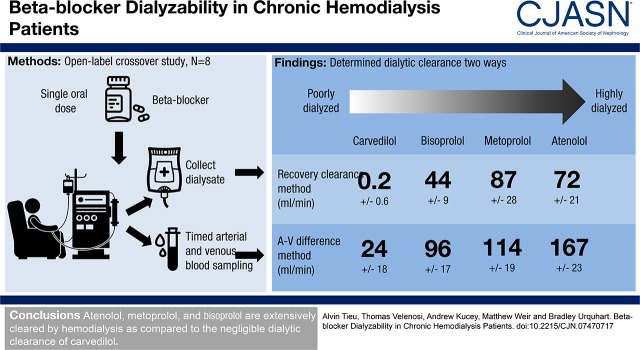
DESIGN, SETTING, PARTICIPANTS, & MEASUREMENTS: Patients on hemodialysis (=8) were recruited to an open label, pharmacokinetic, four-way crossover trial. Single doses of atenolol, metoprolol, bisoprolol, and carvedilol were administered on separate days in random order to each patient. Plasma and dialysate drug concentrations were measured, and dialyzability was determined by the recovery clearance and arterial venous difference methods.
Using the recovery clearance method, the dialytic clearance values for atenolol, metoprolol, bisoprolol, and carvedilol were 72, 87, 44, and 0.2 ml/min, respectively (<0.001). Applying the arterial venous difference method, the dialytic clearance values of atenolol, metoprolol, bisoprolol, and carvedilol were 167, 114, 96, and 24 ml/min, respectively (<0.001).
Atenolol and metoprolol are extensively cleared by hemodialysis compared with the negligible dialytic clearance of carvedilol. Contrary to estimates of dialyzability on the basis of previous literature, our data indicate that bisoprolol is also dialyzable. This finding highlights the importance of conducting dialyzability studies to definitively characterize drug dialytic clearance.
目前可用的数据很少能够描述药物的可透析性。在现有的信息中,大多数是在现代血液透析膜应用之前获得的。我们的研究描述了在高通量血液透析患者中最常开的β受体阻滞剂的可透析性。
设计、地点、参与者和测量:招募了(=8)名正在接受血液透析的患者参加一项开放标签、药代动力学、四交叉试验。在不同的日子里,以随机顺序向每位患者单次给药阿替洛尔、美托洛尔、比索洛尔和卡维地洛。测量血浆和透析液中的药物浓度,并通过恢复清除率和动静脉差方法确定可透析性。
使用恢复清除率法,阿替洛尔、美托洛尔、比索洛尔和卡维地洛的透析清除率值分别为 72、87、44 和 0.2 ml/min(<0.001)。应用动静脉差法,阿替洛尔、美托洛尔、比索洛尔和卡维地洛的透析清除率值分别为 167、114、96 和 24 ml/min(<0.001)。
与卡维地洛可忽略不计的透析清除率相比,阿替洛尔和美托洛尔被血液透析广泛清除。与基于先前文献的可透析性估计相反,我们的数据表明比索洛尔也可透析。这一发现强调了进行可透析性研究以明确描述药物透析清除率的重要性。