• 文献检索
  • 文档翻译
  • 深度研究
  • 学术资讯
  • Suppr Zotero 插件Zotero 插件
  • 邀请有礼
  • 套餐&价格
  • 历史记录
应用&插件
Suppr Zotero 插件Zotero 插件浏览器插件Mac 客户端Windows 客户端微信小程序
定价
高级版会员购买积分包购买API积分包
服务
文献检索文档翻译深度研究API 文档MCP 服务
关于我们
关于 Suppr公司介绍联系我们用户协议隐私条款
关注我们

Suppr 超能文献

核心技术专利:CN118964589B侵权必究
粤ICP备2023148730 号-1Suppr @ 2026

文献检索

告别复杂PubMed语法,用中文像聊天一样搜索,搜遍4000万医学文献。AI智能推荐,让科研检索更轻松。

立即免费搜索

文件翻译

保留排版,准确专业,支持PDF/Word/PPT等文件格式,支持 12+语言互译。

免费翻译文档

深度研究

AI帮你快速写综述,25分钟生成高质量综述,智能提取关键信息,辅助科研写作。

立即免费体验

慢性阻塞性肺疾病患者正确使用吸入器的相关因素——来自真实调查的经验教训

Factors associated with appropriate inhaler use in patients with COPD - lessons from the REAL survey.

作者信息

Price David, Keininger Dorothy L, Viswanad Boomi, Gasser Matthias, Walda Susann, Gutzwiller Florian S

机构信息

Division of Applied Health Sciences, Academic Primary Care, University of Aberdeen, Aberdeen, UK.

Observational and Pragmatic Research Institute, Singapore.

出版信息

Int J Chron Obstruct Pulmon Dis. 2018 Feb 26;13:695-702. doi: 10.2147/COPD.S149404. eCollection 2018.

DOI:10.2147/COPD.S149404
PMID:29520137
原文链接:https://pmc.ncbi.nlm.nih.gov/articles/PMC5834182/
Abstract

BACKGROUND

Nonadherence to medication and incorrect use of inhalers represent significant barriers to optimal disease management of patients with chronic obstructive pulmonary disease (COPD). Thus, health care professionals (HCPs) play a critical role in educating their patients on appropriate inhaler use and in ensuring medication adherence. However, many patients do not receive appropriate inhaler training or have not had their inhaler technique checked.

METHODS

The Real-life Experience and Accuracy of inhaLer use (REAL) survey was a computer-assisted, telephonic survey consisting of 23 questions gathering real-world information on correct inhaler use, inhalation technique, device attributes, adherence, dosing accuracy, training, correct device use, ease of use, and factors that influence patient adherence in commercially available inhalers delivering COPD maintenance therapy. All results are based on patient-reported data.

RESULTS

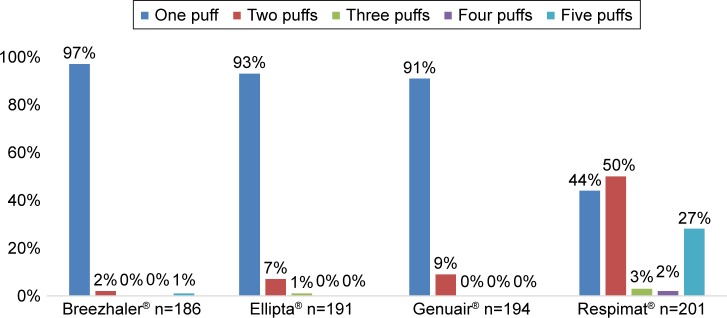
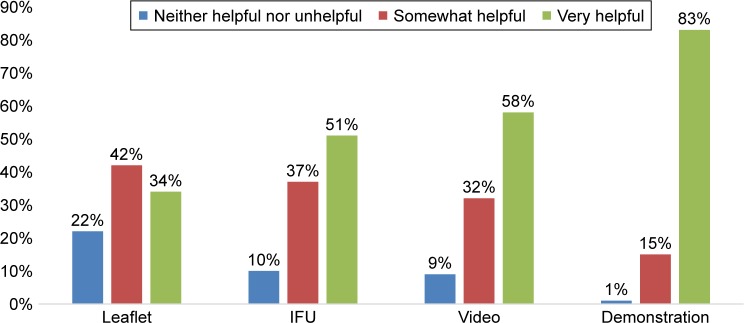
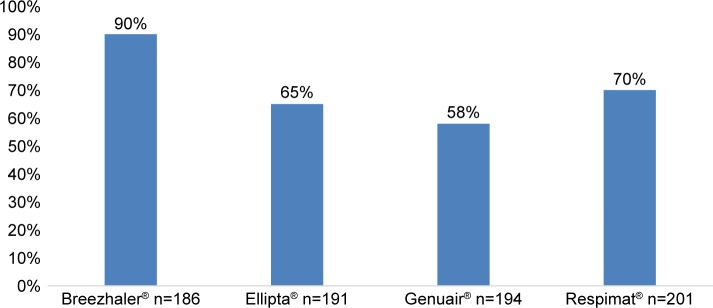
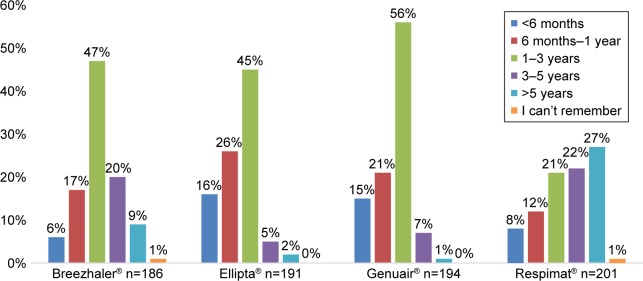
The survey was conducted between January 4, 2016 and February 2, 2016. A total of 764 patients using various inhalers (Breezhaler =186; Ellipta =191; Genuair =194; Respimat =201) with mild to very severe COPD, with a mean ± SD age 56±9.8 years, completed the survey. Patient self-reported adherence was significantly lower in younger patients compared to older patients (=0.020). Eighty-three percent of patients indicated that a demonstration (in-person) was "very helpful" versus 58% for video. Patient preferences for training methods were as follows: demonstration of inhaler use (83%), video (58%), instructions for use (51%), and leaflet (34%). Twenty-nine percent of patients had not been checked to see if they were using their device correctly by a HCP within the last two years. Patients who were checked were significantly more adherent than unchecked patients (=0.020). The majority of the patients using Breezhaler reported either being very confident or confident of having taken a full dose, which was higher than those using Genuair, Ellipta (α=0.05), and Respimat (α=0.05). Treatment adherence in the last 30 days was highest with Breezhaler followed by Respimat, Ellipta, and Genuair.

CONCLUSION

The REAL survey identified attributes that influenced patient adherence and optimal inhaler use. Predictive attributes that influence patient adherence which HCPs should be aware of include age and disease severity. Modifiable attributes which the HCP can influence include correct inhaler use training, choice of training methods, checking patient inhaler technique at subsequent visits, and device selection. Inhalers are integral in the effective management of patients with COPD; it is therefore important that patients use the inhaler correctly and have full confidence in the dosage.

摘要

背景

不坚持用药以及吸入器使用不当是慢性阻塞性肺疾病(COPD)患者实现最佳疾病管理的重大障碍。因此,医疗保健专业人员(HCPs)在教育患者正确使用吸入器以及确保药物依从性方面发挥着关键作用。然而,许多患者没有接受适当的吸入器培训,或者其吸入器使用技术未得到检查。

方法

吸入器使用的实际经验与准确性(REAL)调查是一项计算机辅助电话调查,由23个问题组成,收集关于正确吸入器使用、吸入技术、装置属性、依从性、剂量准确性、培训、正确装置使用、易用性以及影响使用COPD维持治疗商用吸入器的患者依从性的因素等真实世界信息。所有结果均基于患者报告的数据。

结果

该调查于2016年1月4日至2016年2月2日进行。共有764名使用各种吸入器(Breezhaler = 186;Ellipta = 191;Genuair = 194;Respimat = 201)的轻至重度COPD患者完成了调查,平均年龄±标准差为56±9.8岁。与老年患者相比,年轻患者自我报告的依从性显著更低(P = 0.020)。83%的患者表示亲自示范“非常有帮助”,而视频示范的这一比例为58%。患者对培训方法的偏好如下:吸入器使用示范(83%)、视频(58%)、使用说明(51%)和宣传册(34%)。29%的患者在过去两年内未接受HCP检查其吸入器使用是否正确。接受检查的患者依从性显著高于未接受检查的患者(P = 0.020)。使用Breezhaler的大多数患者报告对已服用全剂量非常有信心或有信心,这一比例高于使用Genuair、Ellipta(α = 0.05)和Respimat(α = 0.05)的患者。在过去30天内,Breezhaler的治疗依从性最高,其次是Respimat、Ellipta和Genuair。

结论

REAL调查确定了影响患者依从性和最佳吸入器使用的属性。HCP应了解的影响患者依从性的预测属性包括年龄和疾病严重程度。HCP可以影响的可改变属性包括正确的吸入器使用培训、培训方法的选择、在后续就诊时检查患者的吸入器技术以及装置选择。吸入器是COPD患者有效管理的重要组成部分;因此,患者正确使用吸入器并对剂量充满信心非常重要。
https://cdn.ncbi.nlm.nih.gov/pmc/blobs/bd8a/5834182/79150cc2b8dc/copd-13-695Fig4.jpg
https://cdn.ncbi.nlm.nih.gov/pmc/blobs/bd8a/5834182/76a1601e78ac/copd-13-695Fig1.jpg
https://cdn.ncbi.nlm.nih.gov/pmc/blobs/bd8a/5834182/3fe1f2e50e93/copd-13-695Fig2.jpg
https://cdn.ncbi.nlm.nih.gov/pmc/blobs/bd8a/5834182/d9b56a190d42/copd-13-695Fig3.jpg
https://cdn.ncbi.nlm.nih.gov/pmc/blobs/bd8a/5834182/79150cc2b8dc/copd-13-695Fig4.jpg
https://cdn.ncbi.nlm.nih.gov/pmc/blobs/bd8a/5834182/76a1601e78ac/copd-13-695Fig1.jpg
https://cdn.ncbi.nlm.nih.gov/pmc/blobs/bd8a/5834182/3fe1f2e50e93/copd-13-695Fig2.jpg
https://cdn.ncbi.nlm.nih.gov/pmc/blobs/bd8a/5834182/d9b56a190d42/copd-13-695Fig3.jpg
https://cdn.ncbi.nlm.nih.gov/pmc/blobs/bd8a/5834182/79150cc2b8dc/copd-13-695Fig4.jpg

相似文献

1
Factors associated with appropriate inhaler use in patients with COPD - lessons from the REAL survey.慢性阻塞性肺疾病患者正确使用吸入器的相关因素——来自真实调查的经验教训
Int J Chron Obstruct Pulmon Dis. 2018 Feb 26;13:695-702. doi: 10.2147/COPD.S149404. eCollection 2018.
2
Maintenance inhaler preference, attribute importance, and satisfaction in prescribing physicians and patients with asthma, COPD, or asthma-COPD overlap syndrome consulting for routine care.维持性吸入器偏好、属性重要性以及哮喘、慢性阻塞性肺疾病(COPD)或哮喘-COPD重叠综合征患者及开具处方的医生在接受常规护理咨询时的满意度。
Int J Chron Obstruct Pulmon Dis. 2018 Mar 16;13:927-936. doi: 10.2147/COPD.S154525. eCollection 2018.
3
Inhaler devices for chronic obstructive pulmonary disease: insights from patients and healthcare practitioners.慢性阻塞性肺疾病吸入装置:来自患者和医疗从业者的见解
J Aerosol Med Pulm Drug Deliv. 2015 Jun;28(3):219-28. doi: 10.1089/jamp.2014.1142. Epub 2014 Sep 29.
4
Satisfaction, preference and error occurrence of three dry powder inhalers as assessed by a cohort naïve to inhaler operation.由一组对吸入器操作不熟悉的人群评估的三种干粉吸入器的满意度、偏好和错误发生率。
Int J Chron Obstruct Pulmon Dis. 2018 Jun 15;13:1949-1963. doi: 10.2147/COPD.S152285. eCollection 2018.
5
Preferences and Inhalation Techniques for Inhaler Devices Used by Patients with Chronic Obstructive Pulmonary Disease.慢性阻塞性肺疾病患者使用的吸入装置的偏好和吸入技术。
J Aerosol Med Pulm Drug Deliv. 2018 Aug;31(4):237-247. doi: 10.1089/jamp.2017.1409. Epub 2017 Dec 5.
6
In vitro dose comparison of Respimat inhaler with dry powder inhalers for COPD maintenance therapy.Respimat吸入器与干粉吸入器用于慢性阻塞性肺疾病维持治疗的体外剂量比较。
Int J Chron Obstruct Pulmon Dis. 2017 May 26;12:1565-1577. doi: 10.2147/COPD.S115886. eCollection 2017.
7
The importance of inhaler devices: the choice of inhaler device may lead to suboptimal adherence in COPD patients.吸入装置的重要性:吸入装置的选择可能导致慢性阻塞性肺疾病(COPD)患者的依从性欠佳。
Int J Chron Obstruct Pulmon Dis. 2015 Oct 29;10:2335-45. doi: 10.2147/COPD.S90155. eCollection 2015.
8
Misuse of inhalers among COPD patients in a community hospital in Taiwan.台湾一家社区医院慢性阻塞性肺疾病患者吸入器的误用情况。
Int J Chron Obstruct Pulmon Dis. 2018 Apr 23;13:1309-1316. doi: 10.2147/COPD.S158864. eCollection 2018.
9
A cross-sectional study to assess inhalation device handling and patient satisfaction in COPD.一项评估慢性阻塞性肺疾病(COPD)患者吸入装置使用情况及患者满意度的横断面研究。
Int J Chron Obstruct Pulmon Dis. 2016 Feb 26;11:407-15. doi: 10.2147/COPD.S91118. eCollection 2016.
10
COPD: misuse of inhaler devices in clinical practice.COPD:临床实践中吸入器装置的误用。
Int J Chron Obstruct Pulmon Dis. 2019 May 30;14:1209-1217. doi: 10.2147/COPD.S178040. eCollection 2019.

引用本文的文献

1
Predictors of Suboptimal Peak Inspiratory Flow in Patients with Acute Exacerbation of Chronic Obstructive Pulmonary Disease in Clinical Practice.临床实践中慢性阻塞性肺疾病急性加重患者吸气峰流速未达最佳水平的预测因素
Tuberc Respir Dis (Seoul). 2025 Jul;88(3):516-525. doi: 10.4046/trd.2024.0154. Epub 2025 Mar 6.
2
People Living with Chronic Obstructive Pulmonary Disease (COPD) and Inhalers: Insights and Suggestions from a Human Factors Study on NEXThaler.慢性阻塞性肺疾病(COPD)患者与吸入器:关于NEXThaler的人为因素研究的见解与建议
Patient Prefer Adherence. 2024 Dec 3;18:2415-2423. doi: 10.2147/PPA.S483993. eCollection 2024.
3

本文引用的文献

1
Inhaler Errors in the CRITIKAL Study: Type, Frequency, and Association with Asthma Outcomes.CRITIKAL 研究中的吸入器错误:类型、频率及其与哮喘结局的关联。
J Allergy Clin Immunol Pract. 2017 Jul-Aug;5(4):1071-1081.e9. doi: 10.1016/j.jaip.2017.01.004. Epub 2017 Mar 9.
2
Chronic obstructive pulmonary disease exacerbation and inhaler device handling: real-life assessment of 2935 patients.慢性阻塞性肺疾病恶化和吸入器装置处理:2935 例患者的真实生活评估。
Eur Respir J. 2017 Feb 15;49(2). doi: 10.1183/13993003.01794-2016. Print 2017 Feb.
3
The use of multiple respiratory inhalers requiring different inhalation techniques has an adverse effect on COPD outcomes.
Environmental impact of inhaled medicines: A Thoracic Society of Australia and New Zealand position statement.
吸入药物的环境影响:澳大利亚和新西兰胸科学会立场声明
Respirology. 2025 Feb;30(2):101-112. doi: 10.1111/resp.14852. Epub 2024 Nov 13.
4
Clinical profile, inhaler technique, and predictors of inhaler adherence among asthma and COPD patients who attended the outpatient emergency department for acute exacerbation.因急性加重到门诊急诊科就诊的哮喘和慢性阻塞性肺疾病患者的临床特征、吸入器使用技术及吸入器依从性的预测因素。
Intern Emerg Med. 2024 Nov 5. doi: 10.1007/s11739-024-03810-5.
5
Exploring Experiences and Asthma Management Among Middle Eastern Arabic-Speaking Migrants and Refugees with Asthma: A Qualitative Study.探索中东阿拉伯语移民和哮喘难民的经历及哮喘管理:一项定性研究。
Patient Prefer Adherence. 2024 Aug 27;18:1789-1801. doi: 10.2147/PPA.S471347. eCollection 2024.
6
Systematic review of the effects of patient errors using inhaled delivery systems on clinical outcomes in COPD.使用吸入式给药系统的患者错误对 COPD 临床结果影响的系统评价。
BMJ Open Respir Res. 2024 Apr 16;11(1):e002211. doi: 10.1136/bmjresp-2023-002211.
7
Does mixing inhaler devices lead to unchecked inhaler technique errors in patients with COPD? Findings from the cross-sectional observational MISMATCH study.混合吸入装置是否会导致 COPD 患者的吸入技术错误无法控制?来自横向观察性 MISMATCH 研究的结果。
BMJ Open Respir Res. 2023 Dec 22;10(1):e001821. doi: 10.1136/bmjresp-2023-001821.
8
Clinical Management of COPD in the Real World: Can Studies Reveal Errors in Management and Pathways to Improve Patient Care?慢性阻塞性肺疾病在现实世界中的临床管理:研究能否揭示管理中的错误以及改善患者护理的途径?
Pragmat Obs Res. 2023 Aug 1;14:51-61. doi: 10.2147/POR.S396830. eCollection 2023.
9
Prevalence and Factors Affecting Appropriate Inhaler Use in Elderly Patients with Chronic Obstructive Pulmonary Disease: A Prospective Study.老年慢性阻塞性肺疾病患者吸入器正确使用情况的患病率及影响因素:一项前瞻性研究。
J Clin Med. 2023 Jun 30;12(13):4420. doi: 10.3390/jcm12134420.
10
Correlation Analysis of the Therapy Adherence to Long-Acting Inhalers Among Patients with Stable COPD.稳定期慢性阻塞性肺疾病患者长效吸入器治疗依从性的相关性分析
Patient Prefer Adherence. 2023 Jun 17;17:1467-1475. doi: 10.2147/PPA.S413948. eCollection 2023.
使用需要不同吸入技术的多种呼吸吸入器对慢性阻塞性肺疾病(COPD)的治疗效果有不利影响。
Int J Chron Obstruct Pulmon Dis. 2016 Dec 21;12:59-71. doi: 10.2147/COPD.S117196. eCollection 2017.
4
"Trying, But Failing" - The Role of Inhaler Technique and Mode of Delivery in Respiratory Medication Adherence.“尝试但失败”——吸入器技术和输送模式在呼吸药物依从性中的作用。
J Allergy Clin Immunol Pract. 2016 Sep-Oct;4(5):823-32. doi: 10.1016/j.jaip.2016.03.002.
5
What We Mean When We Talk About Adherence in Respiratory Medicine.当我们在呼吸医学中谈论依从性时,我们的意思是什么。
J Allergy Clin Immunol Pract. 2016 Sep-Oct;4(5):802-12. doi: 10.1016/j.jaip.2016.05.019.
6
Systematic Review of Errors in Inhaler Use: Has Patient Technique Improved Over Time?吸入器使用错误的系统评价:患者的技术是否随着时间的推移而有所改善?
Chest. 2016 Aug;150(2):394-406. doi: 10.1016/j.chest.2016.03.041. Epub 2016 Apr 7.
7
A cross-sectional study to assess inhalation device handling and patient satisfaction in COPD.一项评估慢性阻塞性肺疾病(COPD)患者吸入装置使用情况及患者满意度的横断面研究。
Int J Chron Obstruct Pulmon Dis. 2016 Feb 26;11:407-15. doi: 10.2147/COPD.S91118. eCollection 2016.
8
Comparison of serious inhaler technique errors made by device-naïve patients using three different dry powder inhalers: a randomised, crossover, open-label study.初次使用三种不同干粉吸入器的患者所犯严重吸入器技术错误的比较:一项随机、交叉、开放标签研究。
BMC Pulm Med. 2016 Jan 14;16:12. doi: 10.1186/s12890-016-0169-5.
9
Inhaler devices for chronic obstructive pulmonary disease: insights from patients and healthcare practitioners.慢性阻塞性肺疾病吸入装置:来自患者和医疗从业者的见解
J Aerosol Med Pulm Drug Deliv. 2015 Jun;28(3):219-28. doi: 10.1089/jamp.2014.1142. Epub 2014 Sep 29.
10
Inhaled drug delivery in the hands of the patient.患者自行进行吸入药物给药。
J Aerosol Med Pulm Drug Deliv. 2014 Dec;27(6):414-8. doi: 10.1089/jamp.2014.1132.