Kovács Zsolt, D'Agostino Dominic P, Ari Csilla
Savaria Department of Biology, Eötvös Loránd University (ELTE), Budapest, Hungary.
Department of Molecular Pharmacology and Physiology, Metabolic Medicine Research Laboratory, Morsani College of Medicine, University of South Florida, Tampa, FL, United States.
Front Behav Neurosci. 2018 Feb 22;12:29. doi: 10.3389/fnbeh.2018.00029. eCollection 2018.
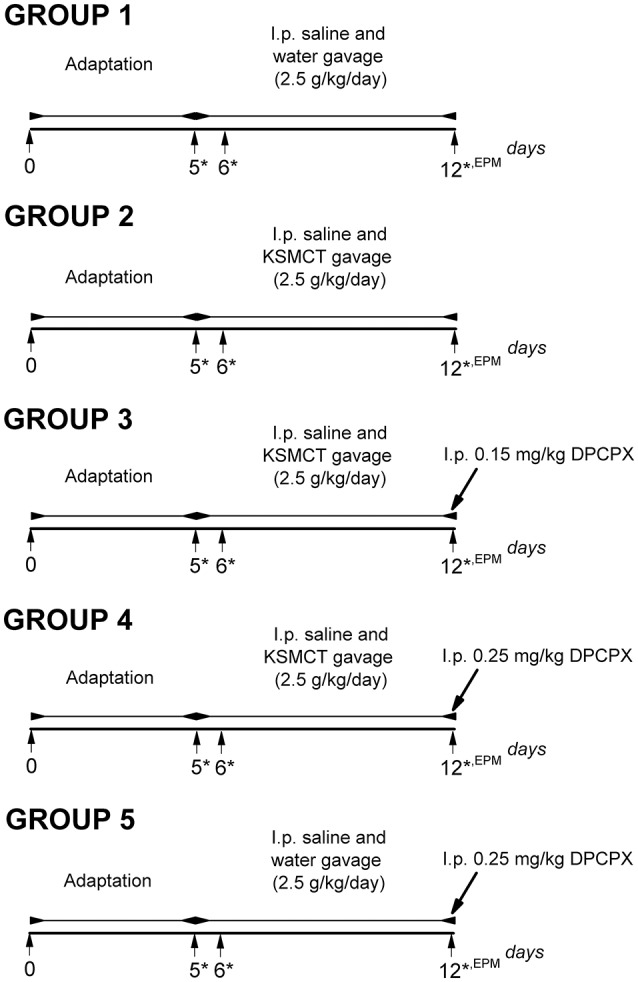
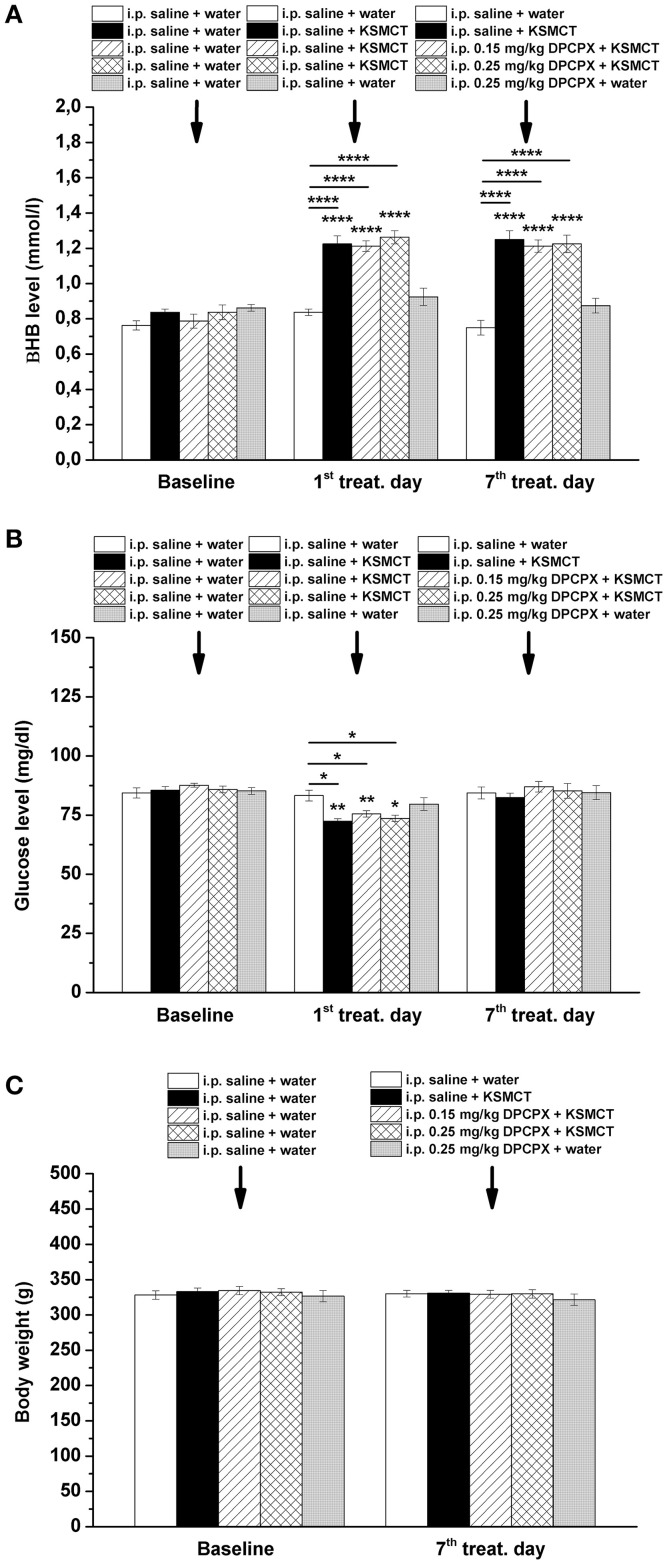
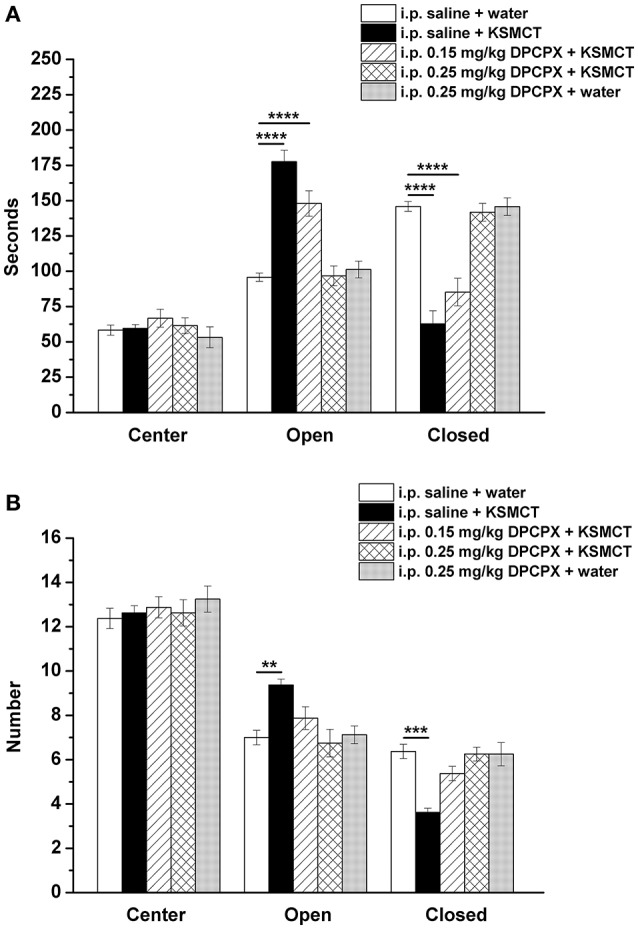
Anxiety disorders are one of the most common mental health problems worldwide, but the exact pathophysiology remains largely unknown. It has been demonstrated previously that administration of exogenous ketone supplement KSMCT (ketone salt/KS + medium chain triglyceride/MCT oil) by intragastric gavage for 7 days decreased the anxiety level in genetically absence epileptic Wistar Albino Glaxo/Rijswijk (WAG/Rij) rats. To investigate the potential role of the adenosinergic system in the pathomechanism of anxiety we tested whether the inhibition of adenosine A receptors (ARs) influence the anxiolytic effect of the exogenous ketone supplement. As ARs may mediate such an effect, in the present study we used a specific AR antagonist, DPCPX (1,3-dipropyl-8-cyclopentylxanthine) to test whether it modulates the anxiolytic effect of sub-chronically (7 days) applied KSMCT in the previously tested animal model by using elevated plus maze (EPM) test. We administered KSMCT (2.5 g/kg/day) alone by intragastric gavage and in combination with intraperitoneally (i.p.) injected of DPCPX in two doses (lower: 0.15 mg/kg, higher: 0.25 mg/kg). Control groups represented i.p saline and water gavage with or without i.p. DPCPX administration (2.5 g/kg/day). After treatments, the level of blood glucose and beta-hydroxybutyrate (βHB), as well as body weight were recorded. KSMCT alone significantly increased the time spent in the open arms and decreased the time spent in the closed arms, supporting our previous results. Injection of lower dose of DPCPX decreased, while higher dose of DPCPX abolished the effect of KSMCT administration on EPM. Blood βHB levels were significantly increased after administration of KSMCT, while DPCPX did not change the KSMCT induced increase in blood βHB levels. These results demonstrate that AR inhibition modified (decreased) the anti-anxiety effect of KSMCT administration implying that the adenosinergic system, likely ARs, may modulate the exogenous ketone supplement induced anxiolytic influence.
焦虑症是全球最常见的心理健康问题之一,但其确切的病理生理学在很大程度上仍不清楚。先前已经证明,通过胃内灌胃给予外源性酮补充剂KSMCT(酮盐/KS + 中链甘油三酯/MCT油)7天可降低遗传性无癫痫Wistar白化病Glaxo/Rijswijk(WAG/Rij)大鼠的焦虑水平。为了研究腺苷能系统在焦虑发病机制中的潜在作用,我们测试了抑制腺苷A受体(ARs)是否会影响外源性酮补充剂的抗焦虑作用。由于ARs可能介导这种作用,在本研究中,我们使用了一种特异性AR拮抗剂DPCPX(1,3 - 二丙基 - 8 - 环戊基黄嘌呤),通过高架十字迷宫(EPM)试验来测试它是否能调节在先前测试的动物模型中,亚慢性(7天)应用KSMCT的抗焦虑作用。我们通过胃内灌胃单独给予KSMCT(2.5 g/kg/天),并与腹腔注射两种剂量的DPCPX(低剂量:0.15 mg/kg,高剂量:0.25 mg/kg)联合使用。对照组分别为腹腔注射生理盐水和灌胃水,同时有或没有腹腔注射DPCPX(2.5 g/kg/天)。治疗后,记录血糖、β - 羟基丁酸(βHB)水平以及体重。单独使用KSMCT显著增加了在开放臂上花费的时间,并减少了在封闭臂上花费的时间,这支持了我们之前的结果。注射低剂量的DPCPX可降低,而高剂量的DPCPX则消除了KSMCT给药对EPM的影响。给予KSMCT后血液βHB水平显著升高,而DPCPX并未改变KSMCT诱导的血液βHB水平升高。这些结果表明,AR抑制改变(降低)了KSMCT给药的抗焦虑作用,这意味着腺苷能系统,可能是ARs,可能调节外源性酮补充剂诱导的抗焦虑影响。