Department of Pharmacy, Juntendo University Hospital, Tokyo, Japan.
Infection Control Research Center, Kitasato Institute for Life Science, Kitasato University, Tokyo, Japan.
PLoS One. 2018 Mar 9;13(3):e0194212. doi: 10.1371/journal.pone.0194212. eCollection 2018.
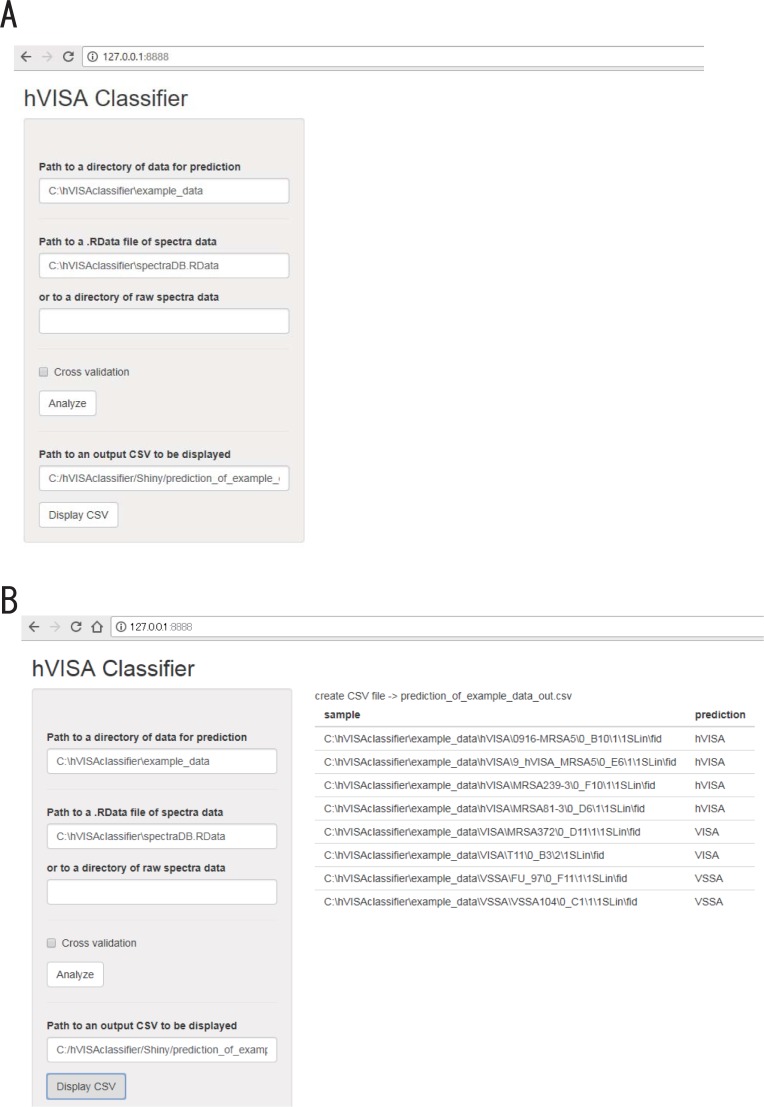
Vancomycin-intermediately resistant Staphylococcus aureus (VISA) and heterogeneous VISA (hVISA) are associated with treatment failure. hVISA contains only a subpopulation of cells with increased minimal inhibitory concentrations, and its detection is problematic because it is classified as vancomycin-susceptible by standard susceptibility testing and the gold-standard method for its detection is impractical in clinical microbiology laboratories. Recently, a research group developed a machine-learning classifier to distinguish VISA and hVISA from vancomycin-susceptible S. aureus (VSSA) according to matrix-assisted laser desorption ionization time-of-flight mass spectrometry (MALDI-TOF MS) data. Nonetheless, the sensitivity of hVISA classification was found to be 76%, and the program was not completely automated with a graphical user interface. Here, we developed a more accurate machine-learning classifier for discrimination of hVISA from VSSA and VISA among MRSA isolates in Japanese hospitals by means of MALDI-TOF MS data. The classifier showed 99% sensitivity of hVISA classification. Furthermore, we clarified the procedures for preparing samples and obtaining MALDI-TOF MS data and developed all-in-one software, hVISA Classifier, with a graphical user interface that automates the classification and is easy for medical workers to use; it is publicly available at https://github.com/bioprojects/hVISAclassifier. This system is useful and practical for screening MRSA isolates for the hVISA phenotype in clinical microbiology laboratories and thus should improve treatment of MRSA infections.
耐万古霉素中间葡萄球菌(VISA)和异质性 VISA(hVISA)与治疗失败有关。hVISA 仅包含具有增加的最小抑菌浓度的细胞亚群,并且由于其通过标准药敏试验被分类为万古霉素敏感,并且其检测的金标准方法在临床微生物学实验室中不切实际,因此其检测存在问题。最近,一个研究小组根据基质辅助激光解吸电离飞行时间质谱(MALDI-TOF MS)数据,开发了一种机器学习分类器,用于区分 VISA 和 hVISA 与万古霉素敏感金黄色葡萄球菌(VSSA)。尽管如此,hVISA 分类的灵敏度被发现为 76%,并且该程序没有完全自动化,没有图形用户界面。在这里,我们通过 MALDI-TOF MS 数据开发了一种更准确的机器学习分类器,用于区分日本医院耐甲氧西林金黄色葡萄球菌(MRSA)分离株中的 hVISA 与 VSSA 和 VISA。该分类器对 hVISA 分类的灵敏度为 99%。此外,我们阐明了制备样品和获取 MALDI-TOF MS 数据的程序,并开发了具有图形用户界面的一体式软件 hVISA Classifier,该软件可自动进行分类,易于医疗工作者使用;它可在 https://github.com/bioprojects/hVISAclassifier 上公开获取。该系统对于在临床微生物学实验室中筛选 MRSA 分离株的 hVISA 表型非常有用且实用,因此应改善 MRSA 感染的治疗效果。