Centro de Investigaciones en Ciencias Microbiológicas, Benemérita Universidad Autónoma de Puebla. Edif. IC11, Ciudad Universitaria, Col. San Manuel Puebla Pue, CP72570, Puebla, Mexico.
Facultad de Farmacia, Universidad Autónoma del Estado de Morelos, Av. Universidad #1001, Col. Chamilpa, C.P, 62209, Cuernavaca, Morelos, Mexico.
BMC Microbiol. 2018 Mar 9;18(1):20. doi: 10.1186/s12866-018-1157-0.
The cyclic-di-GMP (c-di-GMP) second messenger exemplifies a signaling system that regulates many bacterial behaviors of key importance; among them, c-di-GMP controls the transition between motile and sessile life-styles in bacteria. Cellular c-di-GMP levels in bacteria are regulated by the opposite enzymatic activities of diguanylate cyclases and phosphodiesterases, which are proteins that have GGDEF and EAL domains, respectively. Azospirillum is a genus of plant-growth-promoting bacteria, and members of this genus have beneficial effects in many agronomically and ecologically essential plants. These bacteria also inhabit aquatic ecosystems, and have been isolated from humus-reducing habitats. Bioinformatic and structural approaches were used to identify genes predicted to encode GG[D/E]EF, EAL and GG[D/E]EF-EAL domain proteins from nine genome sequences.
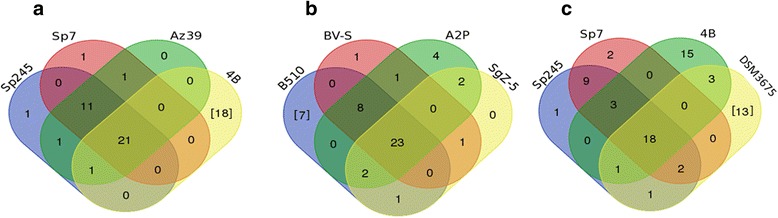
The analyzed sequences revealed that the genomes of A. humicireducens SgZ-5, A. lipoferum 4B, Azospirillum sp. B510, A. thiophilum BV-S, A. halopraeferens DSM3675, A. oryzae A2P, and A. brasilense Sp7, Sp245 and Az39 encode for 29 to 41 of these predicted proteins. Notably, only 15 proteins were conserved in all nine genomes: eight GGDEF, three EAL and four GGDEF-EAL hybrid domain proteins, all of which corresponded to core genes in the genomes. The predicted proteins exhibited variable lengths, architectures and sensor domains. In addition, the predicted cellular localizations showed that some of the proteins to contain transmembrane domains, suggesting that these proteins are anchored to the membrane. Therefore, as reported in other soil bacteria, the Azospirillum genomes encode a large number of proteins that are likely involved in c-di-GMP metabolism. In addition, the data obtained here strongly suggest host specificity and environment specific adaptation.
Bacteria of the Azospirillum genus cope with diverse environmental conditions to survive in soil and aquatic habitats and, in certain cases, to colonize and benefit their host plant. Gaining information on the structures of proteins involved in c-di-GMP metabolism in Azospirillum appears to be an important step in determining the c-di-GMP signaling pathways, involved in the transition of a motile cell towards a biofilm life-style, as an example of microbial genome plasticity under diverse in situ environments.
环二鸟苷酸(c-di-GMP)作为第二信使,是一种调控多种细菌行为的信号系统,其中包括控制细菌从游动到固着生活方式转变的功能。细菌中 c-di-GMP 的水平受二鸟苷酸环化酶和磷酸二酯酶的相反酶活性调控,这两种酶分别具有 GGDEF 和 EAL 结构域。固氮螺菌属是一类具有促进植物生长作用的细菌,该属的许多成员在农业和生态方面都具有重要作用。这些细菌还栖息在水生生态系统中,并且已经从还原型腐殖质栖息地中分离出来。本研究通过生物信息学和结构方法,从 9 个基因组序列中预测编码 GG[D/E]EF、EAL 和 GG[D/E]EF-EAL 结构域蛋白的基因。
分析的序列表明,A. humicireducens SgZ-5、A. lipoferum 4B、Azospirillum sp. B510、A. thiophilum BV-S、A. halopraeferens DSM3675、A. oryzae A2P、A. brasilense Sp7、Sp245 和 Az39 的基因组分别编码 29 到 41 个预测蛋白。值得注意的是,这 9 个基因组中仅 15 个蛋白是保守的:8 个 GGDEF、3 个 EAL 和 4 个 GGDEF-EAL 杂合结构域蛋白,这些蛋白均为基因组的核心基因。预测蛋白的长度、结构和传感器结构域存在差异。此外,预测的细胞定位表明,其中一些蛋白含有跨膜结构域,这表明这些蛋白锚定在膜上。因此,与其他土壤细菌一样,固氮螺菌属的基因组编码了大量可能参与 c-di-GMP 代谢的蛋白。此外,本研究获得的数据强烈表明了宿主特异性和环境特异性适应。
固氮螺菌属的细菌适应了各种环境条件,以在土壤和水生栖息地中生存,并在某些情况下定植和有益于它们的宿主植物。获得有关固氮螺菌属 c-di-GMP 代谢相关蛋白结构的信息,似乎是确定 c-di-GMP 信号通路的重要步骤,该信号通路涉及游动细胞向生物膜生活方式的转变,这是微生物在不同原位环境下基因组可塑性的一个例子。