Champagne Emilie, Moore Ben D, Côté Steeve D, Tremblay Jean-Pierre
Département de biologie Centre d'études nordiques & Chaire de recherche industrielle CRSNG en aménagement intégré des ressources de l'île d'Anticosti Université Laval Québec Canada.
Centre d'étude de la forêt Université Laval Québec Canada.
Ecol Evol. 2018 Feb 10;8(5):2812-2823. doi: 10.1002/ece3.3878. eCollection 2018 Mar.
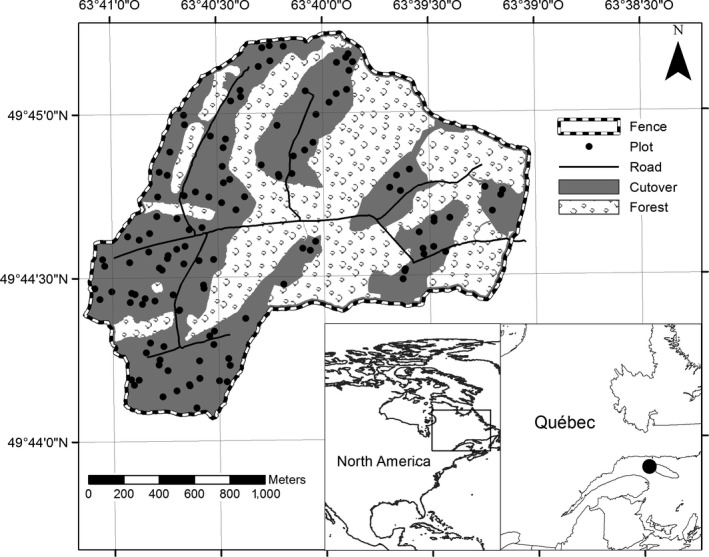
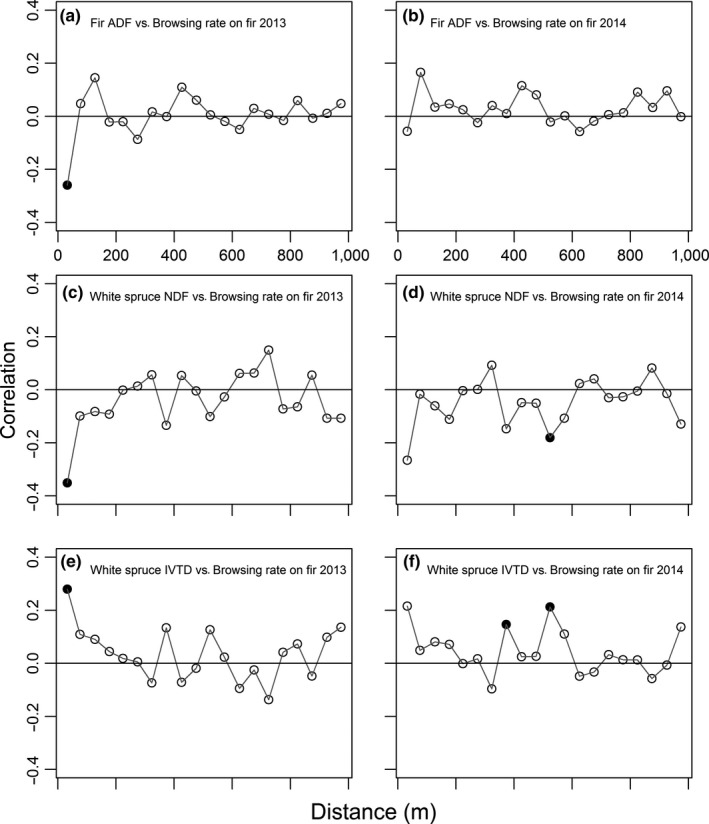
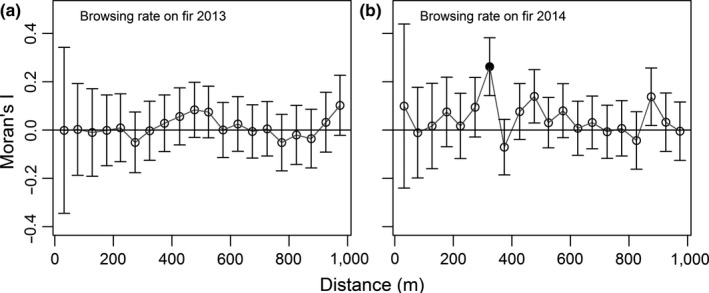
Associational effects, that is, the influence of neighboring plants on herbivory suffered by a plant, are an outcome of forage selection. Although forage selection is a hierarchical process, few studies have investigated associational effects at multiple spatial scales. Because the nutritional quality of plants can be spatially structured, it might differently influence associational effects across multiple scales. Our objective was to determine the radius of influence of neighbor density and nutritional quality on balsam fir () herbivory by white-tailed deer () in winter. We quantified browsing rates on fir and the density and quality of neighboring trees in a series of 10-year-old cutovers on Anticosti Island (Canada). We used cross-correlations to investigate relationships between browsing rates and the density and nutritional quality of neighboring trees at distances up to 1,000 m. Balsam fir and white spruce () fiber content and dry matter true digestibility were correlated with fir browsing rate at the finest extra-patch scale (across distance of up to 50 m) and between cutover areas (300-400 m). These correlations suggest associational effects, that is, low nutritional quality of neighbors reduces the likelihood of fir herbivory (associational defense). Our results may indicate associational effects mediated by intraspecific variation in plant quality and suggest that these effects could occur at scales from tens to hundreds of meters. Understanding associational effects could inform strategies for restoration or conservation; for example, planting of fir among existing natural regeneration could be concentrated in areas of low nutritional quality.
关联效应,即邻近植物对某一植物遭受食草动物啃食的影响,是觅食选择的结果。尽管觅食选择是一个分层过程,但很少有研究在多个空间尺度上调查关联效应。由于植物的营养质量可能在空间上存在结构差异,它可能会在多个尺度上对关联效应产生不同的影响。我们的目标是确定冬季邻居密度和营养质量对白尾鹿()啃食香脂冷杉()的影响半径。我们在加拿大安的列斯岛一系列10年生的采伐迹地上,对冷杉的啃食率以及邻近树木的密度和质量进行了量化。我们使用互相关分析来研究距离达1000米时,啃食率与邻近树木密度和营养质量之间的关系。在最精细的斑块外尺度(距离达50米)以及采伐迹地之间(300 - 400米),香脂冷杉和白云杉()的纤维含量及干物质真实消化率与冷杉的啃食率相关。这些相关性表明存在关联效应,即邻居的低营养质量降低了冷杉被食草动物啃食的可能性(关联防御)。我们的结果可能表明植物质量的种内变异介导了关联效应,并表明这些效应可能发生在几十米到几百米的尺度上。了解关联效应可为恢复或保护策略提供参考;例如,在现有自然更新区域内种植冷杉可集中在营养质量较低的区域。