Zabeen Bedowra, Nahar Jebun, Islam Nasreen, Azad Kishwar, Donaghue Kim
Department of Paediatrics and Changing Diabetes in Children Program, BIRDEM, Bangladesh.
Perinatal Care Project, BIRDEM, Dhaka 1000, Bangladesh.
Indian J Endocrinol Metab. 2018 Jan-Feb;22(1):85-88. doi: 10.4103/ijem.IJEM_269_17.
Diabetic nephropathy is leading cause of morbidity and mortality of type 1 diabetes mellitus (DM). Microalbuminuria is the first clinical sign of nephropathy.
This was a cross-section study with longitudinal evaluation of urinary albumin xcretion in 199 children with type 1 diabetes attending CDiC Clinic in BIRDEM over a period of two years. The aim of the study was to assess the frequency of microalbuminuria and to determine other risk factors. We collected blood and early morning spot urinary sample and analyzed for HbA1c by Clover A1c and urinary microalbumin by a DCA analyzer. Children had urinary microalbumin 30-300 mg/L on at least two occasions were categorized as having persistent microalbuminuria. Demographic and clinical data were recorded including age at onset of diabetes, age during registration, gender and duration of diabetes which were compared between patients without microalbuminuria and with microalbuminuria.
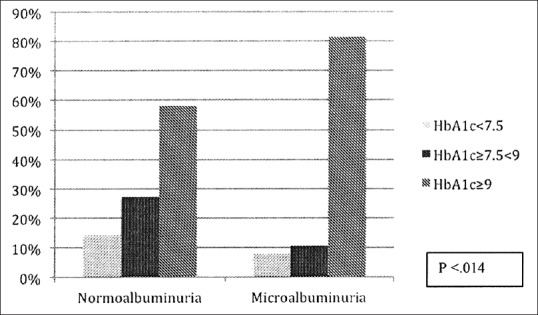
Microalbuminuria developed in forty nine children and adolescents (25%). Among them 24% were Type 1, 27% were with Fibrocalculous pancreatic diabetes (FCPD) and 68% were Type 2 diabetes. Median HbA1c was higher 10.8 [9.4-12.4] vs 9.5 [8.0-11.2] (.006) in adolescents with microalbuminuria. On logistic regression univariate analysis independent predictors of microalbuminuria were older age, systolic blood pressure, BMI SDS and mean HbA1c which remained significant in multivariate analysis as predictors of microalbuminuria.
We found high prevalence of microalbuminuria which was associated with higher age, systolic blood pressure, BMI SDS and HbA1c.
糖尿病肾病是1型糖尿病(DM)发病和死亡的主要原因。微量白蛋白尿是肾病的首个临床症状。
这是一项横断面研究,对在两年时间里就诊于孟加拉国医学科学院糖尿病、内分泌与代谢研究所(BIRDEM)的199例1型糖尿病儿童的尿白蛋白排泄情况进行纵向评估。该研究的目的是评估微量白蛋白尿的发生率,并确定其他风险因素。我们采集了血液和清晨即时尿样,采用糖化血红蛋白分析仪检测糖化血红蛋白(HbA1c),并使用糖尿病化学分析仪检测尿微量白蛋白。至少两次尿微量白蛋白水平在30 - 300 mg/L的儿童被归类为持续性微量白蛋白尿。记录了人口统计学和临床数据,包括糖尿病发病年龄、登记时年龄、性别和糖尿病病程,并在无微量白蛋白尿和有微量白蛋白尿的患者之间进行比较。
49名儿童和青少年(25%)出现了微量白蛋白尿。其中1型糖尿病占24%,纤维钙化性胰腺糖尿病(FCPD)占27%,2型糖尿病占68%。微量白蛋白尿青少年的糖化血红蛋白中位数更高,分别为10.8 [9.4 - 12.4] 和9.5 [8.0 - 11.2] (P = 0.006)。在逻辑回归单因素分析中,微量白蛋白尿的独立预测因素是年龄较大、收缩压、BMI标准差评分(SDS)和平均糖化血红蛋白,在多因素分析中,这些因素作为微量白蛋白尿的预测因素仍然显著。
我们发现微量白蛋白尿的患病率较高,且与年龄较大、收缩压、BMI SDS和糖化血红蛋白有关。
需注意,原文还存在一些小错误,比如“199 children with type 1 diabetes attending CDiC Clinic in BIRDEM”中“CDiC Clinic”表述有误;“Among them 24% were Type 1, 27% were with Fibrocalculous pancreatic diabetes (FCPD) and 68% were Type 2 diabetes.”这里前面说的是1型糖尿病儿童,突然说24%是1型糖尿病,逻辑混乱,推测这里应该是说1型糖尿病中的相关占比、FCPD中的相关占比以及2型糖尿病中的相关占比等情况。不过按照要求未对原文进行修正直接翻译如上。