Anell Anders, Dackehag Margareta, Dietrichson Jens
Department of Business Administration, School of Economics and Management, Lund University, Box 7080, SE-22007, Lund, Sweden.
Department of Economics, School of Economics and Management, Lund University, Box 7082, SE-22007, Lund, Sweden.
BMC Health Serv Res. 2018 Mar 14;18(1):179. doi: 10.1186/s12913-018-2983-3.
Providing equal access to health care is an important objective in most health care systems. It is especially pertinent in systems like the Swedish primary care market, where private providers are free to establish themselves in any part of the country. To improve equity in access to care, 15 out 21 county councils in Sweden have implemented risk-adjusted capitation based on the Care Need Index, which increases capitation to primary care centers with a large share of patients with unfavorable socioeconomic and demographic characteristics. Our aim is to estimate the effects of using care-need adjusted capitation on the supply of private primary care centers.
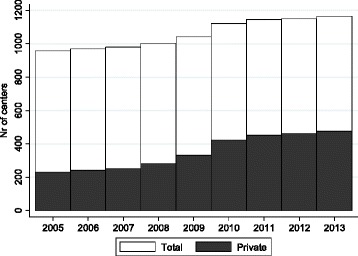
We use a dataset that combines information on all primary care centers in Sweden during 2005-2013, the payment system and other conditions for establishing new primary care centers used in the county councils, and demographic, geographic, and socioeconomic variables for low-level geographic areas. To estimate the effects of care-need adjusted capitation, we use difference-in-differences models, contrasting the development over time between areas with and without risk-adjusted capitation, and with high and low Care Need Index values.
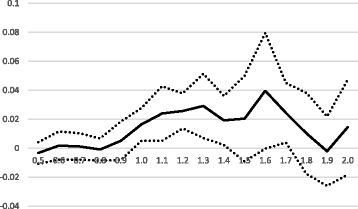
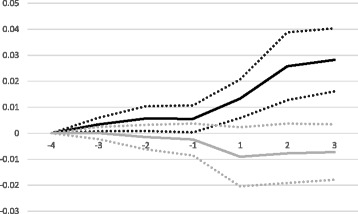
Risk-adjusted capitation significantly increases the number of private primary care centers in areas with relatively high Care Need Index values. The adjustment results in a changed distribution of private centers within county councils; the total number of private centers does not increase in county councils using care-need adjusted capitation. The effects are furthermore increasing over the first three years after the implementation of such capitation, and concentrated to the lower and middle range of the group of areas with high index values.
Risk-adjusted capitation based on the Care Need Index increases the supply of private primary care centers in areas with unfavorable socioeconomic and demographic characteristics. More generally, this result indicates that risk-adjusted capitation can significantly affect private providers' establishment decisions.
在大多数医疗保健系统中,提供平等的医疗保健服务是一个重要目标。这在瑞典初级保健市场这样的系统中尤为相关,在该市场中,私人医疗服务提供者可以在该国任何地区自由设立机构。为了提高医疗服务获取的公平性,瑞典21个郡议会中有15个已根据护理需求指数实施了风险调整后的人头费制度,该制度会增加对那些有很大比例社会经济和人口特征不利患者的初级保健中心的人头费。我们的目的是评估使用护理需求调整后的人头费对私人初级保健中心供应的影响。
我们使用了一个数据集,该数据集结合了2005年至2013年期间瑞典所有初级保健中心的信息、支付系统以及郡议会用于设立新初级保健中心的其他条件,以及低级别地理区域的人口、地理和社会经济变量。为了评估护理需求调整后的人头费的影响,我们使用了差分模型,对比有和没有风险调整后的人头费地区以及护理需求指数值高和低的地区随时间的发展情况。
风险调整后的人头费显著增加了护理需求指数值相对较高地区的私人初级保健中心数量。这种调整导致了郡议会内私人中心分布的变化;在使用护理需求调整后的人头费的郡议会中,私人中心的总数并未增加。此外,在实施这种人头费制度后的头三年里,影响不断增加,并且集中在指数值高的地区组的中低范围。
基于护理需求指数的风险调整后的人头费增加了社会经济和人口特征不利地区的私人初级保健中心供应。更一般地说,这一结果表明风险调整后的人头费会显著影响私人医疗服务提供者的设立决策。