School of Population and Public Health, University of British Columbia, Vancouver, Canada
British Columbia Centre for Disease Control Public Health Laboratory, Vancouver, Canada.
J Clin Microbiol. 2018 Apr 25;56(5). doi: 10.1128/JCM.01778-17. Print 2018 May.
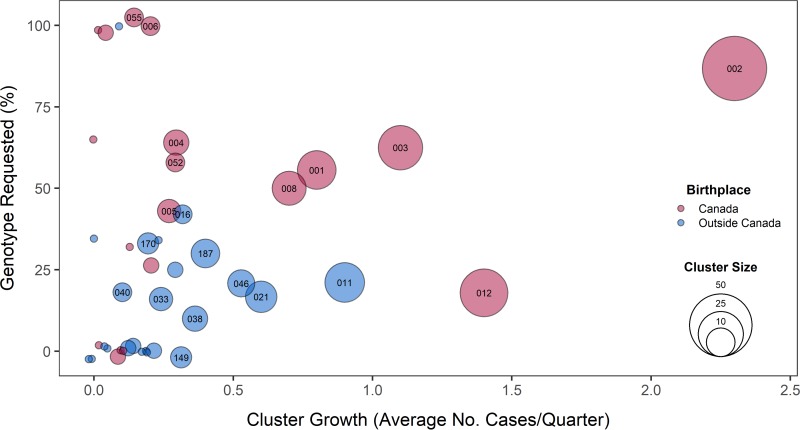
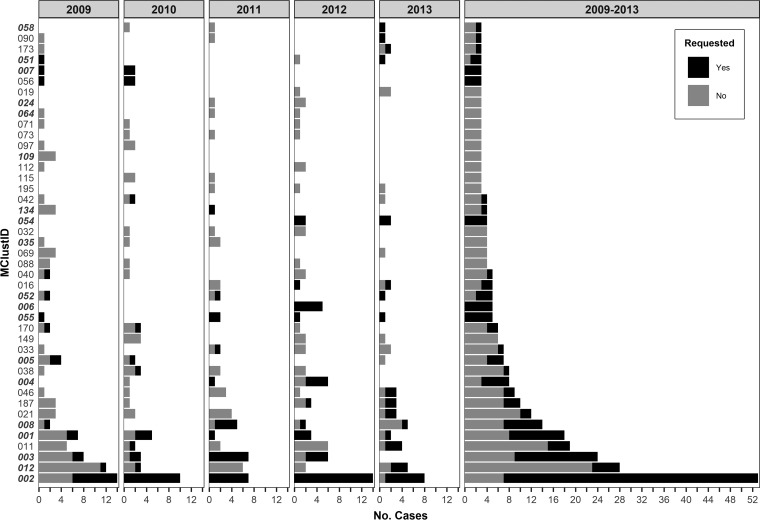
Prospective universal genotyping of tuberculosis (TB) isolates is used by many laboratories to detect clusters of cases and inform contact investigations. Prior to universal genotyping, most TB prevention programs genotyped isolates on request only, relying on requests from public health professionals whose knowledge of a patient's clinical, demographic, and epidemiological characteristics suggested potential transmission. To justify the switch from on-request to universal genotyping-particularly in the public health domain, with its limited resources and competing priorities-it is important to demonstrate the additional benefit provided by a universal genotyping program. We compared the clustering patterns revealed by retrospective 24-locus mycobacterial interspersed repetitive unit-variable-number tandem repeat genotyping of all culture-positive isolates over a 5-year period to the patterns previously established by our genotyping-on-request program in the low-incidence setting of British Columbia, Canada. We found that 23.8% of isolates were requested during the study period, and while requested isolates had increased odds of belonging to a genotype cluster (adjusted odds ratio, 2.3; 95% confidence interval, 1.5 to 3.3), only 54.6% clustered with the requested comparator strain. Universal genotyping revealed 94 clusters ranging in size from 2 to 53 isolates (mean = 5) and involving 432 individuals. On-request genotyping missed 54 (57.4%) of these clusters and 130 (30.1%) clustered individuals. Our results underscore that TB patient networks are complex, with unrecognized linkages between patients, and a prospective province-wide universal genotyping program provides an informative, bias-free tool to explore transmission to a degree not possible with on-request genotyping.
前瞻性的结核分枝杆菌(TB)分离株全基因组分型被许多实验室用于检测病例群集并为接触者调查提供信息。在进行全基因组分型之前,大多数结核病预防项目仅根据请求对分离株进行基因分型,依赖于公共卫生专业人员的请求,他们对患者的临床、人口统计学和流行病学特征的了解表明存在潜在的传播。为了证明从按需全基因组分型向全基因组分型转变的合理性,特别是在公共卫生领域,由于资源有限且存在竞争优先级,因此必须证明全基因组分型计划提供的额外益处。我们将 5 年内所有培养阳性分离株的回顾性 24 位位点分枝杆菌散布重复单位-可变数串联重复基因分型的聚类模式与我们在加拿大不列颠哥伦比亚省低发病率环境下的请求基因分型程序之前建立的模式进行了比较。我们发现,在研究期间有 23.8%的分离株被请求进行基因分型,虽然请求的分离株属于基因型聚类的可能性增加(调整后的优势比,2.3;95%置信区间,1.5 至 3.3),但只有 54.6%与请求的比较菌株聚类。全基因组分型揭示了 94 个大小从 2 到 53 个分离株(平均值=5)的聚类,涉及 432 个人。请求基因分型错过了其中的 54 个(57.4%)聚类和 130 个(30.1%)聚类个体。我们的研究结果强调了结核病人网络的复杂性,以及病人之间未被识别的联系,并且前瞻性的全省范围内的全基因组分型计划提供了一个信息丰富、无偏见的工具,可以在请求基因分型不可能的程度上探索传播。