Department of Biomedical Science, Graduate School of Medicine, Chiba University, Chiba City, Chiba 260-8670, Japan.
Department of Biochemistry and Molecular Pharmacology, Graduate School of Medicine, Chiba University, Chiba City, Chiba 260-8670, Japan.
Int J Mol Sci. 2018 Mar 15;19(3):867. doi: 10.3390/ijms19030867.
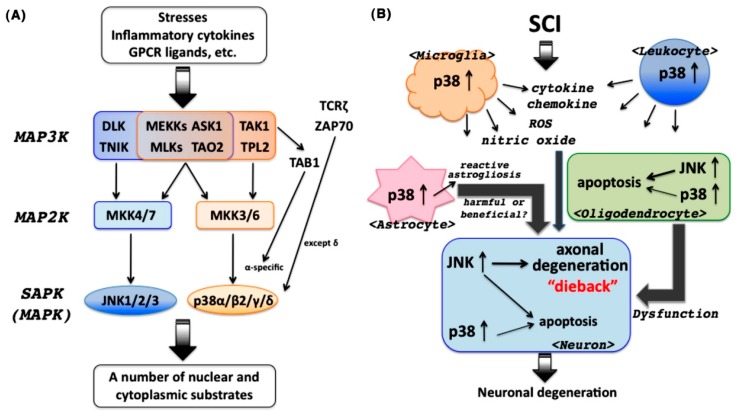
Spinal cord injury (SCI) consists of three phases-acute, secondary, and chronic damages-and limiting the development of secondary damage possibly improves functional recovery after SCI. A major component of the secondary phase of SCI is regarded as inflammation-triggered events: induction of cytokines, edema, microglial activation, apoptosis of cells including oligodendrocytes and neurons, demyelination, formation of the astrocytic scar, and so on. Two major stress-activated protein kinases (SAPKs)-c-Jun N-terminal kinase (JNK) and p38 mitogen-activated protein kinase (p38 MAPK)-are activated in various types of cells in response to cellular stresses such as apoptotic stimuli and inflammatory waves. In animal models of SCI, inhibition of either JNK or p38 has been shown to promote neuroprotection-associated functional recovery. Here, we provide an overview on the roles of SAPKs in SCI and, in particular, the pathological role of p38 will be discussed as a promising target for therapeutic intervention in SCI.
脊髓损伤(SCI)包括三个阶段——急性期、继发性和慢性损伤——限制继发性损伤的发展可能会改善 SCI 后的功能恢复。SCI 继发性阶段的一个主要组成部分被认为是炎症触发事件:细胞因子的诱导、水肿、小胶质细胞激活、包括少突胶质细胞和神经元在内的细胞凋亡、脱髓鞘、星形胶质瘢痕形成等。两种主要的应激激活蛋白激酶(SAPKs)——c-Jun N 末端激酶(JNK)和 p38 丝裂原激活蛋白激酶(p38 MAPK)——在各种类型的细胞中被激活,以响应细胞应激,如凋亡刺激和炎症波。在 SCI 的动物模型中,抑制 JNK 或 p38 均已被证明可促进与神经保护相关的功能恢复。在这里,我们将概述 SAPKs 在 SCI 中的作用,特别是 p38 的病理作用将被讨论为 SCI 治疗干预的一个有前途的靶点。