Red Cell Biology Unit, King's College Hospital, King's College London, UK.
Proteomics Laboratory, Institute of Psychiatry, King's College London, UK.
Haematologica. 2018 Jul;103(7):1136-1142. doi: 10.3324/haematol.2018.187815. Epub 2018 Mar 15.
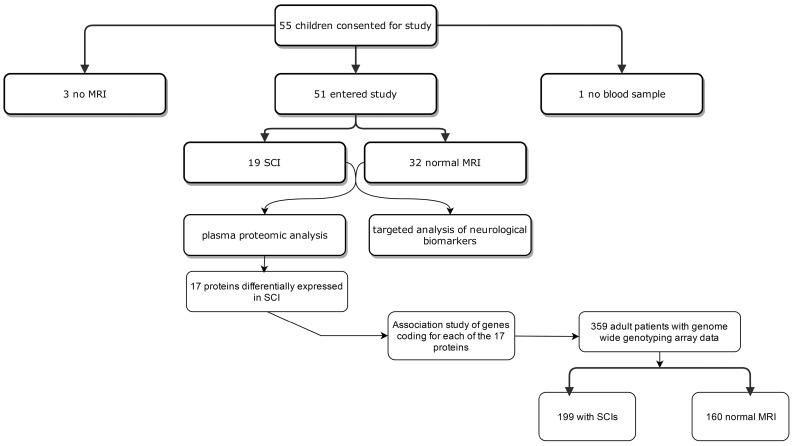
Silent cerebral infarction is the most common neurological abnormality in children with sickle cell anemia, affecting 30-40% of 14 year olds. There are no known biomarkers to identify children with silent cerebral infarcts, and the pathological basis is also unknown. We used an unbiased proteomic discovery approach to identify plasma proteins differing in concentration between children with and without silent cerebral infarcts. Clinical parameters and plasma samples were analysed from 51 children (mean age 11.8 years, range 6-18) with sickle cell anemia (HbSS). A total of 19 children had silent cerebral infarcts and 32 normal MRI; the children with silent infarcts had lower HbF levels (8.6 16.1%, =0.049) and higher systolic blood pressures (115 108.6, =0.027). Plasma proteomic analysis showed 13 proteins increased more than 1.3 fold in the SCI patients, including proteins involved in hypercoagulability (α2-antiplasmin, fibrinogen-γ chain, thrombospondin-4), inflammation (α2-macroglobulin, complement C1s and C3), and atherosclerosis (apolipoprotein B-100). Higher levels of gelsolin and retinol-binding protein 4 were also found in the population with silent infarcts, both of which have been linked to stroke. We investigated the genetic basis of these differences by studying 359 adults with sickle cell disease (199 with silent cerebral infarcts, 160 normal MRIs), who had previously undergone a genome-wide genotyping array. None of the genes coding for the differentially expressed proteins were significantly associated with silent infarction. Our study suggests that silent cerebral infarcts in sickle cell anemia may be associated with higher systolic blood pressure, lower HbF levels, hypercoagulability, inflammation and atherosclerotic lipoproteins.
无症状性脑梗死是镰状细胞贫血儿童中最常见的神经学异常,影响 14 岁儿童的 30-40%。目前尚无确定无症状性脑梗死患儿的生物标志物,其病理基础也不清楚。我们采用无偏蛋白质组学发现方法,鉴定了无症状性脑梗死患儿和无此病变患儿血浆中浓度不同的蛋白。分析了 51 名镰状细胞贫血(HbSS)儿童(平均年龄 11.8 岁,范围 6-18 岁)的临床参数和血浆样本。共有 19 名儿童患有无症状性脑梗死,32 名儿童 MRI 正常;无症状性梗死患儿的 HbF 水平较低(8.6 16.1%,=0.049),收缩压较高(115 108.6,=0.027)。血浆蛋白质组学分析显示,SCI 患儿中有 13 种蛋白的含量增加了 1.3 倍以上,包括与高凝状态相关的蛋白(α2-抗纤溶酶、纤维蛋白原γ链、血栓调节蛋白-4)、炎症相关蛋白(α2-巨球蛋白、补体 C1s 和 C3)和动脉粥样硬化相关蛋白(载脂蛋白 B-100)。在无症状性梗死患者中还发现了更高水平的凝胶蛋白和视黄醇结合蛋白 4,这两者都与中风有关。我们通过研究 359 名镰状细胞病成年人(199 名无症状性脑梗死,160 名 MRI 正常)来探讨这些差异的遗传基础,这些成年人之前进行了全基因组基因分型。差异表达蛋白的编码基因与无症状性梗死均无显著相关性。我们的研究表明,镰状细胞贫血中的无症状性脑梗死可能与较高的收缩压、较低的 HbF 水平、高凝状态、炎症和动脉粥样硬化脂蛋白有关。