Grupo de Inmunología Celular e Inmunogenética, Instituto de Investigaciones Médicas, Facultad de Medicina, Universidad de Antioquia UdeA, Medellín, Colombia.
Unidad de Citometría de Flujo, Sede de Investigación Universitaria, Universidad de Antioquia UdeA, Medellín, Colombia.
Front Immunol. 2018 Mar 1;9:322. doi: 10.3389/fimmu.2018.00322. eCollection 2018.
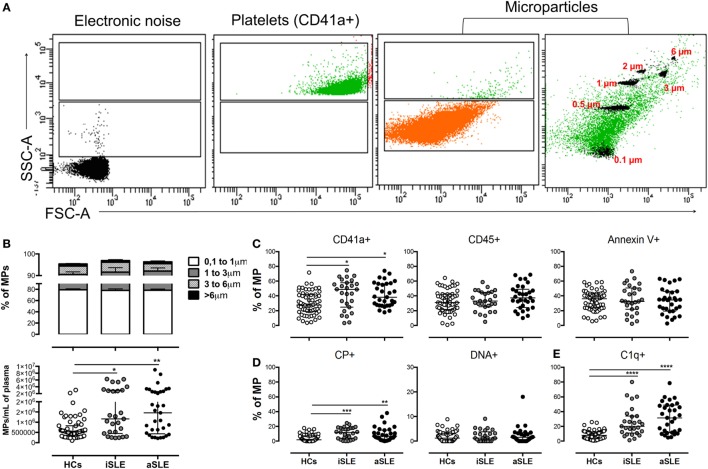
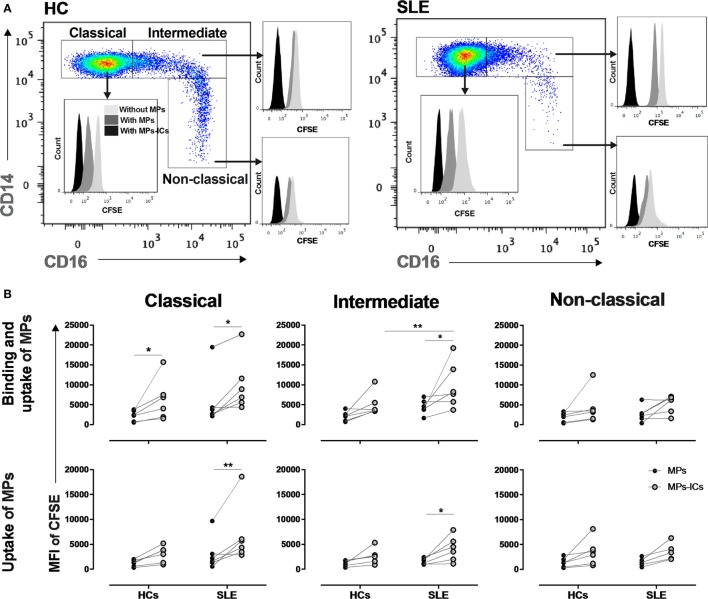
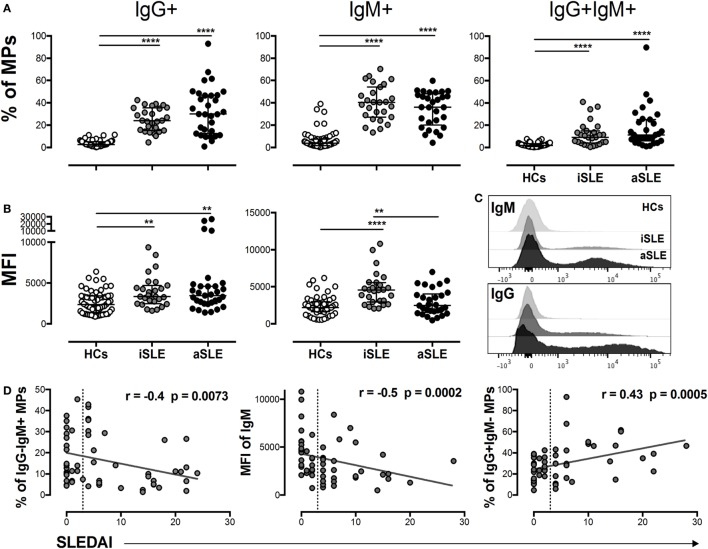
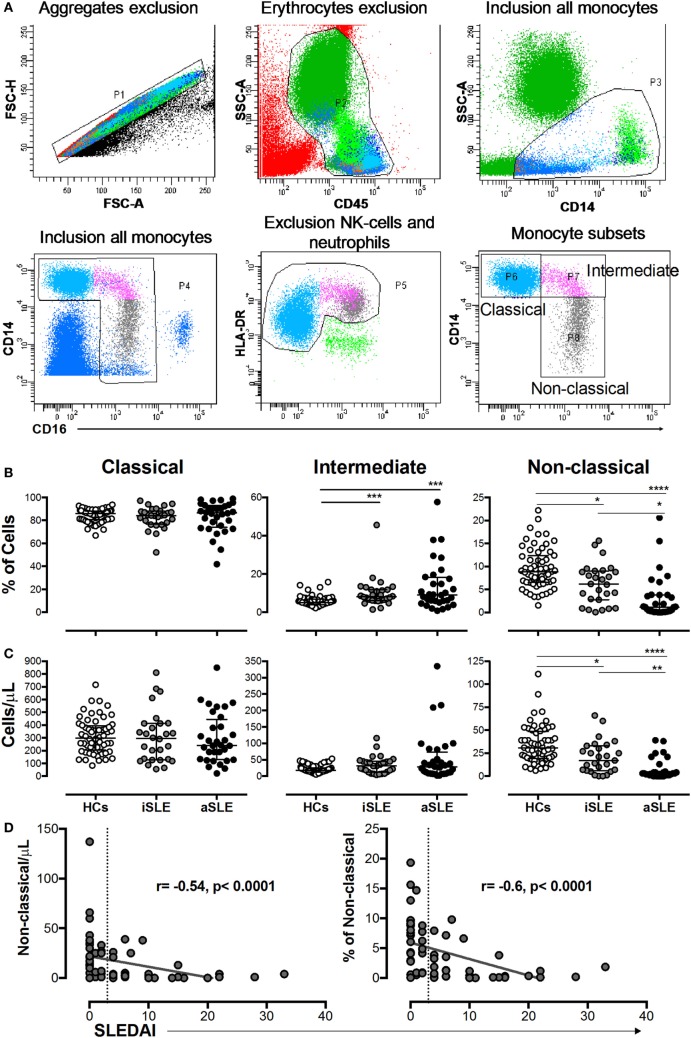
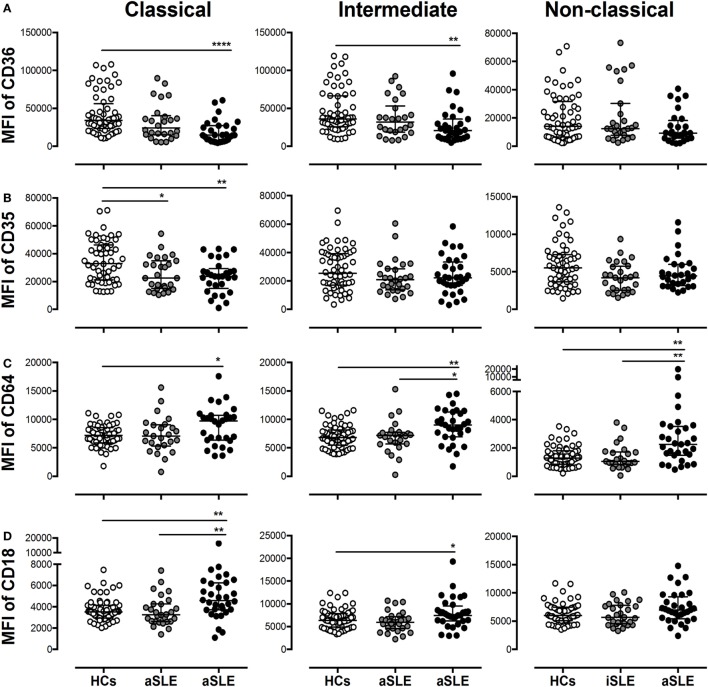
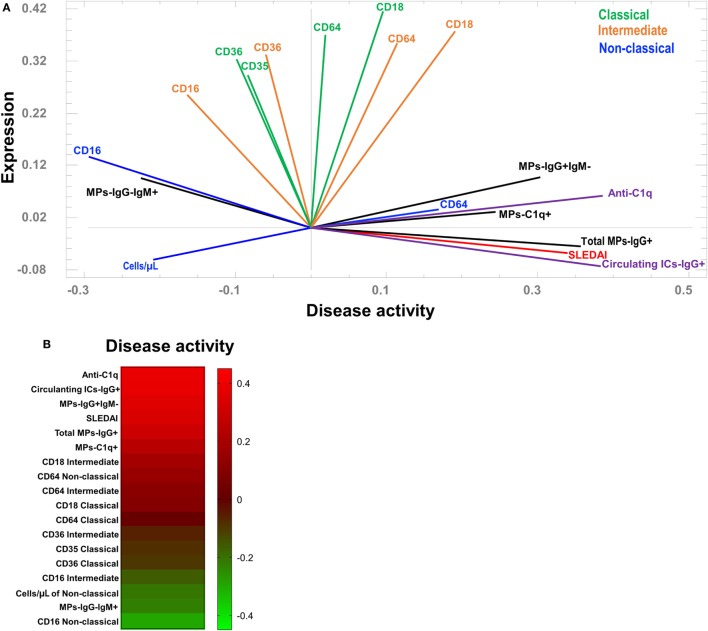
Microparticles (MPs) are vesicles derived from the plasma membrane of different cells, are considered a source of circulating autoantigens, and can form immune complexes (MPs-ICs). The number of MPs and MPs-ICs increases in patients with systemic lupus erythematosus (SLE). MPs activate myeloid cells by inducing IL-6 and TNF-α in both SLE and other diseases. Therefore, we propose that the recognition of MPs-ICs by monocytes rather that MPs may define their phenotype and contribute to the inflammatory process in patients with SLE. Thus, the aims of this study were to evaluate the association among circulating MPs-ICs from different cell sources, alterations observed in monocyte subsets, and disease activity in patients with SLE and to establish whether monocytes bind and respond to MPs-ICs . Circulating MPs and monocyte subsets were characterized in 60 patients with SLE and 60 healthy controls (HCs) using multiparametric flow cytometry. Patients had higher MP counts and frequencies of MPs-CD41a + (platelet-derived) compared with HCs, regardless of disease activity. MPs from patients with SLE were C1q + and formed ICs with IgM and IgG. MPs-IgG + were positively correlated with active SLE (aSLE), whereas MPs-IgM + were negatively correlated. Most of the circulating total ICs-IgG + were located on MPs. The proportion and number of non-classical monocytes were significantly decreased in patients with SLE compared with HCs and in patients with aSLE compared with patients with the inactive disease. Non-classical monocytes obtained from patients with SLE exhibited increased levels of CD64 associated with MPs-IgG +, MPs-C1q +, total circulating ICs-IgG +, and disease activity. The direct effects of MPs and MPs-IgG + on monocytes were evaluated in cell culture. Monocytes from both HCs and patients bound to and internalized MPs and MPs-IgG + independent of CD64. These vesicles derived from platelets (PMPs), mainly PMPs-IgG +, activated monocytes and increased the expression of CD69, CD64, and pro-inflammatory cytokines such as IL-1β, TNF-α, and IFN-α. Therefore, MPs are one of the most representative sources of the total amount of circulating ICs-IgG + in patients with SLE. MPs-IgG + are associated with SLE activity, and PMPs-IgG + stimulate monocytes, changing their phenotype and promoting pro-inflammatory responses related to disease activity.
微粒(MPs)是源自不同细胞的质膜的囊泡,被认为是循环自身抗原的来源,并且可以形成免疫复合物(MPs-ICs)。系统性红斑狼疮(SLE)患者的 MPs 和 MPs-ICs 数量增加。 MPs 通过在 SLE 和其他疾病中诱导 IL-6 和 TNF-α 来激活髓样细胞。因此,我们提出,单核细胞对 MPs-ICs 的识别而不是 MPs 可能定义其表型并有助于 SLE 患者的炎症过程。因此,本研究的目的是评估来自不同细胞来源的循环 MPs-ICs 之间的关联、观察到的单核细胞亚群的改变以及 SLE 患者的疾病活动,并确定单核细胞是否结合并对 MPs-ICs 作出反应。使用多参数流式细胞术对 60 例 SLE 患者和 60 例健康对照者(HCs)进行循环 MPs 和单核细胞亚群的特征分析。与 HCs 相比,无论疾病活动如何,SLE 患者的 MPs 计数和 MPs-CD41a+(血小板衍生)频率均较高。来自 SLE 患者的 MPs 是 C1q+,并与 IgM 和 IgG 形成 ICs。 MPs-IgG+与活动期 SLE(aSLE)呈正相关,而 MPs-IgM+与 SLE 呈负相关。循环总 ICs-IgG+中的大多数位于 MPs 上。与 HCs 相比,SLE 患者的非经典单核细胞比例和数量明显减少,与无活动疾病的患者相比,SLE 患者的非经典单核细胞减少。来自 SLE 患者的非经典单核细胞表现出与 MPs-IgG+、MPs-C1q+、循环总 ICs-IgG+和疾病活动相关的 CD64 增加。在细胞培养中评估 MPs 和 MPs-IgG+对单核细胞的直接影响。来自 HCs 和患者的单核细胞与 MPs 和 MPs-IgG+结合并内化,与 CD64 无关。这些源自血小板的 MPs(PMPs),主要是 PMPs-IgG+,激活单核细胞并增加 CD69、CD64 和促炎细胞因子(如 IL-1β、TNF-α 和 IFN-α)的表达。因此,MPs 是 SLE 患者循环总 ICs-IgG+量的最具代表性来源之一。MPs-IgG+与 SLE 活动相关,PMPs-IgG+刺激单核细胞,改变其表型并促进与疾病活动相关的促炎反应。